
Setting the right yoga studio membership pricing can be surprisingly difficult. Charge too little and your classes may stay busy while the business struggles to make money. Charge too much and potential members may choose another studio, buy occasional drop-ins, or decide that yoga simply does not fit their budget.
There is also no universal price that works for every yoga studio. A small neighborhood studio with 12-person classes has very different economics from a premium hot yoga studio running 30-person classes in a major city.
The goal is to create a pricing structure that feels reasonable to clients while generating enough recurring revenue to cover instructors, rent, marketing, payment fees, software, and other operating expenses.
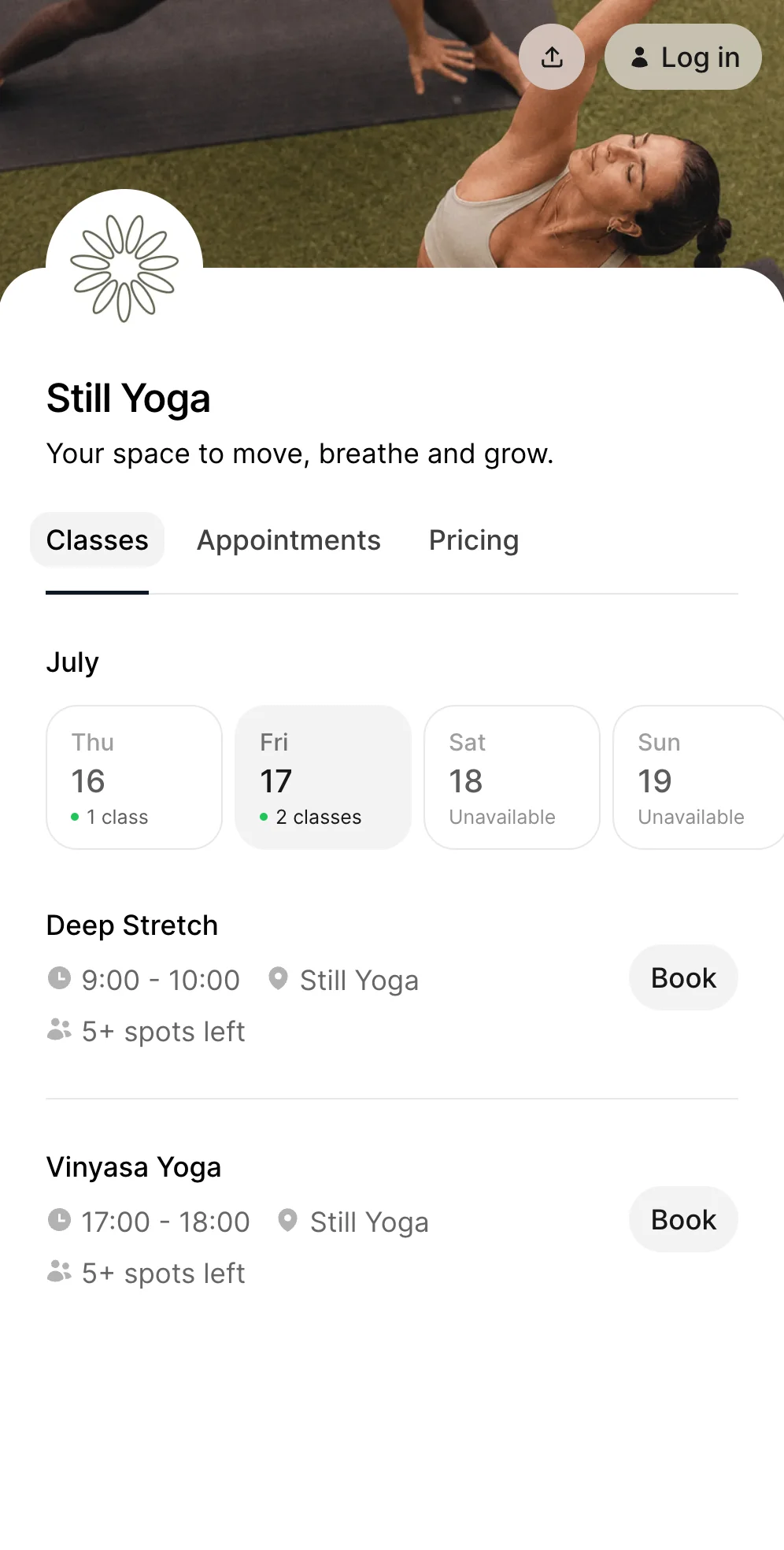
Time2book helps yoga studios sell recurring memberships and class packs, accept online payments, manage classes, and keep track of clients from one place. Try Time2book free today and simplify your yoga studio bookings, memberships, payments, and client management.
In this guide, we'll break down yoga studio membership pricing in 2026, including what studios typically charge, how to calculate your own membership prices, and which pricing models work best.
How Much Should a Yoga Studio Membership Cost?
As a starting point, many independent yoga studios can expect monthly memberships to fall somewhere around:
| Yoga membership | Typical starting range |
|---|---|
| 4 classes per month | $50–$90 |
| 8 classes per month | $80–$130 |
| 10–12 classes per month | $90–$150 |
| Monthly unlimited | $100–$180 |
| Premium unlimited | $150–$220+ |
| Annual unlimited | $900–$1,800+ per year |
These should be treated as planning ranges rather than fixed industry prices. Location, studio positioning, class size, instructor costs, amenities, competition, and local income levels all influence what clients are willing to pay.
Current studio pricing illustrates how wide the range can be. Downtown Yoga Center offers monthly unlimited yoga for $109, while Sacred Space Astoria lists an auto-renewing unlimited membership at $165. Home Studio Yoga charges $138 month-to-month but reduces the effective price for longer commitments.
European prices vary similarly. Balance Yoga & Wellness Studio in Vilnius currently offers an €99 monthly membership including 11 practices, while Temple Bar Yoga in Dublin lists unlimited membership at €139 and plans to increase that to €149 from October 2026.
The more important question, therefore, is not simply "What do other yoga studios charge?"
It is:
"What price does my studio need to charge for each member to be profitable?"
A Simple Yoga Studio Membership Pricing Structure
Most yoga studios do not need ten different memberships. Too much choice can make the decision harder for clients and add unnecessary complexity for staff.
A simple yoga pricing menu might look like this:
| Pricing option | Example price | Best for |
|---|---|---|
| Intro offer | $39 for 14 days | New students |
| Drop-in | $25 | Occasional visitors |
| 5-class pack | $110 | Infrequent students |
| 10-class pack | $200 | Flexible regulars |
| 4 classes/month | $75/month | Once-a-week students |
| 8 classes/month | $115/month | Twice-a-week students |
| Unlimited | $149/month | Frequent students |
| Annual unlimited | $1,490/year | Loyal members |
This gives clients several clear choices without overwhelming them.
Your exact numbers may look completely different. The important part is creating a logical progression where the more committed a client becomes, the better their effective price per class gets.
Start With Your Yoga Drop-In Price
Your drop-in rate provides an anchor for almost every other price on your menu.
For example, imagine your yoga studio charges:
$25 per drop-in class
Someone attending four classes individually would pay:
$25 × 4 = $100
You might therefore price a four-class membership at $75–$85.
Someone attending eight drop-in classes would pay:
$25 × 8 = $200
An eight-class membership could therefore cost around $110–$140.
The membership becomes attractive because regular clients receive better value in exchange for recurring billing and greater commitment to your studio.
This is one reason you should avoid making your drop-in price too cheap. If a single class costs $15 while your unlimited membership costs $130, clients need to attend nearly nine times before the membership starts looking worthwhile.
How to Calculate Your Yoga Studio Membership Pricing
Looking at competitor prices can provide context, but your studio's costs should ultimately determine your pricing.
Start with four numbers:
- Monthly operating expenses
- Desired studio profit
- Expected active members
- Additional revenue from drop-ins, workshops, retail, private sessions, and other services
Imagine your yoga studio has the following monthly expenses:
| Expense | Monthly cost |
|---|---|
| Rent | $5,000 |
| Instructor payroll | $7,000 |
| Reception/admin | $2,000 |
| Utilities | $800 |
| Insurance | $300 |
| Cleaning | $600 |
| Software | $200 |
| Marketing | $1,000 |
| Payment fees | $600 |
| Other expenses | $500 |
| Total | $18,000 |
Suppose you want approximately $4,000 left for profit, owner compensation, reserves, and reinvestment.
Your target monthly revenue becomes approximately:
$22,000
If you expect $3,000 from workshops, private yoga sessions, drop-ins, merchandise, and other revenue, memberships need to generate approximately:
$19,000 per month
With 150 active members:
$19,000 ÷ 150 = $126.67 average membership revenue per client
That tells you something important.
If your average membership currently costs $79, reaching your financial target may be extremely difficult unless you significantly increase membership volume or generate more revenue elsewhere.
Price Based on Average Revenue Per Visit
One of the most useful metrics for yoga studio owners is revenue per visit.
Imagine an unlimited membership costs $150 per month.
Different clients produce very different economics:
| Monthly attendance | Effective revenue per class |
|---|---|
| 4 classes | $37.50 |
| 6 classes | $25.00 |
| 8 classes | $18.75 |
| 10 classes | $15.00 |
| 12 classes | $12.50 |
| 16 classes | $9.38 |
| 20 classes | $7.50 |
Most unlimited members will not attend every day.
That is what makes unlimited memberships financially viable. You are pricing based partly on expected average usage rather than maximum theoretical usage.
Mindbody's yoga pricing guidance similarly recommends evaluating memberships according to attendance behavior rather than choosing an arbitrary number. Its guidance suggests that memberships are particularly suited to high-attendance clients and that studios should continually review attendance and class performance when refining pricing.
Should Yoga Studios Offer Unlimited Memberships?
For many yoga studios, yes.
Unlimited memberships are attractive because they are simple. Clients know exactly what they pay every month and can attend more frequently without calculating the cost of every class.
For the studio, unlimited memberships create predictable recurring revenue.
However, unlimited pricing needs to be high enough to account for your most active members.
If unlimited access costs $99 and a member attends 20 times per month, you are generating less than $5 per visit from that client. That might still work in a large class with unused capacity, but it could become problematic when popular classes constantly sell out.
Unlimited memberships work particularly well when:
- Your studio has enough class capacity.
- Members attend approximately 6–12 times per month on average.
- Most classes have available spaces.
- Your schedule offers enough variety to make membership valuable.
- You want predictable monthly recurring revenue.
Be more careful with unlimited memberships when:
- Classes have very small capacities.
- Popular classes regularly sell out.
- Instructor costs are high.
- Clients attend extremely frequently.
- Your studio offers highly specialized or premium classes.
A boutique studio with eight available places may need a completely different pricing strategy from a 30-person yoga room.
4-Class and 8-Class Yoga Memberships
Not every member wants unlimited yoga.
Someone who realistically attends once per week may look at a $150 unlimited membership and decide it is too expensive, even if they love your studio.
This is where limited monthly memberships become useful.
Example 4-Class Membership
Drop-in price: $25
Four drop-ins: $100
Membership: $79/month
Effective price:
$79 ÷ 4 = $19.75 per class
The client saves $21 compared with buying four individual classes.
Example 8-Class Membership
Eight drop-ins:
$25 × 8 = $200
Membership:
$119/month
Effective price:
$119 ÷ 8 = $14.88 per class
The client receives a stronger discount in exchange for spending more each month and becoming a more committed member.
Limited memberships can also protect your revenue because the maximum number of visits is predictable.
Yoga Memberships vs Class Packs
Memberships and yoga class packs solve different problems.
Memberships
Memberships normally renew automatically every month.
They are best for clients who practise consistently and want yoga to become part of their weekly routine.
From the studio's perspective, memberships create predictable monthly recurring revenue.
Class Packs
Class packs allow clients to buy a fixed number of visits without committing to monthly billing.
For example:
- 5 classes for $110
- 10 classes for $200
- 20 classes for $360
Class packs usually have an expiration date such as 60, 90, or 180 days.
They work particularly well for clients with irregular schedules, frequent travellers, or people who attend several different fitness studios.
The important rule is that class packs generally should not offer better value than recurring memberships.
Otherwise your most regular clients may choose class packs instead of memberships, reducing predictable recurring revenue.
How Much Should a Yoga Class Pack Cost?
Your class pack should normally discount your standard drop-in price while keeping recurring memberships more attractive.
Consider a $25 drop-in:
| Option | Total price | Price per class |
|---|---|---|
| Drop-in | $25 | $25 |
| 5-class pack | $115 | $23 |
| 10-class pack | $210 | $21 |
| 20-class pack | $380 | $19 |
| Membership | — | Potentially lower |
The discount does not need to be enormous.
Clients are already receiving flexibility by avoiding recurring billing, so there is little reason to heavily discount class packs.
Create a Strong Yoga Intro Offer
Before worrying about whether a new student should buy your $129 or $159 membership, you first need to get them into the studio.
A low-risk intro offer can make that much easier.
Popular formats include:
- First class free
- First class for $10–$15
- 3 classes for $30
- 2 weeks unlimited for $39
- 21 days unlimited for $49
- 30 days unlimited for $59–$79
For example, Sacred Space Astoria currently offers new students two weeks of unlimited yoga for $79, while Temple Bar Yoga offers 30 days unlimited for €69.
The objective is not necessarily to maximize profit on the intro offer itself.
The objective is to convert someone who has never visited your studio into a long-term recurring member.
Make sure the offer has a clear expiration period and can only be purchased once.
Monthly vs Annual Yoga Membership Pricing
Annual memberships can improve retention and cash flow.
Suppose your normal unlimited membership costs:
$149/month
Over 12 months:
$149 × 12 = $1,788
You might offer an annual membership for:
$1,490
The client effectively receives around two months free while your studio gets a much longer commitment.
You can also offer annual commitments with monthly billing:
- Flexible unlimited: $149/month
- 6-month commitment: $135/month
- 12-month commitment: $125/month
Home Studio Yoga uses a similar structure, listing $138 month-to-month unlimited access while reducing its annual plan to the equivalent of $99 per month.
The longer commitment gives the studio more predictable revenue, so giving the client a discount can make financial sense.
Should You Discount Yoga Memberships?
Discounting should have a specific purpose.
Permanent discounts for anyone who asks can quickly weaken your pricing model. However, targeted membership pricing can make sense.
You might offer special rates for:
- Students
- Seniors
- Teachers
- Healthcare workers
- Couples or families
- Corporate partners
- Founding members
- Annual commitments
Another approach is offering community or accessibility memberships with limited availability.
Whatever system you choose, document it clearly so staff are not making different pricing decisions for different clients.
Add Value Instead of Lowering the Price
When clients hesitate at your membership price, lowering it is not always the best solution.
Consider adding benefits instead.
Your unlimited membership might include:
- Unlimited regular yoga classes
- Priority booking
- Workshop discounts
- Guest passes
- Free mat rental
- Member-only classes
- Discounted private sessions
- Retail discounts
- Online yoga library access
- Early access to events
This makes the membership more attractive without reducing your recurring revenue.
Several studios already use this approach. Downtown Yoga Center includes member perks such as discounts and storage, while Sacred Space Astoria includes workshop discounts and mat storage with its unlimited membership.
Factor Class Capacity Into Your Yoga Studio Pricing
Capacity matters enormously.
Imagine two yoga studios.
Studio A
Capacity: 30 students
Average attendance: 18
Membership: $120
Studio B
Capacity: 10 students
Average attendance: 8
Membership: $120
Charging exactly the same amount does not necessarily make sense.
Studio B has far fewer available spaces across its schedule. Every member consumes a greater proportion of the studio's capacity.
Smaller studios therefore often need:
- Higher membership prices
- Limited monthly memberships
- More restrictive unlimited plans
- Premium pricing
- Stronger cancellation policies
Your pricing should reflect the economics of your physical space.
Consider Your Yoga Studio Positioning
Not every yoga studio should compete on price.
Studios offering premium interiors, experienced instructors, small classes, showers, towels, mat rental, wellness facilities, or specialized styles may reasonably charge more.
Think about the experience clients are buying.
A simple community yoga room might compete through affordability and accessibility.
A boutique hot yoga studio might compete through instructors, atmosphere, amenities, location, and brand.
Trying to be the cheapest studio in your area can be dangerous because there will nearly always be someone willing to charge less.
Instead, build pricing around the value and experience your studio provides.
Don't Copy Competitors Without Understanding Their Business
Competitor research is useful, but copying their yoga studio membership pricing is not.
The studio charging $99 may:
- Own its building.
- Have 35-person classes.
- Pay instructors differently.
- Generate significant teacher-training revenue.
- Have been operating for 15 years.
- Have hundreds more members than you.
Meanwhile, your studio could have higher rent, smaller capacity, and fewer classes.
Use competitors to understand your local pricing environment, but use your own finances to decide what you actually need to charge.
How Many Members Does Your Yoga Studio Need?
Membership price directly affects how many clients you need.
Suppose you want memberships to generate $20,000 per month.
| Average membership revenue | Members required |
|---|---|
| $75 | 267 |
| $90 | 223 |
| $100 | 200 |
| $110 | 182 |
| $125 | 160 |
| $150 | 134 |
| $175 | 115 |
A $25 difference in average membership revenue can dramatically change the number of active clients required to reach the same revenue target.
This is why small changes in yoga studio membership pricing can have a major effect on profitability.
If you are creating your broader financial plan, it is also worth reviewing your expected yoga studio owner salary and understanding how memberships, occupancy, and monthly expenses eventually translate into owner income.
When Should You Raise Yoga Membership Prices?
Prices should not stay unchanged forever.
Rent increases. Instructor wages increase. Insurance, payment processing, utilities, software, and cleaning become more expensive.
You may want to review pricing when:
- Classes regularly have waitlists.
- Your schedule is consistently busy.
- Instructor costs have increased.
- Rent or operating expenses have risen.
- You have significantly improved the studio.
- Your prices are far below similar local studios.
- Profit margins have become too small.
Even a modest increase can have a significant effect.
If 200 members pay $110:
200 × $110 = $22,000/month
Increasing membership to $119 produces:
200 × $119 = $23,800/month
That is an additional:
$1,800 per month
or:
$21,600 per year
You do not need to double prices to meaningfully improve studio finances.
Common Yoga Studio Pricing Mistakes
Offering Too Many Options
Five or six clear options are usually easier to understand than fifteen slightly different memberships.
Reduce unnecessary complexity.
Making Unlimited Membership Too Cheap
An unlimited membership should reward committed clients without destroying your average revenue per visit.
Study actual attendance before deciding on the price.
Discounting Everything
Intro offers and long-term commitments can justify discounts. Constant promotions teach clients to wait for the next deal.
Ignoring Expiration Dates
A 10-class pass that never expires creates an accounting and capacity problem years into the future.
Give class packs reasonable expiration periods.
Competing Only on Price
A yoga studio is an experience-based business. Instructors, community, atmosphere, class quality, schedule, convenience, and customer experience can matter just as much as price.
Never Reviewing Pricing
Review membership performance at least once or twice per year.
Look at member attendance, churn, average revenue per member, class occupancy, expenses, and profitability before making changes.
Example Yoga Studio Pricing Menu for 2026
If you are starting from scratch, the following structure provides a useful example:
New Client Offer
14 Days Unlimited — $39
Available once to new clients.
Drop-In
Single Class — $25
Best for occasional visitors.
Class Packs
5 Classes — $115
$23 per class.
10 Classes — $210
$21 per class.
Monthly Memberships
4 Classes per Month — $79
Approximately one class per week.
8 Classes per Month — $119
Approximately two classes per week.
Unlimited Yoga — $149
Unlimited regular classes.
Annual Membership
Annual Unlimited — $1,490
Equivalent to approximately $124 per month.
This is only an example. A studio in New York, London, Sydney, Vilnius, or a small suburban town may need a completely different pricing structure.
The framework matters more than the specific numbers.
Manage Yoga Memberships Without Creating More Admin
A strong membership model only works if it is easy for clients to buy, book, and manage their sessions.
Your yoga studio booking system should make it possible for clients to:
- Buy memberships online.
- Pay automatically each billing period.
- See remaining visits.
- Book eligible classes.
- Cancel bookings according to your policy.
- Receive booking confirmations and reminders.
- View upcoming classes from their phone.
On the studio side, you should be able to see memberships, payments, attendance, bookings, class capacity, and client information without jumping between multiple tools.
Time2book combines bookings, class schedules, memberships, class packs, payments, and client management in one simple system built for fitness studios.
If you are reviewing your setup, our guide to yoga studio booking software explains what to look for in a modern booking system. You can also use our yoga class descriptions guide to make your online schedule clearer and easier for new clients to understand.
Frequently Asked Questions About Yoga Studio Membership Pricing
Yoga studio membership prices vary significantly by location and studio type, but monthly memberships commonly fall around $80–$180. Limited memberships may cost less, while premium unlimited memberships in major cities can exceed $200 per month.
Your own costs, capacity, instructors, location, and positioning should determine the final price rather than industry averages alone
Many studios can start by considering approximately $70–$90 for four classes per month, $100–$130 for eight classes, and around $120–$180 for unlimited yoga.
Studios with small class capacities, premium facilities, expensive locations, or specialist instructors may need to charge considerably more.
A yoga drop-in commonly costs around $18–$30, although prices vary by market.
Your drop-in should usually be the highest effective price per class. Memberships and packs can then offer progressively better value to clients who make larger commitments.
Unlimited yoga memberships can be profitable when they are priced according to average attendance. A $150 member attending eight times generates $18.75 per visit, while someone attending 20 times generates only $7.50 per visit.
Track how frequently unlimited members actually attend before setting or changing your price.
Most studios benefit from offering both. Monthly memberships are best for regular students and provide recurring revenue, while class packs appeal to clients who want more flexibility.
Memberships should normally provide the strongest value for frequent clients so regular students have an incentive to subscribe.
If your drop-in price is around $25, a 10-class pack might cost approximately $200–$220, giving clients a modest discount while keeping memberships more attractive. Avoid discounting class packs so heavily that clients have no reason to choose recurring memberships.
There is no fixed schedule, but reviewing yoga studio membership pricing at least once a year is sensible. Consider instructor wages, rent, inflation, occupancy, client retention, local competitors, and overall profit margins. A small periodic increase is often easier for clients to accept than waiting several years and making one very large increase.
For many independent studios, a simple combination works best: an intro offer, drop-in rate, one or two class packs, a limited monthly membership, an unlimited membership, and an annual option.
The best structure is easy for clients to understand while encouraging frequent students toward recurring memberships.
Final Thoughts on Yoga Studio Membership Pricing
There is no single perfect yoga studio membership price.
A studio charging $99 per month can be highly profitable, while another charging $179 could still struggle. The difference comes down to class capacity, attendance, rent, instructor costs, member volume, retention, and operating efficiency.
Start with your own financial requirements. Calculate how much monthly revenue the studio needs, determine how many active members you can realistically support, and work backward toward an average membership value.
Then create a simple pricing ladder where occasional students can buy drop-ins or class packs while your best value is reserved for recurring members.
Most importantly, continue reviewing your numbers. Yoga studio membership pricing should evolve as your studio grows, costs change, and classes become busier.
Time2book makes it easy to sell memberships and class packs, collect payments, manage your yoga schedule, and keep all your client information in one place.
Try Time2book free today and simplify your studio bookings, payments, memberships, and client management.