
Opening a yoga studio can turn a passion for teaching into a full-time business, but before signing a lease, hiring instructors, and building a class schedule, there is an important financial question to answer: how much do yoga studio owners actually make?
The short answer is that yoga studio owner salary can range from almost nothing during the early stages of a business to $100,000+ per year for a profitable, established studio. Current salary estimates provide a useful starting point. Indeed reports an average yoga studio owner salary of approximately $51,705 per year in the United States, while ZipRecruiter suggests many yoga studio owners earn somewhere around $30,000 to $80,000 annually.
Studio ownership is different from being an employee, however. An owner may receive a regular salary for managing the studio, earn additional money from classes or private sessions they personally teach, and take business profits or owner distributions. Workshops, teacher training, retreats, corporate yoga, retail, and online classes can create additional income too.
That means two yoga studios generating exactly the same annual revenue can produce completely different incomes for their owners.
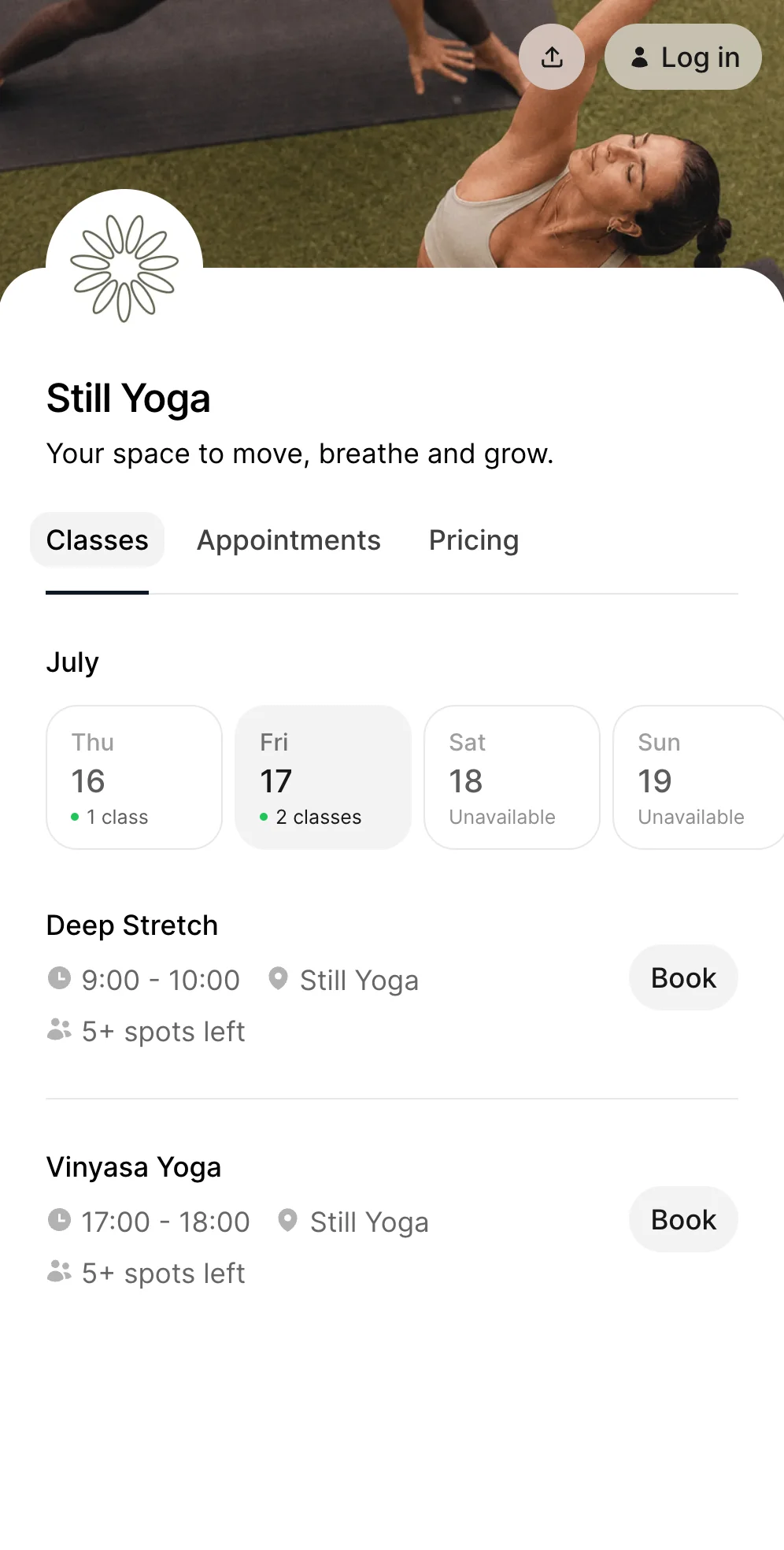
If you're building or growing a yoga business, Time2book helps you manage classes, memberships, bookings, payments, instructors and clients from one place, giving you a clearer view of how your studio is performing.
Try Time2book free today and simplify your yoga studio bookings, payments and client management.
In this guide, we'll break down the average yoga studio owner salary in 2026, realistic income ranges, revenue and expense examples, and the biggest factors that determine how much a studio owner can actually take home.
What Is the Average Yoga Studio Owner Salary in 2026?
Current US salary data gives studio owners a useful benchmark, although it should be treated carefully because yoga studio owners do not usually receive income in exactly the same way as salaried employees.
Indeed reports an average yoga studio owner salary of $51,705 per year in the United States. Its dataset for this specific job title is relatively small, while ZipRecruiter provides a broader estimated range of approximately $30,000–$80,000 per year, depending on studio size, location, profitability, and business model.
A practical way to think about yoga studio owner income is:
| Studio situation | Possible annual owner income |
|---|---|
| New / early-stage studio | $0–$30,000 |
| Small owner-operated studio | $30,000–$60,000 |
| Established profitable studio | $60,000–$100,000 |
| Strong high-volume studio | $100,000–$150,000+ |
| Multi-location / diversified business | $150,000+ |
These are planning ranges rather than guaranteed salaries. Your actual income depends on revenue, expenses, debt, taxes, reinvestment, and how much work you personally perform inside the business.
Yoga Studio Owner Salary Is Not the Same as Yoga Studio Revenue
This is one of the most important distinctions for anyone considering opening a yoga studio. If someone says, "My yoga studio makes $300,000 per year," they are usually talking about business revenue, not personal income.
A studio generating $300,000 still has to pay for rent, yoga instructors, reception or management staff, utilities, insurance, booking software, payment processing, cleaning, marketing, accounting, equipment, repairs, taxes, and other operating expenses. Only after those costs are covered does money become available as business profit or owner compensation.
A Simple Yoga Studio Revenue Example
Imagine a yoga studio generates $25,000 per month, or $300,000 per year.
| Item | Monthly | Annual |
|---|---|---|
| Studio revenue | $25,000 | $300,000 |
| Operating expenses | $20,000 | $240,000 |
| Remaining operating profit | $5,000 | $60,000 |
The owner does not make $300,000 simply because the studio generates $300,000 in revenue. In this example, approximately $60,000 remains before considering taxes, debt repayments, cash reserves, reinvestment, and other owner-level expenses.
Understanding the difference between revenue, profit, and personal income is essential when evaluating whether a yoga studio is financially successful.
How Much Do Yoga Studio Owners Make Per Month?
Using the broad $30,000–$80,000 annual income range, a yoga studio owner's monthly income could fall somewhere between approximately $2,500 and $6,700. Owners of highly profitable studios may make considerably more.
| Annual owner income | Monthly equivalent |
|---|---|
| $30,000 | $2,500 |
| $40,000 | $3,333 |
| $50,000 | $4,167 |
| $60,000 | $5,000 |
| $80,000 | $6,667 |
| $100,000 | $8,333 |
| $150,000 | $12,500 |
Yoga studio income is rarely distributed perfectly evenly throughout the year. January may be particularly strong because of New Year's fitness demand, while summer months could be quieter. Teacher-training courses, retreats, or workshops can also create occasional spikes in revenue.
Unexpected expenses matter too. A lease deposit, major equipment purchase, renovation, or tax payment could significantly reduce the amount available for an owner to withdraw during a particular month. For that reason, studio owners should avoid treating whatever happens to remain in the business bank account as personal income.
How Yoga Studio Owners Actually Pay Themselves
Yoga studio owners can receive income in several different ways. The exact accounting and tax structure depends on your country and company structure, so local professional advice is important, but from a business perspective it helps to separate payment for work from profit generated by the business.
1. Salary for Managing the Studio
If you effectively work as the studio's full-time manager, you are performing a job that somebody else would otherwise need to do. Creating schedules, managing instructors, helping clients, processing refunds, selling memberships, managing finances, marketing the studio, and handling daily operational problems all represent real work.
For context, ZipRecruiter currently reports average US yoga studio manager pay of approximately $28.10 per hour, with many positions falling roughly between $23 and $33 per hour.
A useful way to evaluate your own contribution is to ask: What would I have to pay someone else to do everything I currently do?
If you work 30 management hours every week without paying yourself, the studio may appear more profitable than it really is because the business is benefiting from unpaid owner labor.
2. Pay for Classes You Teach
Many yoga studio owners also teach classes themselves, particularly during the early stages of the business. This is another type of work that should be separated from business profit when evaluating your studio's performance.
Indeed currently reports average yoga instructor pay of approximately $34.83 per hour in the US, although actual rates vary significantly by city, experience, and employer.
Suppose you teach 10 classes per week and the normal instructor rate at your studio is $40 per class. Over 50 working weeks, your teaching represents approximately:
10 classes × $40 × 50 weeks = $20,000 per year
If your studio reports $40,000 in annual profit but you also perform $20,000 worth of unpaid teaching plus substantial unpaid management work, that $40,000 is not truly passive business profit. A significant portion of it is effectively compensation for your own labor.
3. Business Profit
Business profit is different. This is the money remaining after paying the costs required to operate the studio, including the people needed to deliver classes and manage the business.
That is what makes studio ownership potentially more valuable than simply working as an instructor. If your studio can eventually operate without requiring you to personally teach every class, answer every email, or manage every booking, you have built a business capable of generating income beyond your individual working hours.
For many studio owners, that is the long-term goal.
Yoga Studio Owner Income Example: Small Studio
Consider a small neighborhood yoga studio with 150 recurring members paying an average of $100 per month. Memberships would generate $15,000 monthly, while drop-ins, class packs, private sessions, and workshops could provide additional revenue.
Monthly Revenue
| Revenue source | Monthly revenue |
|---|---|
| Memberships | $15,000 |
| Drop-ins and class packs | $2,500 |
| Private sessions | $1,000 |
| Workshops | $1,000 |
| Total monthly revenue | $19,500 |
This gives the studio approximately $234,000 in annual revenue.
Now consider the operating expenses.
Monthly Expenses
| Expense | Monthly |
|---|---|
| Rent | $4,000 |
| Instructors | $5,000 |
| Front desk / admin | $1,500 |
| Marketing | $1,000 |
| Utilities | $600 |
| Insurance | $250 |
| Software | $150 |
| Cleaning & supplies | $500 |
| Payment fees | $600 |
| Other expenses | $900 |
| Total | $14,500 |
After approximately $14,500 in monthly expenses, the studio has around $5,000 remaining each month, equivalent to roughly $60,000 per year before taxes, additional reserves, and reinvestment.
The owner could potentially take much of that as income, but a sensible business would usually keep at least some money inside the company for slower months, unexpected expenses, equipment, or growth.
Yoga Studio Owner Income Example: Larger Studio
Now consider an established studio with 300 active members paying an average of $115 per month. Membership revenue alone reaches $34,500 per month, with additional revenue coming from class packs, private sessions, workshops, and other services.
| Revenue source | Monthly revenue |
|---|---|
| Memberships | $34,500 |
| Drop-ins and packs | $4,000 |
| Private sessions | $2,500 |
| Workshops | $2,000 |
| Other revenue | $2,000 |
| Total | $45,000 |
That gives the studio approximately $540,000 in annual revenue.
If operating expenses average $35,000 per month, approximately $10,000 remains each month, or $120,000 per year before taxes, reserves, and owner-level considerations.
The owner of this business could therefore potentially earn considerably more than the average reported yoga studio owner salary. Reaching this level, however, usually requires strong membership retention, appropriate pricing, healthy class occupancy, and careful control of operating expenses.
What Determines a Yoga Studio Owner's Salary?
The number of classes on your schedule is only one part of the equation. In most studios, active memberships, pricing, occupancy, payroll, and rent have a much larger impact on the owner's eventual income.
Number of Active Members
Recurring memberships are usually the financial foundation of a yoga studio because they create predictable monthly revenue.
Consider the difference:
| Active members | Average membership | Monthly recurring revenue |
|---|---|---|
| 100 | $100 | $10,000 |
| 150 | $100 | $15,000 |
| 200 | $100 | $20,000 |
| 250 | $100 | $25,000 |
Growing from 100 to 250 members at the same average price adds $15,000 in monthly recurring revenue, or $180,000 annually, before additional costs.
This is why membership acquisition and retention usually matter more than constantly trying to increase drop-in sales.
Membership Pricing
Small pricing changes can also make a major difference when multiplied across hundreds of members.
For example, with 200 members:
- $90/month = $18,000 monthly revenue
- $110/month = $22,000 monthly revenue
That is a difference of $4,000 per month, or $48,000 per year.
Of course, you cannot simply keep raising prices. Pricing needs to reflect your local market, instructors, positioning, schedule, facilities, and client experience. But consistently underpricing your studio can significantly limit how much profit—and therefore owner income—the business can generate.
Class Occupancy
Occupancy determines how efficiently your schedule generates revenue. A class with space for 20 people costs almost the same to operate whether five or fifteen people attend because instructor pay, rent, utilities, cleaning, and software costs remain relatively stable.
A class with five clients has 25% occupancy, while a class with fifteen clients has 75% occupancy. The second class spreads essentially the same operating costs across three times as many customers.
For that reason, class occupancy is one of the most important metrics a yoga studio owner can monitor.
The Danger of Being Busy but Unprofitable
A yoga studio can look extremely successful from the outside while producing very little owner income. Classes may run throughout the day, instructors may be busy, and students may constantly walk through the door, but high activity does not necessarily equal high profitability.
Consider an additional midday class averaging four attendees. If the average realized revenue per visit is $15, the class generates:
4 clients × $15 = $60
If the instructor receives $40, only $20 remains before accounting for rent, payment processing, utilities, cleaning, software, marketing, and other overhead.
That class may add activity to your schedule without adding meaningful profit to the business. In some cases, removing or rescheduling consistently underperforming classes can improve profitability more than adding new ones.
Rent Can Make or Break Your Yoga Studio Salary
Rent is another expense with a direct impact on owner income. A beautiful central-city studio can help attract clients, but an expensive lease can absorb a large share of revenue before the owner sees any profit.
Imagine two yoga studios both generate $300,000 per year:
| Studio | Annual revenue | Annual rent |
|---|---|---|
| Studio A | $300,000 | $36,000 |
| Studio B | $300,000 | $84,000 |
Studio B spends an additional $48,000 every year on rent. Assuming everything else is equal, that difference could represent most of the owner's potential annual income.
When evaluating a location, don't only ask whether the business can technically afford the monthly lease. Calculate how many memberships and class bookings will be required simply to cover the space before paying instructors or yourself.
Owner-Teacher vs. Owner-Manager
How much you personally earn can also depend on the role you choose to play inside the business.
Owner-Teacher
An owner-teacher may teach 15–25 classes per week while also handling private sessions, bookings, marketing, and client relationships. This model can produce a reasonable income from a relatively small studio because the owner replaces work that would otherwise need to be performed by paid employees or contractors.
The downside is that income remains heavily dependent on the owner's personal working capacity. If you stop teaching, payroll costs increase or revenue decreases.
Owner-Manager
An owner-manager may teach only a few classes—or none at all—and instead focus on growth, membership sales, operations, staff management, retention, finance, and partnerships.
Payroll will usually be higher because other instructors deliver the classes, but the studio becomes less dependent on the owner physically being present every day. This can make the business easier to scale or eventually expand into multiple locations.
Neither model is inherently better. The important thing is understanding whether you are building a well-paid job for yourself or a business that can operate independently of your teaching hours.
Can a Yoga Studio Owner Make $100,000 a Year?
Yes, but the studio needs enough profit to support it.
A $100,000 annual owner income represents approximately $8,333 per month before considering personal taxes or how owner compensation is structured. If your studio generates only $15,000 in total monthly revenue, withdrawing more than half of it as owner income is unlikely to be sustainable.
At $40,000–$60,000+ in monthly revenue, a six-figure owner income becomes considerably more realistic if instructor payroll, rent, and other expenses remain under control.
The goal is not simply to reach a certain number of students. What matters is building a healthy relationship between:
Revenue → operating expenses → profit → owner compensation
A studio generating $600,000 with extremely high expenses could pay its owner less than a well-run studio generating $350,000.
How to Increase Your Yoga Studio Owner Salary
Increasing your income does not necessarily mean teaching more classes or working longer hours. In many cases, the best opportunity is to improve the economics of the schedule you already have.
Increase Recurring Membership Revenue
Recurring memberships create predictable cash flow and make it easier to plan payroll, rent, marketing, and owner compensation.
A client buying a $20 drop-in may or may not return next week. Someone paying $110 every month creates recurring revenue that the studio can forecast. For that reason, studios should create a clear journey from an introductory offer toward memberships or recurring plans.
Improve Class Occupancy
Before adding more classes, evaluate whether you can fill the ones already on your schedule.
Useful metrics include:
- Class capacity
- Average attendance
- Occupancy percentage
- Revenue per class
- Instructor cost
- Highest-performing times
- Consistently underperforming classes
One well-timed class operating near capacity can generate more profit than several poorly attended sessions.
Offer Higher-Value Services
Group classes do not need to be your only source of income. Yoga studios can increase revenue per client by offering complementary services such as:
- Private yoga
- Semi-private sessions
- Workshops
- Teacher training
- Retreats
- Corporate yoga
- Online classes
- On-demand video
- Specialty programs
Corporate yoga can be especially useful because companies often pay a fixed amount per session rather than paying per participant. Even a few recurring corporate clients can create meaningful additional revenue without requiring more capacity inside your studio.
The key is not to add every possible revenue stream. Start with services that fit your existing instructors, audience, and brand.
Use Software to Understand Your Yoga Studio Numbers
As your business grows, managing bookings and payments is only part of the job. Owners also need visibility into revenue, attendance, memberships, class packs, new clients, instructor schedules, payments, and cancellations to understand what is actually driving profitability.
This is where dedicated yoga studio software becomes important. Time2book gives yoga studios one place to manage class schedules, memberships, packs, payments, instructors, and client activity while helping owners understand how the business is performing.
If you're comparing platforms, see our guide to the best yoga studio booking software.
You can also use our yoga class description examples when creating your schedule or follow our guide to setting up online booking for a yoga studio.
Try Time2book free today and manage bookings, memberships, payments and clients from one simple platform.
Frequently Asked Questions About Yoga Studio Owner Salary
Yoga studio owners may earn approximately $30,000–$80,000 per year, although income varies significantly depending on location, studio size, expenses, and profitability. New owners may take home very little while building the business, while owners of successful established studios can earn $100,000 or more annually.
Indeed currently reports an average US yoga studio owner salary of approximately $51,705 per year. However, owner salary datasets are relatively limited because business owners often receive income through a combination of salary, teaching compensation, and business profit rather than a single conventional salary.
Yes. A profitable yoga studio can provide a full-time income for its owner, but revenue must first cover rent, instructors, utilities, marketing, software, insurance, payment processing, and other expenses.
Strong recurring memberships and healthy class occupancy generally make sustainable owner income much easier to achieve.
Yes. Established studios with strong recurring memberships, appropriate pricing, healthy occupancy, and controlled expenses can support six-figure owner incomes.
Reaching that level becomes easier when the studio also earns revenue from services such as private sessions, workshops, teacher training, corporate yoga, retreats, or multiple locations.
Yoga studios can be profitable, but profitability depends heavily on rent, instructor payroll, pricing, membership retention, and class occupancy. A studio can have a busy schedule and still generate relatively little profit if classes are underpriced or operating costs are too high.
Owners should therefore track revenue and costs alongside bookings rather than using attendance alone as a measure of success.
A small studio might generate roughly $10,000–$25,000 per month, while an established studio with several hundred members could generate $30,000–$60,000+ per month.
These figures represent business revenue, not the owner's salary. Rent, payroll, marketing, software, insurance, payment fees, and other operating costs still need to be deducted.
The strongest opportunities usually include increasing recurring membership revenue, improving class occupancy, reviewing pricing, reducing consistently underperforming classes, and introducing higher-value services such as private yoga, workshops, teacher training, or corporate programs.
The goal should be to increase studio profitability rather than simply increasing the number of hours the owner works.
Many do, particularly when the studio is new. Teaching classes themselves can reduce payroll costs and allow owners to earn teaching income alongside business profit.
As the studio grows, some owners gradually reduce their teaching schedule and focus more on management, marketing, retention, team leadership, and business growth.
Final Thoughts: How Much Can a Yoga Studio Owner Make?
There is no fixed yoga studio owner salary. Current estimates suggest that many owners may earn somewhere around $30,000–$80,000 per year, while established and highly profitable studios can potentially generate six-figure incomes for their owners.
The amount you make ultimately depends less on how busy your studio looks and more on the strength of the underlying business. A studio needs appropriate pricing, recurring memberships, good class occupancy, controlled payroll and rent, and enough margin left after expenses to compensate the owner sustainably.
A new studio owner may spend the first year reinvesting most of the profit. An established owner-operated studio could eventually provide a comfortable full-time income, while a larger studio with several hundred members, workshops, teacher training, or multiple locations may generate considerably more.
The number that matters most isn't total revenue. It's what remains after running the studio properly.
Track memberships, occupancy, revenue per class, instructor payroll, and operating expenses carefully. Build predictable recurring revenue instead of relying entirely on drop-ins, and create systems that allow the business to operate without requiring every task to pass through you.
That's how a yoga studio becomes more than a place where you teach—it becomes a sustainable business.
Try Time2book free today and simplify your yoga studio bookings, memberships, payments and client management.