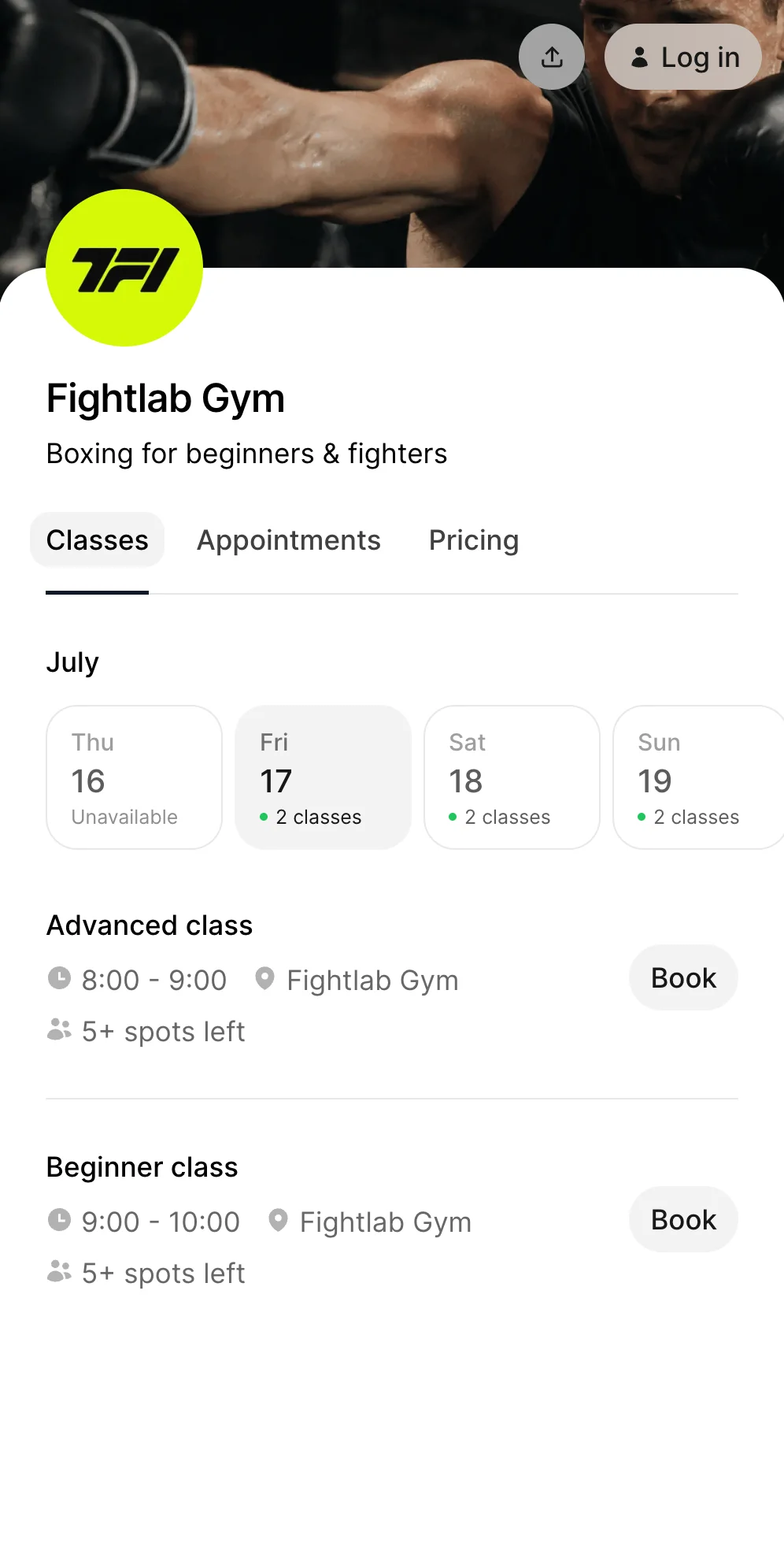

Running a martial arts school involves much more than teaching classes. You also need to manage schedules, students, memberships, payments, trial sessions, private lessons, cancellations, and attendance.
As your school grows, these small administrative tasks begin to take up more time. You may find yourself checking bank transfers, updating spreadsheets, replying to booking messages, and reminding students that their memberships have expired.
Martial arts school software brings these tasks together. For a small dojo, academy, gym, or independent coach, the right system should make the business easier to run without introducing unnecessary complexity.
What is martial arts school software?
Martial arts school software helps dojos, academies, gyms, and independent instructors manage the operational side of their business.
Depending on the platform, it may include:
- Class scheduling
- Online booking
- Student management
- Memberships and class packs
- Recurring payments
- Trial classes
- Private lessons
- Attendance tracking
- Waitlists
- Automated reminders
- Payment reporting
- Belt and rank tracking
- Digital waivers
- Family accounts
Some platforms are designed specifically for traditional martial arts schools. They may include detailed belt progression, grading eligibility, family billing, and student development records.
Other systems focus on the everyday commercial side of running a class-based business, including schedules, bookings, payments, memberships, and student records.
Neither approach is automatically better. The right option depends on how your school operates and which problems you actually need the software to solve.
Who needs martial arts management software?
Martial arts software is not only for large academies with hundreds of students. It can also help smaller schools and independent instructors reduce administration and create a more professional booking experience.
It can be useful for:
- Independent martial arts instructors
- Small karate and taekwondo schools
- Brazilian jiu-jitsu academies
- Boxing and kickboxing gyms
- MMA gyms
- Judo schools
- Muay Thai gyms
- Self-defence instructors
- Coaches offering private lessons
- Multi-discipline martial arts centres
- Schools running children’s and adult programmes
A solo boxing coach may only need a simple schedule, online payments, and private-session booking. A traditional karate school may also need belt records, gradings, family memberships, and parent communication.
A growing MMA or BJJ gym may need several class schedules, recurring memberships, instructor management, capacity limits, and attendance reports.
The purpose of the software is similar in each case: reduce repetitive admin and make it easier for students to book, pay, and keep training.
Signs you have outgrown manual administration
Many martial arts businesses begin with a spreadsheet, a social media page, and payments made through cash or bank transfer. That can work when you have a small group of students and only a few weekly classes.
As the school grows, the same setup becomes harder to manage. Information becomes spread across messages, spreadsheets, payment records, and paper attendance sheets.
You may be ready for martial arts management software when:
- Students regularly ask when classes are running
- Parents message you to reserve places for their children
- Bookings arrive through WhatsApp, Instagram, email, and phone calls
- You manually check who has paid
- You track class packs in a spreadsheet
- You cannot quickly see which memberships are active
- Students forget about private lessons or trial classes
- You are unsure how many people will attend
- Late cancellations leave unused spaces
- Several instructors need access to the schedule
- You spend evenings updating business records
- You are avoiding adding more classes because administration already feels difficult
Software becomes useful when manual work starts limiting how many classes or students you can manage.
The goal is not to automate the relationship with your students. It is to automate the repetitive work around that relationship.
Essential martial arts software features
Martial arts platforms can offer long feature lists, but a smaller school may only use a small part of them. Start by looking at the tasks you repeat every day or every week.
The best features are not necessarily the most advanced ones. They are the features that remove real work from your business.
1. Class scheduling
Most martial arts schools operate around a recurring weekly timetable. You may offer children’s karate, beginner BJJ, adult kickboxing, open mat sessions, competition training, private coaching, and weekend seminars.
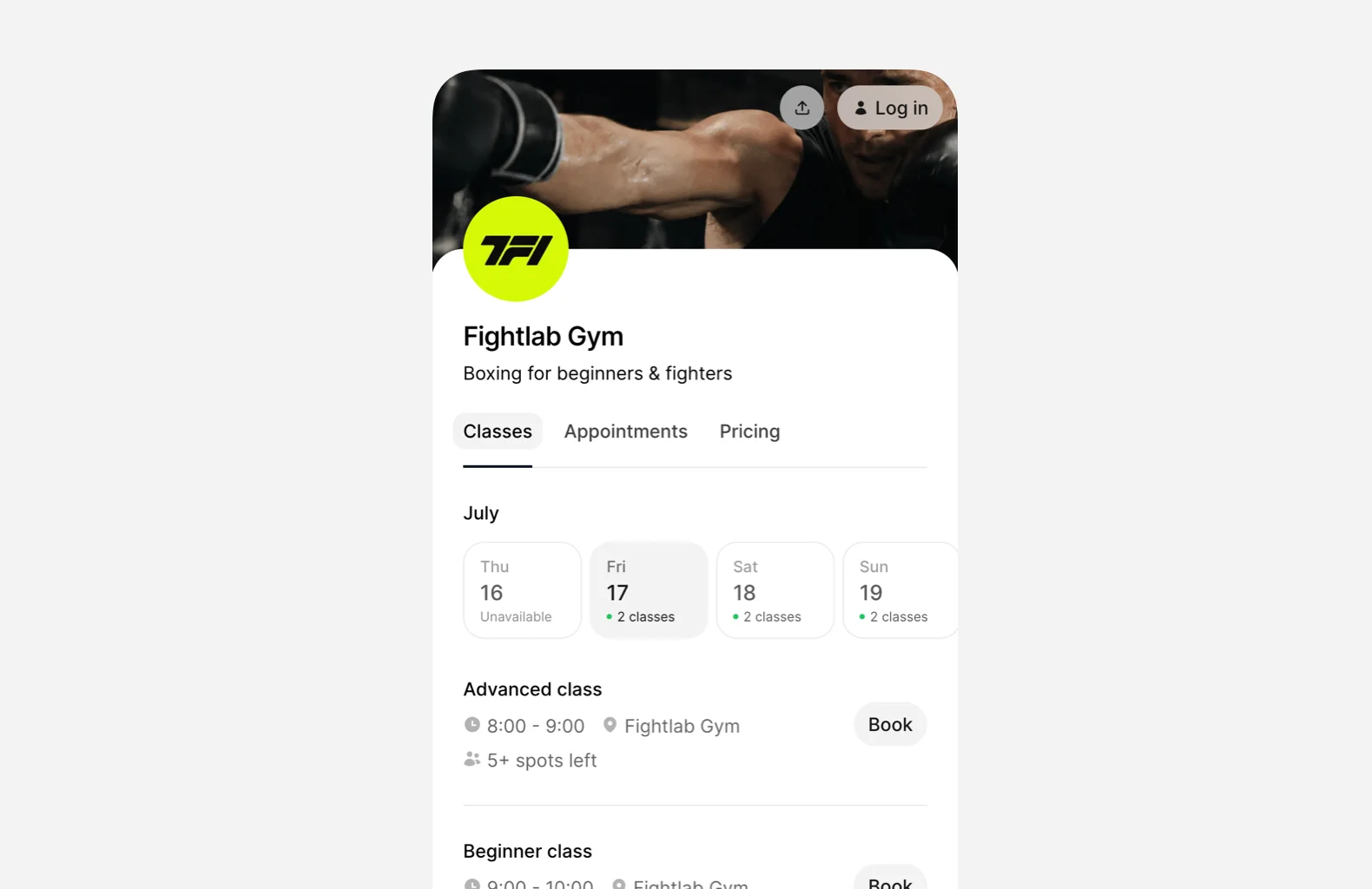
Creating every class individually would take unnecessary time. Martial arts scheduling software should let you create recurring and one-off classes, then adjust individual sessions when needed.
Each class may need its own:
- Instructor
- Age group
- Skill level
- Capacity
- Location
- Duration
- Booking window
- Cancellation policy
- Eligible membership
Time2book lets martial arts businesses create different classes for children, teenagers, adults, beginners, intermediate students, and advanced students. Each class can have its own schedule, capacity, instructor, price, and booking rules.
A clear timetable also helps students understand which sessions are suitable for them. Someone joining for the first time should not need to message you to ask whether they can attend an advanced sparring class.
2. Online booking
Without online booking, every reservation can become a conversation.
Students may ask:
- Is training on tonight?
- Can I join the beginner class?
- Is there still space?
- Can you move me to Thursday?
- Which membership do I need?
These messages may only take a minute each, but they quickly add up.
A martial arts booking system gives students one place to:
- View upcoming classes
- Check available spaces
- Choose an appropriate session
- Book a trial class
- Reserve a private lesson
- Join a waitlist
- Review their upcoming bookings
The booking experience should work well on mobile. Parents may book a children’s class in the evening, while a new student may discover your gym through Google on a Sunday.
Your booking page should stay open even when the gym is not.
3. Memberships and recurring payments
Recurring memberships are an important part of many martial arts businesses. They create more predictable revenue for the school and make regular training easier for students.

Common pricing options include:
- Monthly memberships
- Unlimited memberships
- One-class-per-week memberships
- Children’s programmes
- Family plans
- Ten-class packs
- Drop-in sessions
- Private-lesson packs
- Beginner courses
- Trial offers
- Seminar tickets
Martial arts membership software should connect each plan to the classes it covers. When a student books, the system should know whether they have an active membership, an available class credit, or need to pay for the session.
Recurring billing can also reduce uncomfortable payment conversations. Instead of asking a student or parent whether they remembered to transfer the monthly fee, the agreed payment can be collected automatically.
Time2book supports recurring memberships, prepaid class packs, and individual drop-ins. Payments and available class credits remain connected to the student’s profile.
4. Student profiles
As your community grows, it becomes difficult to keep every detail in your head. A central student profile gives you one place to view the information connected to each person.
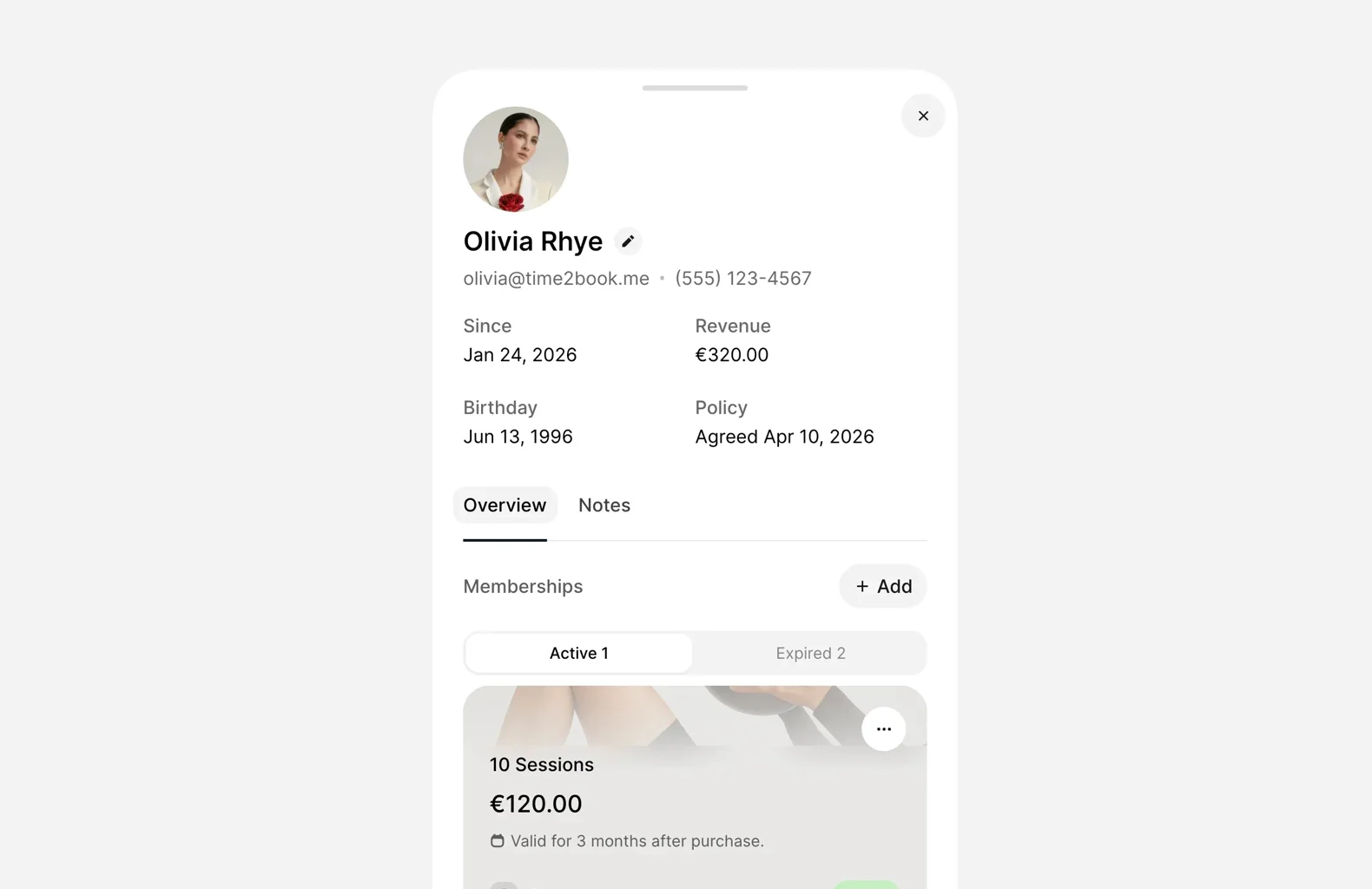
A profile may include:
- Contact information
- Upcoming bookings
- Past classes
- Membership status
- Remaining class credits
- Payment history
- Private lessons
- Cancellations
- Notes
- Attendance activity
This makes it easier to check whether someone has an active plan, which classes they attend, or when they last trained.
Connected profiles are particularly useful when several coaches work with the same students. The information belongs to the school rather than staying inside one instructor’s messages or personal spreadsheet.
5. Trial-class management
Trial classes are often the first step between someone discovering your school and becoming a member. A smooth trial experience can make the school feel organised before the student even enters the gym.
A potential student should be able to:
- Find the beginner programme
- Choose a suitable time
- Enter their details
- Pay or claim the trial offer
- Receive confirmation
- Understand what to bring
- Attend the correct class
The school should then be able to see who booked the trial, whether they attended, and whether they later purchased a membership.
Without a structured process, trial students can disappear between social media messages, paper forms, and instructor notes. Martial arts software keeps the first booking connected to the student’s future membership and attendance history.
6. Attendance tracking
Attendance shows more than who was in the room. It can help you understand how students are training and how well different parts of the timetable are performing.
Attendance data can show:
- Which classes are growing
- Which students train consistently
- Who has stopped attending
- Which programmes have low participation
- Whether another class should be added
- Whether a membership is being used
- Which students may be losing motivation
A student who normally trains three times per week but has not attended for a month may need a friendly check-in. A children’s class that reaches capacity every Tuesday may need another session.
A quiet lunchtime class may need a different time, format, or instructor.
Attendance tracking should help coaches notice changes early without turning every class into a reporting task.
7. Private lesson booking
Many martial arts coaches earn additional revenue through private training. These sessions may be used for technical development, grading preparation, competition coaching, pad work, sparring analysis, or beginner introductions.
Unlike recurring classes, private sessions are usually booked from the coach’s available time slots. The system should prevent scheduling conflicts and clearly show students when the coach is available.
Martial arts appointment software should let the coach:
- Set session duration
- Define the price
- Add preparation or transition time
- Collect payment
- Sell private-session packages
- Apply cancellation rules
- See upcoming appointments
Time2book supports recurring group classes and one-to-one martial arts appointments within the same booking system. Coaches do not need one platform for the weekly class timetable and another for private sessions.
8. Booking reminders and notifications
Students forget bookings, and parents sometimes miss schedule changes. A regular member may also assume a class is running during a public holiday.
Automated confirmations and reminders help keep everyone informed without requiring instructors to send individual messages.
Notifications may cover:
- Booking confirmations
- Upcoming class reminders
- Class cancellations
- Schedule changes
- Payment confirmations
- Failed payments
- Membership purchases
- Membership renewals
- Private-session reminders
Clear communication can reduce no-shows and prevent students from arriving at the wrong time. It also gives students more time to cancel when they cannot attend.
Your team should still communicate personally when it matters. Software simply handles the predictable updates.
9. Waitlists and class capacity
Capacity limits are important in martial arts classes. The number of available spaces may depend on mat size, instructor numbers, equipment, student age, training format, and safety considerations.
The booking system should stop accepting reservations when a class reaches its limit. Students should then be able to join a waitlist.
When someone cancels, the available place can be offered to another student without the instructor contacting several people manually.
Waitlists also provide useful demand information. If the same beginner BJJ class fills every week, it may be time to add another session.
10. Reporting and analytics
Small martial arts schools do not necessarily need complex business intelligence. They need clear answers to practical questions.
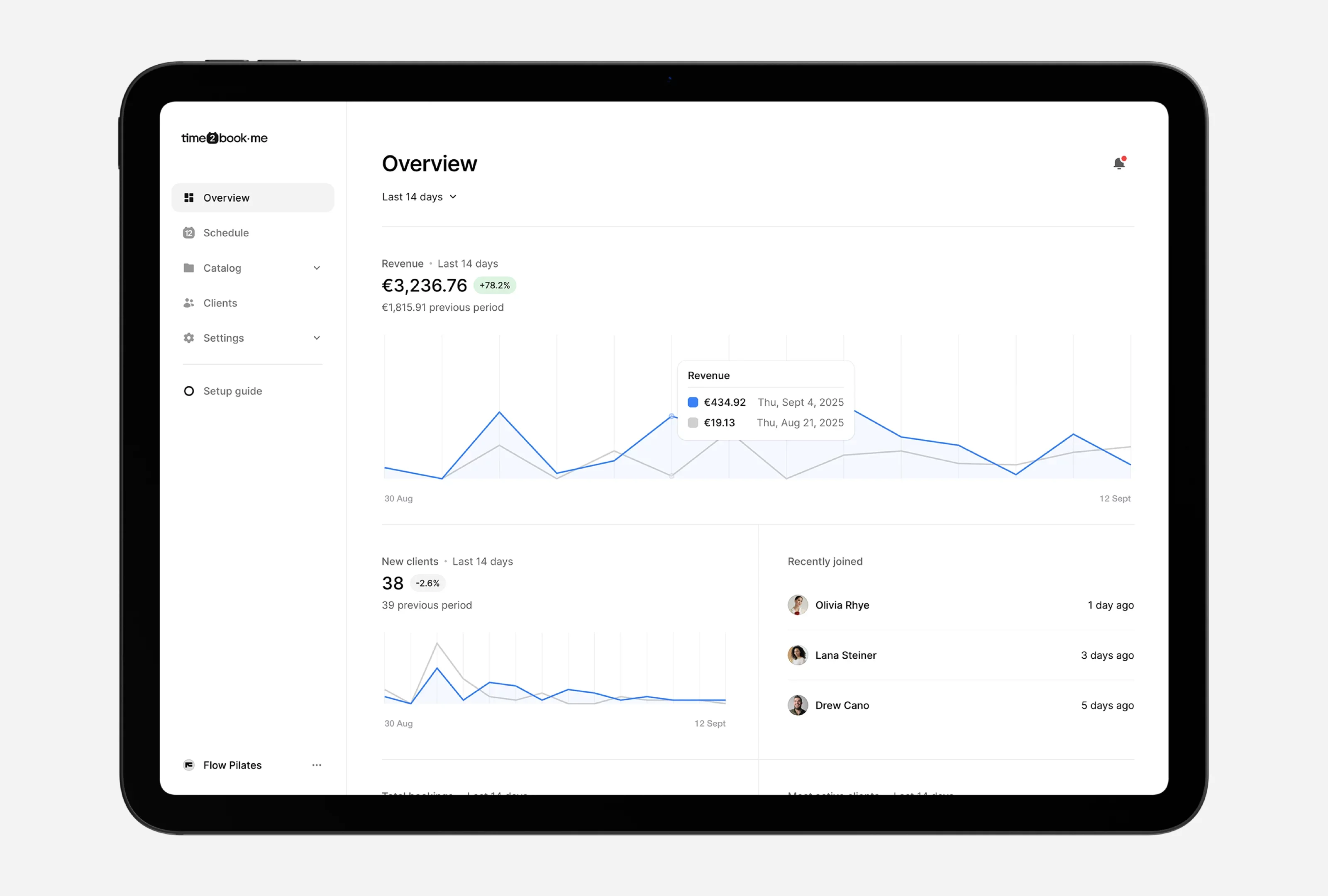
Useful reports may help you understand:
- How many active students you have
- How many bookings you received this month
- Which classes are busiest
- Which memberships sell best
- How much revenue you collected
- Whether trial students become members
- Which students have stopped attending
- Whether private lessons are growing
- Which time slots are busiest
The purpose of reporting is not to create more work. It is to help you make better decisions with less guessing.
For example, you may decide to add another beginner class, remove an underused time slot, or contact members whose attendance has dropped.
11. Family and children’s bookings
Children’s programmes introduce a different booking relationship. The person attending the class may not be the person managing the account or making the payment.
Parents may need to:
- Book for a child
- Purchase a membership
- Manage several children
- Receive confirmations
- Update contact details
- Pay for events or gradings
- Accept policies
- See upcoming sessions
Large family programmes may benefit from household accounts, sibling discounts, and parent-managed memberships. Smaller schools may only need a clear way to connect each child’s classes and plan with the parent who pays.
Consider how much of your business comes from children and families before choosing a system. A school with 150 children may have very different requirements from an adult-only boxing gym. Learn more about parent & children booking.
Martial arts software by discipline
Different martial arts businesses often prioritise different features. Do not assume you need every martial arts-specific feature because it appears on a competitor’s feature list. Start with the way your own school operates.
Simple martial arts software vs specialised dojo software
A simpler martial arts platform may be a better fit when you mainly need:
- Online booking
- Recurring class schedules
- Memberships
- Class packs
- Drop-ins
- Online payments
- Private lessons
- Student profiles
- Waitlists
- Basic attendance
- Business reporting
A specialised dojo management system may be more suitable when you need:
- Detailed belt progression
- Grading eligibility
- Technique tracking
- Family billing structures
- Sibling discounts
- Parent-managed accounts
- Digital waiver storage
- Lead-management pipelines
- Retail inventory
- Advanced communication automation
- Several locations
More features do not automatically create a better experience. They can also mean more setup, higher costs, additional staff training, and more screens to manage.
A small martial arts school should not need weeks of onboarding to publish a timetable and accept a payment.
Choose the simplest system that handles your real requirements.
What should martial arts school software cost?
Martial arts software pricing varies widely. Some platforms charge based on the number of students, locations, staff members, or features included.
Additional charges may apply for:
- Payment processing
- Text messages
- Additional instructors
- Extra locations
- Branded mobile apps
- Websites
- Setup
- Data migration
- Premium support
- Reporting
- Digital waivers
- Marketing automation
Specialised martial arts platforms may include belt tracking, family management, and sales automation, but they may also charge more as the student base grows.
General booking platforms may offer a simpler monthly price but not include advanced martial arts-specific features.
The best-value software is not always the cheapest plan. It is the system that saves more time and manual work than it costs.
How martial arts software works in practice
Imagine you run a small academy offering children’s karate, adult kickboxing, beginner BJJ, and private lessons.
You create each recurring programme and assign its instructor, capacity, schedule, and booking rules. A parent finds your children’s karate page, purchases a monthly membership, and reserves a place in the Tuesday class.
The booking appears on your schedule, and the payment is connected to the student’s profile.
An adult beginner books an introductory BJJ session for Thursday evening. They receive a confirmation with the class time and location.
A regular kickboxing member tries to book Saturday’s session, but the class is full. They join the waitlist.
Another student cancels, and the available place can be offered to the waiting member. Meanwhile, someone books and pays for a private lesson from your available Friday time slots.
You open one dashboard and see who is attending, which classes are full, which students are new, which plans were purchased, and which private lessons are coming up.
No searching through messages. No separate payment spreadsheet.
Classes, payments, and students. Handled.
How Time2book helps martial arts schools
Time2book is designed for martial arts coaches, gyms, and smaller schools that want to simplify their daily business operations.
You can use Time2book to:
- Create recurring martial arts classes
- Offer private lessons
- Organise classes by age and level
- Set class capacity
- Assign instructors
- Accept online bookings
- Collect online and in-person payments
- Sell recurring memberships
- Sell class packs and drop-ins
- Offer trial sessions
- Manage waitlists
- Apply booking and cancellation policies
- Send confirmations and reminders
- Manage student profiles
- Review bookings and payment history
- Track revenue and plan performance
- Sell gift cards
- Create discount codes
Time2book is not intended to be a heavy belt-grading or martial-arts-only administration platform. Its focus is simpler: helping martial arts businesses manage classes, bookings, payments, memberships, and students without unnecessary complexity.
That makes it particularly suitable for:
- Independent coaches
- Boxing gyms
- Kickboxing studios
- BJJ academies
- MMA gyms
- Self-defence instructors
- New martial arts schools
- Smaller academies
- Schools that do not need advanced promotion workflows
You can learn more about Time2book for martial arts schools, compare the best martial arts software platforms, or explore practical ideas for martial arts marketing.
Final thoughts
The best martial arts school software is not necessarily the largest or most specialised system. It is the one that matches the way your school works.
A traditional academy may need advanced belt tracking and family administration. A small BJJ school may mainly need memberships, schedules, attendance, and payments.
An independent boxing coach may only need classes, private lessons, packages, and a professional booking page.
Start with the problems taking up your time today. Students should be able to find the right class, book, pay, and manage their schedule without waiting for a reply.
You should be able to see your classes, students, memberships, and payments without opening several different tools.
Less admin. More time on the mat.
Frequently asked questions
Martial arts software helps dojos, academies, gyms, and independent coaches manage class schedules, online bookings, students, memberships, payments, attendance, private lessons, and communication from one system.
Specialised platforms may also include belt tracking, grading management, family accounts, and digital waivers.
The best martial arts software for a small school should be simple to set up, easy for students to use, and capable of managing the school’s main daily tasks.
Look for online booking, class scheduling, memberships, payments, student profiles, private lessons, attendance, reminders, and waitlists. Only pay for advanced belt, grading, or family-management tools when your school genuinely needs them.
Dojo management software is another name for software used to manage a martial arts school. It may include scheduling, student records, recurring billing, attendance, belt progression, grading, communication, waivers, and reporting.
Yes. Martial arts booking software allows students or parents to view the live schedule, choose an appropriate class, purchase a membership or class pack, and reserve a place online.
They can usually book from a phone or computer at any time.
Yes. Martial arts membership software can manage recurring subscriptions, prepaid class packs, private-lesson packages, trials, and drop-in payments.
The student’s membership and available credits stay connected to their profile and bookings.
Martial arts software can track which students booked and attended each class.
Some platforms offer simple attendance records, while specialised systems may provide check-in kiosks, access control, grading eligibility, and detailed training histories.
Some specialised martial arts platforms include belt, stripe, grading, and rank-progression tools.
General booking platforms may focus instead on schedules, payments, memberships, attendance, and client management. The right option depends on whether belt progression is central to your school’s administration.
Yes. You can create separate schedules for children, teenagers, and adults, with different instructors, capacities, prices, memberships, and booking rules.
Schools with large children’s programmes should also check whether the software supports parent-managed profiles, family memberships, sibling discounts, and minor waivers.
Yes. Software that supports both classes and appointments lets you run recurring group sessions and bookable private lessons through the same system.
Students can select an available private time, make a payment, and receive confirmation online.
The price depends on the platform, number of students, locations, instructors, and included features.
Check for additional costs related to payment processing, SMS messages, branded apps, belt tracking, family accounts, marketing automation, onboarding, migration, and additional staff.