"How much should I charge?" is one of the first questions every personal trainer asks, and one of the hardest to get right. Charge too little and you burn out training 40 clients a week to pay the bills. Charge too much without the results and reviews to back it up and your schedule stays empty.
This guide covers what personal trainers charge in 2026, how to work out your own rate, and how to price PT packages, monthly coaching, online training and semi-private sessions. It includes example price lists you can copy and adjust.
How Much Do Personal Trainers Charge in 2026?
Most US personal trainers charge $50–$120 for a 60-minute 1-on-1 session. Where you train, who you train, and how you sell your sessions all move the price.
| Type of training | Typical US price |
|---|---|
| 1-on-1, big-box gym | $40–$90 per hour |
| 1-on-1, independent trainer or private studio | $60–$120 per hour |
| 1-on-1, major city (NYC, LA, SF) | $100–$200 per hour |
| In-home or mobile training | 20–40% above your studio rate |
| 30-minute session | 55–65% of the hourly rate |
| Semi-private (2–4 people) | $20–$60 per person |
| Small-group training (5–10 people) | $15–$35 per person |
| Online coaching | $100–$300 per month |
These ranges come from published trainer guides and public gym price lists, not from an official survey. Treat them as a starting point: the prices of 5–10 trainers near you are a better guide than any national average.
Personal training prices in the UK and Europe
In the UK, most trainers charge £30–£60 per hour, according to guides from Studyactive and Insure4Sport. London rates of £50–£100 are common. Across Europe, prices follow local costs: €40–€80 per hour is typical in larger cities, less in smaller towns.
Client price vs. what trainers earn
The price a client pays isn't what the trainer takes home. The US Bureau of Labor Statistics puts the median wage for fitness trainers and instructors at $47,160 a year, or $22.67 an hour, in May 2025.
The gap comes from two things. Gyms keep a share of each session: commercial gyms commonly pay trainers 40–60% of what the client pays. And trainers spend unpaid hours on programming, messages, travel and gaps between clients. Independent trainers keep the whole fee but pay their own rent, insurance, software and marketing.
What Affects How Much You Can Charge?
Location
A trainer in central London or Manhattan pays more for rent and travel, and their clients earn more. The same session can be worth twice as much in a big city as in a small town.
Where you train
- Employed at a big-box gym: The gym sets the price and pays you a share or an hourly wage.
- Renting space in a gym or studio: You set your price and pay rent, either a flat monthly fee or a percentage of each session.
- Your own private studio: Higher costs, but you control the experience and can charge more.
- In-home or outdoor training: No rent, but travel time is unpaid, so charge a premium.
- Online: Low costs and no limit on location, but more competition.
Experience, results and reviews
Certifications get you in the door. Results get you paid. A trainer with before-and-after stories, 50 Google reviews and a waiting list can charge far more than a newly qualified one with the same certificate.
Specialism
Specialists can charge more because there are fewer of them and clients can see why they're worth it. Common examples:
- Pre and postnatal training
- Injury rehab and post-physio programs
- Training for older adults
- Sport-specific or competition prep
- Weight loss for clients with medical conditions (alongside their doctor)
Session length and format
Shorter sessions, semi-private sessions and online check-ins all change the price per hour. More on each below.
How to Work Out Your Personal Training Rate
Don't start with what other trainers charge. Start with what you need to earn, then check it against the local market.
Step 1: Set your income goal
Decide what you want to take home each month after tax. For example, $4,000 a month.
Step 2: Add tax
If you are self-employed, set money aside for income tax and, in the US, self-employment tax. Many trainers put aside 25–30%. Ask an accountant for your real number. At 27%, $4,000 take-home means about $5,500 before tax.
Step 3: Add your business costs
List everything you pay to run your business each month. A typical independent trainer might pay:
| Cost | Monthly |
|---|---|
| Gym rent or studio fee | $500 |
| Insurance | $30 |
| Booking and payment software | $40 |
| Card fees | $200 |
| Marketing | $50 |
| Equipment, education and certifications | $80 |
| Total | $900 |
For reference, most US personal trainer liability insurance costs $160–$400 per year. Card fees depend on your provider; Stripe charges 2.9% + 30¢ per online card payment in the US.
$5,500 + $900 = $6,400 a month that your sessions need to bring in.
Step 4: Count your realistic sessions
Count paid sessions, not hours at the gym. Plan for holidays, sick days and cancellations: most trainers work about 46 weeks a year.
At 25 paid sessions a week: 25 × 46 weeks ÷ 12 months ≈ 96 sessions a month.
Step 5: Divide
$6,400 ÷ 96 sessions ≈ $67 per session. Round it to $70.
That's your minimum. If trainers near you charge $90, you can probably charge more. If they charge $50, you need to show clients why you're worth more, choose a different niche or setting, or lower your costs.
Tip: Run the numbers again at 15 sessions a week. Most trainers don't start with a full schedule, so make sure the price works while you build up.
Personal Training Pricing Models
Most trainers mix three or four of these. The goal is simple: make it easy to start, then move clients to an option that keeps them training.
Pay per session
One price per session, paid each time.
- Good for: First sessions, occasional clients, drop-ins.
- Watch out for: Unpredictable income, and clients who skip weeks because nothing is paid upfront.
Make single sessions the most expensive way to train with you.
Session packs
Clients buy 5, 10 or 20 sessions upfront at a lower price per session.
- Good for: Clients who want flexibility without a monthly commitment.
- Watch out for: Packs that never expire. Set a validity period, such as 3 months for a 10-pack and 6 months for a 20-pack, so clients keep coming and you don't carry unused sessions forever.
Monthly coaching
A fixed monthly price for a set number of sessions, for example 8 sessions a month, billed automatically.
- Good for: Steady income and consistent clients. A client who pays monthly books every week.
- Watch out for: Unused sessions. Decide upfront whether they roll over (for example, up to 2 sessions into the next month) or expire.
Many trainers add a minimum term, such as 3 months, for transformation programs. It matches how long results take and stops clients quitting after week three.
Online coaching
A monthly price for programming, check-ins and messaging, without in-person sessions. More on pricing it below.
Hybrid coaching
Monthly online coaching plus 1 or 2 in-person sessions a month. It's a good middle option for clients who can't afford weekly 1-on-1s but want some face-to-face coaching.
How to Price Personal Training Packages
Most of your income will come from packages, so set them up with care.
Example price list
Here is an example for a trainer whose single session is $80:
| Option | Price | Per session | Saving |
|---|---|---|---|
| Single session | $80 | $80 | – |
| 5-session pack (valid 2 months) | $375 | $75 | 6% |
| 10-session pack (valid 3 months) | $700 | $70 | 13% |
| 20-session pack (valid 6 months) | $1,300 | $65 | 19% |
| Monthly coaching, 8 sessions | $560 / month | $70 | 13% |
| 12-week program, 24 sessions | $1,560 (or 3 × $520) | $65 | 19% |
Package pricing tips
- Keep discounts between 5% and 20%. Bigger discounts train clients to expect cheap sessions.
- Offer three main options, not ten. For example, a 10-pack, a 20-pack and monthly coaching. Too many options slow people down.
- Put your best plan in the middle. Most people pick the middle option.
- Name packages by the result, not just the number. "12-Week Strength Kickstart" says more than "24 sessions".
- Add things that cost you little. A program for days between sessions, a monthly progress check or messaging support adds value without adding hours.
How to Price Online Personal Training
Online coaching is priced by the month. What you include sets the price more than how many hours it takes.
| Level | Typical price | Usually includes |
|---|---|---|
| Program only | $50–$100 / month | A training plan in an app, little contact |
| Standard coaching | $100–$250 / month | Custom program, weekly check-in, messaging |
| Premium coaching | $250–$500+ / month | Video calls, form reviews, nutrition coaching, fast replies |
These ranges are drawn from coaching guides, such as FitBudd, and vary widely.
Two things to keep in mind:
- Count your time per client. If a $150 client takes 2 hours a month, that's $75 an hour. If they take 5, it's $30.
- Online clients can leave in a click. Weekly check-ins and a 3-month minimum term help clients stay long enough to see results.
How to Price Semi-Private and Small-Group Training
Training 2–4 people at once lets clients pay less while you earn more per hour.
Semi-private (2–4 people)
Charge each person around 35–60% of your 1-on-1 rate, going lower as the group grows. If your 1-on-1 session is $80:
- 2 people at $45 each = $90 an hour
- 3 people at $35 each = $105 an hour
- 4 people at $30 each = $120 an hour
Small-group training (5–10 people)
Price per person closer to a boutique class: $15–$35 in most US markets. With 8 people at $25, you earn $200 an hour.
Semi-private training is also a good step for clients who love training with you but can't afford weekly 1-on-1s. Offer it before they leave, not after.
How to Price 30- and 45-Minute Sessions
Shorter sessions are popular with busy clients and those on a budget. Don't halve the price: the time around a session (travel, setup, messages, gaps in your day) stays the same.
| Length | Share of hourly rate | At $80/hour |
|---|---|---|
| 60 minutes | 100% | $80 |
| 45 minutes | 75–80% | $60–$64 |
| 30 minutes | 55–65% | $45–$50 |
Intro Offers: Should You Give Free Sessions?
A first session lowers the barrier for new clients, but a fully free workout tends to attract people who were never going to buy.
Better options:
- A free 15–30 minute consultation. Talk about goals, injuries and schedule, then recommend a plan.
- A paid, discounted first session that's credited toward a package if they sign up within a week.
- An intro pack, such as 3 sessions for a set price, enough to show progress and build the habit.
Whatever you choose, recommend the next step before the client leaves. Our guide to intro offers has more ideas that work just as well for personal training.
Cancellation Policy and Payment Terms
Pricing isn't just the number. A missed session costs you an hour you can't sell again, so protect it.
- Cancellation window: 24 hours is standard. Some trainers use 12 hours for early-morning sessions.
- Late cancellations and no-shows: The session is used, or charged in full.
- Payment upfront: Take payment when the client books or buys the pack. Chasing payments later wastes your time.
- Pack expiry: State how long packs are valid.
- Price changes: Say how much notice you give before prices go up.
Put your policy where clients see it before they book, and ask them to agree to it. For a template you can adapt, see our cancellation policy guide.
When and How to Raise Your Prices
Raise your prices when:
- Your schedule is more than 80–90% full
- You have a waiting list
- You've added a new certification or specialism
- Your costs have gone up
How to do it:
- Review prices once a year. A rise of 5–10% is easier to accept than a big jump every few years.
- Charge new clients first. Change the prices on your booking page today.
- Give existing clients notice. At least 30 days, by email or in person.
- Let loyal clients lock in. Offer to let them buy a pack at the old price before the change.
- Don't apologise. Explain briefly and move on.
Common Personal Training Pricing Mistakes
- Copying the cheapest trainer in your gym. You can't win on price, and cheap clients are rarely loyal.
- Forgetting tax and costs. $70 a session isn't $70 in your pocket.
- Pricing for a full schedule. Build the numbers for the schedule you have now.
- Big discounts on packages. 30–40% off teaches clients that your real price is lower.
- Packs that never expire. They lead to inconsistent clients and unpaid sessions years later.
- No cancellation policy. Every late cancellation is unpaid time.
- Hiding your prices. Visitors who can't find a price often leave instead of asking.
- Never raising prices. Your costs go up every year, so your prices should too.
How to Sell Personal Training Packages With Time2book
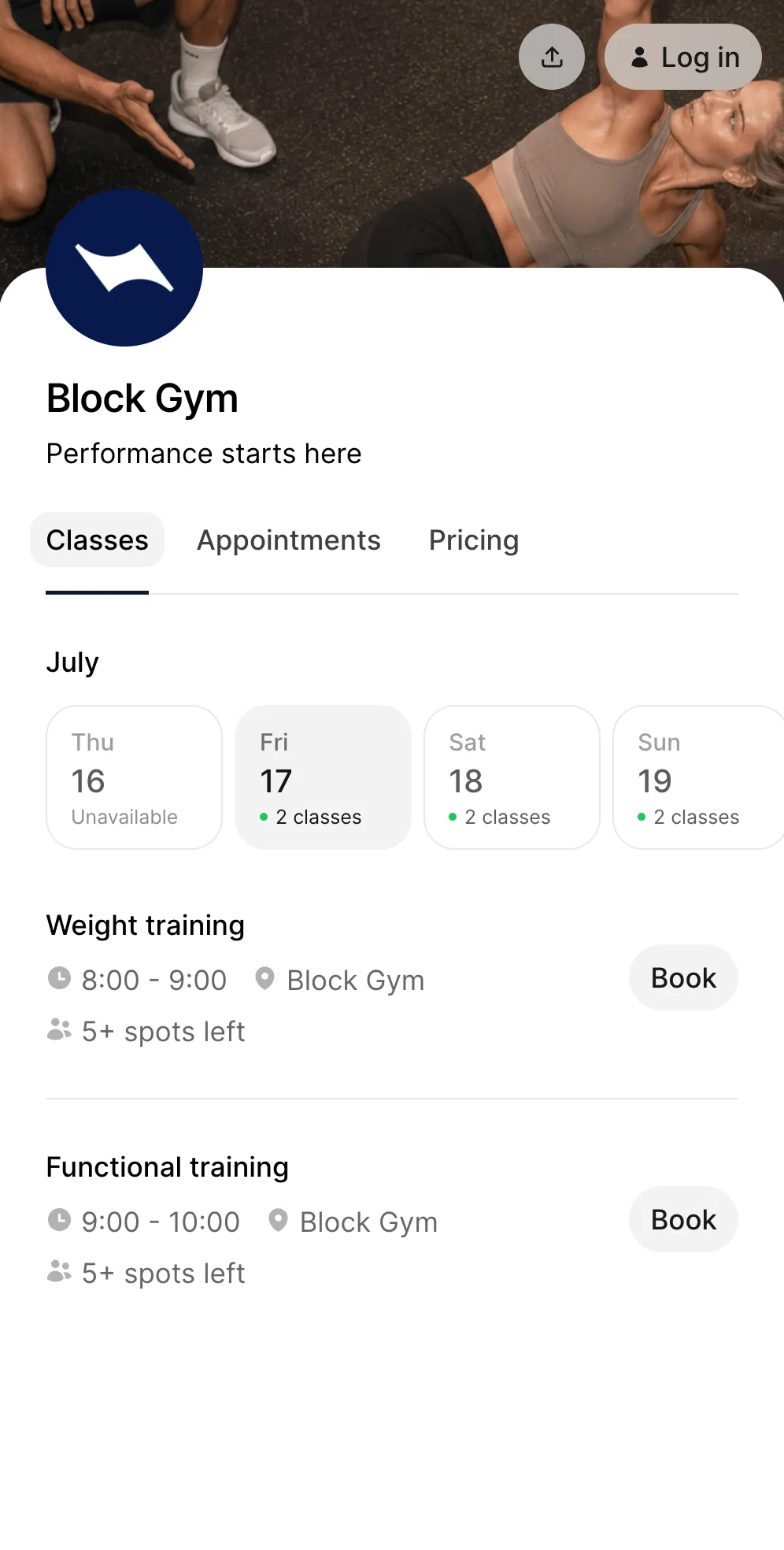
Time2book lets clients book and pay for training online, so you don't have to chase payments or juggle bookings over text.
- 1-on-1 sessions: Create each type of session as an appointment with its own price. Clients book only inside your working hours.
- Session packs: Sell packs of sessions, such as 10 sessions valid for 3 months. Time2book counts sessions down as clients book.
- Monthly coaching: Set up recurring memberships that bill automatically each month, and add a minimum term for 12-week programs.
- Small-group and semi-private sessions: Run them as classes with a set capacity, alongside your 1-on-1s.
- Cancellation policy: Add your rules to your studio policy. Clients see them at checkout, and you can require them to agree before booking.
- Payments: Clients pay online by card through Stripe when they book or buy a plan. See payments.
Each client's profile shows their active packs and memberships and how many sessions they have left. Time2book Starter costs $39 a month, plus Stripe fees and a 0.9% Time2book platform fee on online payments. You can try it free for 7 days without a credit card.
Comparing tools? See our roundup of the best personal trainer software and the best CRM for personal trainers.
Final Thoughts
Your personal training price should cover your costs and your income goal, sit within the range clients expect locally, and reflect the results you deliver. Work out your minimum with the formula above, build two or three clear packages around it, and publish your prices so ready clients can book.
Then fill your schedule. Our guides on how to get clients as a personal trainer and personal trainer advertising cover what comes next.
Frequently Asked Questions About Personal Training Pricing
Most US personal trainers charge $50–$120 for a 60-minute session. Rates in big cities such as New York, Los Angeles and San Francisco often reach $100–$200, while small towns and big-box gyms sit closer to $40–$70.
Start from your costs and income goal, then check what trainers near you charge. If your number falls far below the local range, you are undercharging.
Most UK personal trainers charge about £30–£60 per hour. In London, rates of £50–£100 are common, and well-known or specialist trainers charge more. These figures come from trainer guides and marketplaces, not an official survey, so check local rates.
New trainers usually price at the lower end of the local range, for example $40–$60 per session in many US markets. Charge enough to cover your costs and plan small increases as your schedule fills and your results and reviews build up.
Charge about 55–65% of your hourly rate. If your 60-minute session is $80, a 30-minute session at $45–$50 is fair. Don't simply halve the price: the time around a short session (travel, setup, messages) is the same.
Most trainers sell packs of 5, 10 or 20 sessions with a 5–20% discount off the single-session price. For example, at $80 per session: 10 sessions for $700 ($70 each) and 20 sessions for $1,300 ($65 each). Give each pack an expiry date, such as 3 months for 10 sessions.
Online coaching is usually priced per month, not per session. Most plans sit around $100–$300 per month. Lower prices tend to mean a program and app with little contact; higher prices include weekly check-ins, form reviews and messaging.
Charge each person less than a 1-on-1 session but earn more per hour in total. A common range is $20–$60 per person in the US. For example, if your 1-on-1 rate is $80, charge two people $45 each ($90 an hour) or three people $35 each ($105 an hour).
Both work. Per-session pricing and packs are simple and suit new or occasional clients. Monthly coaching gives you steadier income and helps clients stay consistent. Many trainers offer a single session for trying, packs for flexibility, and a monthly plan as the main option.
A free consultation of 15–30 minutes works well for many trainers. A full free workout often attracts people who never book again. A paid, discounted first session that counts toward a package filters for serious clients and still lowers the barrier.
Usually yes. Clear prices save you from answering the same question in DMs and let ready clients book straight away. If your coaching is custom, show a "from" price or your most popular package so visitors know the range before they get in touch.
Review your prices once a year. A small rise of 5–10% is easier to accept than a big jump every few years. Charge new clients the new price first, and give existing clients at least 30 days' notice.
Yes. In Time2book you can sell single sessions, packs of sessions with an expiry date, and monthly coaching that bills automatically, with an optional minimum term. Clients book 1-on-1s inside your working hours and pay online, and each client's profile shows how many sessions they have left.