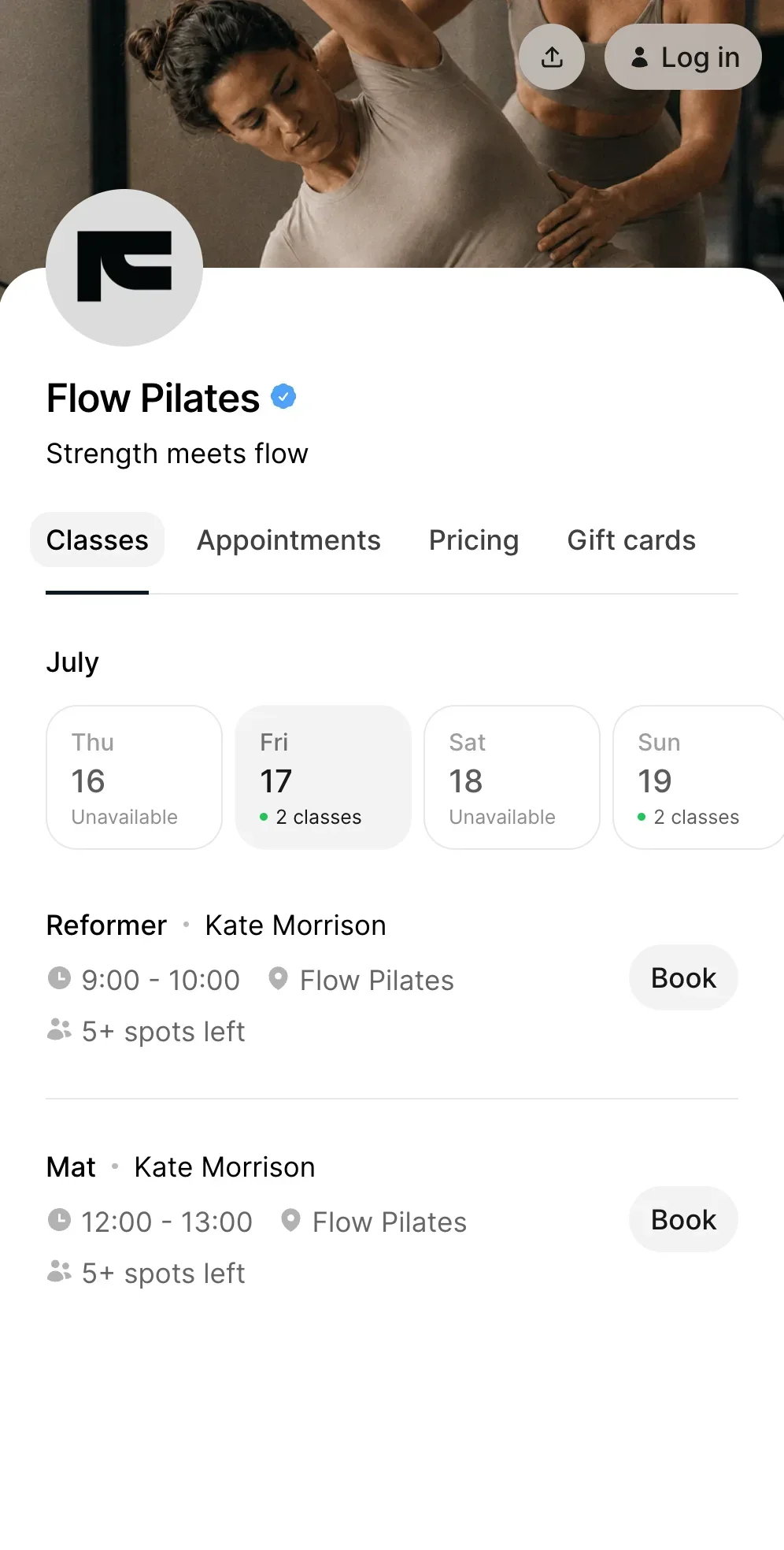

Late cancellations can be expensive for a Pilates studio. When a client cancels shortly before a reformer class, there may not be enough time to offer the space to someone else. The instructor still needs to be paid, the equipment remains reserved, and a potentially valuable class spot goes unused.
A clear Pilates studio cancellation policy helps protect your revenue without making the client experience feel unfriendly. It explains when clients can cancel, what happens to their class credit, how no-shows are handled, and whether exceptions are available. When the policy is supported by modern Pilates studio software, much of the process can be handled automatically.
Try Time2book free today to manage Pilates bookings, payments, memberships, reminders, and client information in one simple platform.
In this guide, we’ll explain how to create a fair Pilates studio cancellation policy for 2026, what it should include, and how to adapt the included template for your studio.
What Is a Pilates Studio Cancellation Policy?
A Pilates studio cancellation policy is a set of rules explaining how clients can cancel or reschedule a booked class or private session.
The policy normally defines:
- How much notice a client must provide
- How clients should cancel their booking
- Whether the class credit is returned
- What happens after a late cancellation
- What happens when a client does not attend
- Whether no-show or late cancellation fees apply
- How waitlisted clients are promoted
- When the studio may make an exception
The cancellation policy should be visible before a client completes a booking. It should also be included in your studio terms, booking confirmation, client account, and frequently asked questions.
A cancellation policy is not the same as a membership cancellation policy.
A class cancellation policy applies when someone cancels a specific booking. A membership cancellation policy explains how a client can end, pause, or change a recurring membership. Your studio should document both separately.
Why Pilates Studios Need a Cancellation Policy
Every Pilates studio has limited capacity. A mat class may accommodate a larger group, but a reformer class is restricted by the number of machines available.
If your studio owns eight reformers, you can only sell eight places in that class. A late cancellation can therefore remove a meaningful percentage of the class revenue.
A clear Pilates cancellation policy helps your studio:
- Reduce last-minute cancellations
- Encourage clients to manage bookings responsibly
- Give waitlisted clients time to attend
- Protect instructor income
- Keep popular classes available
- Apply rules consistently
- Reduce arguments about credits and refunds
- Forecast attendance more accurately
Without clear rules, clients may assume they can cancel at any time and receive their class credit back. Staff may also handle similar situations differently, creating confusion and frustration.
The purpose of the policy is not to punish clients. It is to establish a predictable system that is fair to clients, instructors, and the studio.
For additional attendance strategies, read our guide on how to reduce no-shows in a Pilates studio.
What Is a Fair Cancellation Window for Pilates Classes?
A cancellation window is the minimum amount of notice a client must provide to retain their class credit or avoid a fee.
Pilates studios commonly use windows ranging from several hours to 24 hours. Current studio policies show examples of 6-, 8-, 9- and 12-hour windows, depending on the type of session, location, demand, and membership structure.
For many smaller studios, 12 hours is a practical starting point.
It gives clients some flexibility while providing enough time to contact someone on the waitlist. Studios offering private sessions or highly specialised appointments may prefer a 24-hour policy because those bookings are more difficult to replace.
Comparing common cancellation windows
| Cancellation window | Best suited to | Potential disadvantage |
|---|---|---|
| 6 hours | Studios with flexible schedules and strong local demand | May not leave enough time to fill the space |
| 8 hours | Studios wanting a more client-friendly policy | Same-day morning cancellations may be difficult to replace |
| 12 hours | Most group reformer and mat Pilates studios | Clients must plan earlier |
| 24 hours | Private sessions, duets and premium appointments | Can feel restrictive for standard group classes |
A practical policy structure
A balanced Pilates cancellation policy could use:
- 12 hours for group classes
- 24 hours for private, duet or semi-private sessions
- Loss of the session credit for late cancellations
- Loss of credit plus a fee for no-shows on unlimited plans
- One discretionary exception for genuine emergencies
Your ideal cancellation window depends on how quickly your classes fill, whether you use a waitlist, how far clients travel, and whether instructors are paid regardless of attendance.
What Should a Pilates Studio Cancellation Policy Include?
A useful policy should answer every common cancellation question before a client needs to contact the studio.
1. The cancellation deadline
State the exact number of hours before class that clients can cancel without a penalty.
Avoid vague wording such as:
Please give us plenty of notice.
Use a specific rule:
Please cancel at least 12 hours before the scheduled class start time.
The deadline should be calculated from the beginning of the class, not from the time the client originally booked.
2. How clients must cancel
Explain exactly where cancellations should be made.
For example:
Cancellations must be completed through your online booking account. Instagram messages, text messages and comments on social media are not accepted as cancellations.
Requiring clients to cancel through your booking system creates a timestamped record and prevents messages from being missed.
However, the process should remain simple. A policy is more effective when clients can cancel in a few taps rather than needing to call during studio opening hours.
3. What happens after an early cancellation
Tell clients whether their class credit is automatically returned.
For example:
When you cancel more than 12 hours before class, the session credit will be returned to your active membership or class pack.
You should also explain whether the returned credit keeps its original expiration date.
4. What counts as a late cancellation
Define a late cancellation clearly.
For example:
A booking cancelled less than 12 hours before the class start time is considered a late cancellation.
Explain whether the client loses the session, pays a fee, or both.
5. What happens after a no-show
A no-show usually means the client did not cancel and did not attend.
Some studios treat late cancellations and no-shows equally. Others apply a larger penalty to no-shows because cancelling—even at the last minute—may still give someone on the waitlist a chance to attend.
For example:
If you do not attend and have not cancelled your booking, the session will be deducted from your plan. Unlimited members will be charged a $15 no-show fee.
Several operating studios distinguish between late cancellations and no-shows, using a higher no-show fee or an additional charge alongside the lost session.
6. How unlimited memberships are handled
Losing one class credit does not create a consequence for someone with an unlimited membership. Studios therefore commonly apply a fixed late cancellation or no-show fee to unlimited members.
Possible approaches include:
- A fixed fee for every late cancellation
- A higher fee for a no-show
- One free late cancellation per month
- Temporary booking restrictions after repeated no-shows
- Converting an unlimited plan into a limited booking allowance
Whatever approach you choose, include the exact fee and explain when it will be charged.
7. How private sessions are handled
Private Pilates sessions often require a longer cancellation window because replacing the booking is more difficult.
A private-session policy might say:
Private, duet and semi-private sessions must be cancelled at least 24 hours before the appointment. Cancellations made within 24 hours will be charged at the full session rate.
Make sure clients understand whether rescheduling within the cancellation window is treated as a late cancellation.
8. Whether exceptions are available
Life happens. Illness, emergencies, transport problems and unexpected family responsibilities can prevent a client from attending.
Your policy should give the studio some discretion without promising that every late cancellation will be refunded.
For example:
We understand that emergencies happen. Exceptions may be considered at the studio’s discretion but are not guaranteed.
You could also allow one courtesy late cancellation every three, six or twelve months.
9. What happens when the studio cancels
Your policy must also explain what clients receive when the studio cancels a class.
For example:
If the studio cancels a class, your session credit will be returned automatically. Where possible, we will notify you by email as early as possible.
Clients should not lose a credit when the class is cancelled by the studio.
10. How the waitlist works
Explain what happens when a space becomes available.
Your waitlist policy should state:
- Whether promotion is automatic
- How clients are notified
- How close to class time clients may be added
- Whether clients can decline the place
- Whether the usual cancellation policy applies after promotion
- When the waitlist closes
A waitlist makes a cancellation policy more effective because released spaces can be offered to other clients. Time2book supports waitlists alongside booking rules, client notifications and attendance history.
Pilates Studio Cancellation Policy Template
The following template can be adapted for a reformer, mat, classical or contemporary Pilates studio.
Standard Pilates cancellation policy template
Cancellation Policy
We understand that plans can change. To keep our schedule fair for all clients and give waitlisted members an opportunity to attend, please cancel group classes at least 12 hours before the scheduled start time.
Cancellations made more than 12 hours before class will have the session credit returned to the client’s active membership or class pack. The original expiration date of the credit will continue to apply.
Cancellations made within 12 hours of the class start time are considered late cancellations. Late cancellations will result in the session being deducted from the client’s membership or class pack.
Clients with an unlimited membership will be charged a [currency and amount] late cancellation fee.
A client who does not attend and has not cancelled the booking will be recorded as a no-show. No-shows will result in the session being deducted or a [currency and amount] no-show fee for unlimited members.
Private, duet and semi-private sessions must be cancelled at least 24 hours before the appointment. Sessions cancelled within 24 hours may be charged at the full session rate.
All cancellations must be completed through [booking system, website or app]. Messages sent through social media may not be accepted as cancellations.
If the studio cancels a class or session, the booking credit will be returned automatically. We will contact affected clients using the email address connected to their account.
We understand that emergencies happen. Exceptions may be considered at the studio’s discretion but are not guaranteed.
By completing a booking, you confirm that you have read and accepted this cancellation policy.
This template is a practical starting point, not legal advice. Your final policy should reflect your pricing, contracts, local consumer rules, and booking-system capabilities. Consider having your full studio terms reviewed by a qualified local professional.
Short Pilates Cancellation Policy for the Booking Page
Your full terms may contain a detailed policy, but clients also need a shorter version during checkout.
Use clear language such as:
Cancel at least 12 hours before class to keep your session credit. Late cancellations and no-shows will be charged as used sessions. Private sessions require 24 hours’ notice.
This version is short enough to display near the booking confirmation button.
You can then link to the complete policy for clients who want more information.
Pilates Cancellation Policy Examples for Different Business Models
There is no single policy that works for every Pilates business. The rules should match the service being reserved.
Reformer Pilates class policy
Reformer classes must be cancelled at least 12 hours before class. Late cancellations and no-shows result in the loss of the class credit. Unlimited members are charged a $15 late cancellation fee and a $20 no-show fee.
This works well for small-capacity classes where each reformer represents a sellable place.
Mat Pilates class policy
Mat classes must be cancelled at least 8 hours before class. Late cancellations result in the loss of the class credit. No additional fee applies.
A shorter window may work when classes have more capacity and are easier to fill.
Private Pilates session policy
Private and duet sessions require 24 hours’ cancellation notice. Sessions cancelled within 24 hours will be charged in full. The fee may be waived in exceptional circumstances at the studio’s discretion.
Unlimited membership policy
Unlimited members must cancel at least 12 hours before class. Late cancellations incur a $10 fee, while no-shows incur a $15 fee. Repeated no-shows may result in temporary booking restrictions.
Intro offer cancellation policy
Classes booked using an introductory offer follow the standard 12-hour cancellation policy. Late-cancelled and missed classes will be deducted from the introductory package and cannot be extended.
Introductory offers are already heavily discounted, so it is reasonable to prevent expired or missed credits from being repeatedly restored.
Should You Charge a Late Cancellation Fee?
A studio does not necessarily need to charge an additional fee to every client.
For clients using class packs or limited memberships, deducting the reserved session may be enough. The client has already paid for the place, and the unused booking still counts against their plan.
A separate fee is more useful for:
- Unlimited memberships
- Complimentary classes
- Recurring bookings
- High-demand sessions
- Repeat late cancellers
- Clients with no financial consequence for missing class
Avoid penalties that feel disproportionate. For example, deducting a full-price class and adding another large fee may surprise clients unless the additional charge was made highly visible before booking. Client discussions show that unexpected double penalties can create frustration even when the client accepts responsibility for cancelling late.
The fee should be high enough to discourage casual reservations, but not so high that one mistake ends the client relationship.
How to Handle Repeated Late Cancellations
Most clients will occasionally need to cancel. The bigger problem is a repeated pattern.
Use a consistent process:
- Record the cancellation. Make sure it appears in the client’s booking history.
- Apply the published rule. Deduct the credit or charge the relevant fee.
- Send an automatic confirmation. Clearly explain what happened.
- Contact repeat offenders personally. A polite conversation may resolve the issue.
- Restrict advance bookings when necessary. Clients who repeatedly reserve and miss popular classes may need a temporary limit.
- Document any exception. Staff should know when and why a fee was waived.
Avoid enforcing the policy differently depending on which staff member is working. Inconsistent exceptions can quickly make a policy difficult to defend.
How to Communicate Your Pilates Cancellation Policy
A policy should not be hidden in a long document that clients only see after a dispute.
Display it in several places:
- On the booking page
- Before payment
- In your terms and conditions
- In booking confirmation emails
- In reminder emails
- On the studio FAQ page
- Inside the client account
- In introductory offer terms
- In membership agreements
- At reception during onboarding
Ask clients to actively accept the policy before their first purchase or booking.
When updating an existing policy, notify members before the new rules take effect. Include the effective date and explain what has changed.
Keep the tone direct and professional:
From September 1, our cancellation window will change from 8 to 12 hours. This gives waitlisted clients more time to attend when a space becomes available. You can cancel upcoming bookings through your online account.
The message explains both the rule and the reason for it.
Best Practices for a Fair Pilates Cancellation Policy
Keep it simple
Clients should be able to understand the main rule in one sentence.
Cancel at least 12 hours before class to keep your credit.
More detailed terms can explain special situations.
Make cancellation easy
Do not require clients to call, email and message several staff members. A self-service cancellation option encourages clients to release spaces instead of becoming no-shows.
Use reminders
Send a reminder before the free cancellation deadline. A reminder arriving after the deadline does not give the client a useful opportunity to act.
Connect cancellations to your waitlist
When a client cancels, the available place should become visible or be offered to someone waiting as quickly as possible.
Apply the policy consistently
Create an internal procedure explaining when staff can waive a fee. This prevents different instructors from giving different answers.
Review the results
Track:
- Total bookings
- Early cancellations
- Late cancellations
- No-shows
- Fees waived
- Waitlist promotions
- Places successfully refilled
- Repeat offenders
If almost every class has open places, an extremely strict cancellation policy may be unnecessary. If your busiest classes have long waitlists and frequent late cancellations, stronger rules may be justified.
How Pilates Booking Software Helps Enforce Cancellation Policies
A written policy is useful, but manually checking every booking can create more administrative work.
Modern Pilates booking software can help you:
- Set a cancellation window
- Show policies during booking
- Collect payments online
- Track remaining membership sessions
- Record cancelled bookings
- View client booking history
- Send confirmations and reminders
- Notify clients about cancellations
- Fill available places through a waitlist
- Keep studio terms attached to the booking process
Time2book combines scheduling, payments, memberships, class packs, waitlists, and client management in one platform. This gives small and growing studios a simpler alternative to managing bookings through spreadsheets, messages, separate payment links, and manual attendance lists.
For a broader setup guide, read our Pilates studio startup checklist. Studio owners comparing platforms can also read how to run a Pilates studio without Mindbody.
Frequently Asked Questions About Pilates Studio Cancellation Policies
A fair Pilates studio cancellation policy gives clients enough flexibility while protecting limited class capacity. A common starting point is 12 hours for group classes and 24 hours for private sessions.
Bookings cancelled before the deadline normally have the session credit returned. Late cancellations usually result in the loss of the credit, while unlimited members may be charged a fixed fee.
A 24-hour cancellation policy may feel restrictive for regular group classes, but it can be appropriate for private, duet, semi-private or highly specialised sessions.
Studios should consider demand, class size, instructor agreements and how quickly cancelled spaces are normally filled.
Pilates studios may deduct a session credit, charge a no-show fee, or use both approaches where clearly disclosed. A fixed no-show fee is particularly useful for unlimited memberships because the client does not otherwise lose a limited session credit.
A late cancellation happens when the client cancels after the free cancellation deadline. A no-show happens when the client does not cancel and does not attend.
Studios may apply a larger fee to no-shows because the place was never released to another client.
Yes. A studio may waive a cancellation fee in cases such as illness, emergencies, booking errors or unexpected transport disruption.
The policy should state that exceptions are considered at the studio’s discretion so that clients do not assume every late cancellation will be refunded.
Deducting the class credit is a common approach for limited memberships and class packs. The client reserved a place that the studio may no longer be able to sell. The rule should be clearly shown before the booking is confirmed.
Unlimited memberships can use a fixed late cancellation and no-show fee. Some studios also allow one courtesy late cancellation each month or temporarily restrict advance bookings after repeated no-shows. The exact fees and consequences should be included in the membership terms.
Final Thoughts
A good Pilates studio cancellation policy should be clear, visible and easy to follow. It should protect limited reformer spaces and instructor time while giving clients a reasonable opportunity to change their plans.
For many studios, a balanced starting point is:
- 12 hours for group Pilates classes
- 24 hours for private and duet sessions
- Loss of credit after a late cancellation
- A fixed fee for unlimited members
- A higher consequence for no-shows
- Clear but discretionary emergency exceptions
- Automatic reminders before the deadline
- A waitlist that helps refill cancelled spaces
Your cancellation policy will work best when it is built directly into your booking process rather than enforced manually.
Try Time2book free today and simplify your Pilates studio bookings, payments, memberships, waitlists, and client management.