Pilates Studio Monthly Expenses: Complete Cost Breakdown for 2026

Ignas Lunenas
Sep 3, 2026
12 min read

Opening a Pilates studio is often discussed in terms of reformers, class pricing, memberships, and potential revenue. But once the studio is operating, the number that matters just as much is how much it costs every month to keep the business running.
A Pilates studio can easily spend $10,000–$30,000+ per month once rent, instructor payroll, equipment, payment fees, marketing, insurance, cleaning, software, and administration are included. Larger studios with more instructors, expensive locations, and full-time management can spend significantly more.
The exact amount depends heavily on your studio model. A six-reformer owner-operated studio has very different monthly expenses from a 14-reformer studio running eight classes per day with several instructors and front-desk staff.
Time2book helps Pilates studios manage classes, payments, memberships, clients, instructors, waitlists, and business analytics in one simple system, reducing the need for multiple separate tools.
Try Time2book free today and simplify your studio bookings, payments, and client management.
In this guide, we'll break down the typical Pilates studio monthly expenses in 2026, explain which costs are fixed and variable, and show realistic example budgets for small and established studios.
How Much Does It Cost to Run a Pilates Studio Per Month?
For planning purposes, a small Pilates studio might spend around $8,000–$15,000 per month, while an established boutique reformer studio could spend $15,000–$30,000+ per month. Larger studios with premium locations, substantial payroll, management staff, and equipment financing can exceed $40,000–$50,000 in monthly operating costs.
These are planning ranges rather than universal industry averages because location makes an enormous difference. Rent, wages, insurance, taxes, and utilities can vary considerably between New York, London, Sydney, Toronto, or a smaller regional city.
A simplified monthly budget might look like this:
Expense | Example monthly cost |
|---|---|
Rent | $5,000 |
Instructor payroll | $8,000 |
Management/admin | $2,500 |
Equipment financing/maintenance | $1,000 |
Marketing | $1,500 |
Payment processing | $1,000 |
Software | $100 |
Insurance | $300 |
Utilities/internet | $600 |
Cleaning | $500 |
Supplies and miscellaneous | $1,000 |
Total monthly expenses | $21,500 |
A studio spending $21,500 per month needs to generate at least that amount simply to cover operating expenses. To produce meaningful profit, revenue needs to be higher.
For example, if that studio generates $30,000 per month, approximately $8,500 remains before taxes and any other costs not included in the example.
Fixed vs. Variable Pilates Studio Expenses
Before building a studio budget, it helps to separate expenses into fixed costs and variable costs.
Fixed costs stay relatively similar regardless of how many clients attend. Rent, insurance, software subscriptions, loan repayments, and some salaries usually fall into this category.
Variable costs increase or decrease depending on how busy the business becomes. Payment processing fees, instructor compensation tied to attendance, laundry, supplies, and some marketing expenses can change as revenue grows.
Typical Fixed Costs
- Studio rent
- Insurance
- Booking software
- Internet
- Equipment financing
- Salaried management
- Accounting
- Business licenses
Typical Variable Costs
- Instructor payroll
- Payment processing
- Cleaning
- Laundry
- Consumable supplies
- Marketing
- Equipment maintenance
- Credit card fees
Understanding the difference helps you calculate your break-even point. Even during a quiet month, fixed costs still need to be paid, which makes reliable recurring membership revenue particularly valuable.
1. Pilates Studio Rent
Rent is usually one of the largest Pilates studio monthly expenses, particularly in major cities.
Your actual cost depends on location, square footage, street visibility, parking, building condition, lease terms, and whether utilities or common-area charges are included. A studio occupying premium retail space in a major city can easily pay several times more than a similar-sized studio in a suburban or regional location.
For planning purposes, you might model:
Studio type | Example monthly rent |
|---|---|
Small studio | $2,000–$4,000 |
Boutique studio | $4,000–$8,000 |
Large/premium-location studio | $8,000–$15,000+ |
These figures should only be used for early financial modelling. Before signing a lease, research actual commercial rents in your target neighborhood and include service charges, property taxes, maintenance fees, and other occupancy-related costs where applicable.
The biggest danger is choosing a studio based on what it could generate at 100% capacity. Your rent needs to remain sustainable even while occupancy is still growing.
2. Pilates Instructor Payroll
For many Pilates businesses, instructor payroll is the largest monthly operating expense after rent — or even larger than rent.
A practical US planning range for a reformer instructor in 2026 is approximately $35–$60 per standard group class, while experienced or highly qualified instructors may earn $60–$80+ depending on the market.
Imagine your studio runs:
- 6 classes per day
- 26 days per month
- $45 instructor pay per class
That gives you: 6 × 26 × $45 = $7,020 per month
If you increase to eight classes each day: 8 × 26 × $45 = $9,360 per month
Private-session compensation, staff meetings, training, administration, employment taxes, benefits, holiday pay, and other employment costs can increase payroll further.
This is why instructor scheduling needs to follow demand. Adding more classes does not automatically create more revenue, but it almost always creates more payroll.
For a complete breakdown, see our guide to Pilates Instructor Pay: How Much Should Pilates Studios Pay Instructors in 2026?
3. Pilates Equipment Payments and Maintenance
Equipment makes reformer Pilates different from many other boutique fitness businesses.
Commercial-grade reformers can cost several thousand dollars each. For example, Merrithew currently lists its V2 Max Reformer at $4,999, while its larger Complete Studio Package is listed at $35,499.
That does not necessarily mean the full equipment expense appears in one month. Studios may purchase equipment upfront, finance it, or lease it.
Merrithew's current financing examples show how equipment costs can turn into a recurring monthly expense. One listed $24,499 studio package has an example payment of approximately $805 per month over 36 months, while more expensive equipment configurations can cost considerably more.
A Pilates studio should therefore budget for:
- Reformer financing or leasing
- Springs
- Ropes
- Straps
- Boxes
- Props
- Upholstery repairs
- Replacement parts
- Regular servicing
- Cleaning supplies
Even after equipment is fully paid off, keep a monthly equipment reserve. Reformers will eventually need maintenance and replacement, and treating this as a predictable business expense is safer than waiting for a major repair bill.
4. Booking and Pilates Studio Software
Booking software is one of the smaller expenses in the overall studio budget, but it affects almost every part of daily operations.
Your system may manage:
- Class schedules
- Online bookings
- Memberships
- Class packs
- Payments
- Client profiles
- Waitlists
- Instructor schedules
- Automated reminders
- Reporting
Time2book's current Pilates studio plans start at $39 per month when paid monthly, with Growth at $79, Professional at $129, and Business at $259. Annual billing lowers those monthly-equivalent prices.
Compared with rent and payroll, software may represent a relatively small portion of operating expenses. The bigger question is whether the system reduces administration for the owner and staff.
If your team spends hours every week manually moving bookings, checking payments, managing memberships, updating spreadsheets, or answering questions that could be handled automatically, inexpensive software can still become expensive through the labor it creates.
5. Payment Processing Fees
Payment processing is easy to overlook because it normally comes out of each transaction instead of arriving as one large monthly bill.
That does not make it insignificant.
For example, Stripe's standard US online card pricing is currently 2.9% + $0.30 per successful domestic card transaction, with additional costs applying in some situations such as international transactions or currency conversion.
If your Pilates studio processes tens of thousands of dollars every month, percentage-based fees can become a meaningful operating expense.
A simple planning example: $30,000 monthly card revenue × approximately 3% = around $900
The exact result will depend on transaction sizes, card types, country, payment provider, and pricing arrangement.
Time2book uses Stripe for payments and currently adds a 0.9% platform fee to online payments.
When calculating your studio's real revenue per booking, always use the amount you keep after payment fees rather than assuming the full advertised class price reaches the business.
6. Pilates Studio Insurance
A Pilates studio will normally need several forms of insurance depending on its country, legal structure, employees, lease requirements, and services.
Policies may include:
- General liability insurance
- Professional liability insurance
- Property insurance
- Workers' compensation
- Employer liability
- Business interruption insurance
- Equipment coverage
A small studio might budget a few hundred dollars per month, but actual premiums vary too much by region and coverage to use one number for every business.
The important part is not to treat insurance as an optional expense. Check local requirements, your commercial lease, and the coverage needed for instructors and services before opening.
7. Utilities and Internet
Pilates studios generally use less electricity than large traditional gyms filled with cardio machines, but utilities still need to be included in the budget.
Typical costs can include:
- Electricity
- Heating
- Air conditioning
- Water
- Internet
- Phone service
- Waste collection
Depending on the size of the space and local energy costs, a studio might budget $300–$1,000+ per month for utilities and connectivity.
Climate matters as well. A studio requiring significant air conditioning throughout summer or heating throughout winter could spend considerably more than a studio operating in a mild climate.
8. Cleaning and Laundry
Cleanliness has a direct impact on how clients experience a Pilates studio.
Reformers, mats, props, floors, bathrooms, changing areas, mirrors, and reception spaces all need regular cleaning. Premium studios may hire professional cleaners every day, while smaller businesses sometimes handle part of the cleaning internally.
A reasonable planning range might be around $200–$1,000+ per month, depending on studio size and frequency.
Studios supplying towels will also need to account for laundry, replacement towels, detergent, water, and staff time.
This is another expense that tends to increase as client volume grows.
9. Marketing and Client Acquisition
Marketing expenses can vary enormously.
An established neighborhood studio with strong referrals and a waiting list may spend relatively little. A brand-new studio entering a competitive market may need to invest heavily in paid advertising, launch offers, events, content, photography, and partnerships.
Possible monthly marketing expenses include:
- Meta ads
- Google Ads
- Photography
- Video
- Social media
- Email marketing
- Local partnerships
- Influencer collaborations
- Referral rewards
- Introductory offers
- Events
A small Pilates studio might budget $500–$1,500 per month, while a growing studio could easily spend $2,000–$5,000+.
The right marketing budget depends on how much a new client is worth.
Spending $100 to acquire someone who buys one $35 class is difficult to sustain. Spending $100 to acquire someone who becomes a $220-per-month member and stays for two years creates very different economics.
10. Studio Manager and Front-Desk Payroll
Smaller studios often avoid this expense because the owner handles reception, scheduling, client questions, sales, and administration.
As the studio grows, however, administration can become a full-time job.
You may eventually need:
- Studio manager
- Receptionist
- Sales/member experience staff
- Operations assistant
- Bookkeeper
- Marketing support
This can add several thousand dollars per month to payroll, but it may also allow the owner to stop spending every day answering messages and managing schedule changes.
When comparing two studios' profit margins, owner labor is important. A studio that appears highly profitable because the owner performs 50 hours of unpaid work each week is not necessarily more efficient than one that employs a manager.
11. Accounting, Legal and Business Administration
Pilates studios also have smaller recurring professional expenses that are easy to forget when building a budget.
These may include:
- Accounting
- Bookkeeping
- Payroll services
- Legal support
- Business licenses
- Bank charges
- Tax preparation
- Music licensing
- Professional memberships
Depending on the business, these expenses might range from a few hundred dollars per month to substantially more.
Instead of trying to predict every small expense individually, it can be useful to create an administration and professional services category in your monthly budget.
12. Pilates Studio Supplies
Small purchases add up over time.
Studios may regularly replace or purchase:
- Mats
- Pilates rings
- Resistance bands
- Balls
- Cleaning products
- Paper products
- Towels
- Water
- Office supplies
- Retail bags
- Printer supplies
- Staff uniforms
A smaller studio might only spend a few hundred dollars per month, but higher-volume studios can spend significantly more. Creating a dedicated supplies budget prevents these expenses from disappearing into a vague "miscellaneous" category.
Example Monthly Expenses for a Small Pilates Studio
Consider an owner-operated studio with six reformers. The owner manages the business, teaches some classes, and uses contractors or part-time instructors for the rest.
Expense | Monthly example |
|---|---|
Rent | $3,000 |
Instructor payroll | $4,500 |
Equipment financing/maintenance | $700 |
Payment processing | $700 |
Marketing | $800 |
Software | $79 |
Insurance | $250 |
Utilities/internet | $400 |
Cleaning | $300 |
Accounting/admin | $250 |
Supplies/miscellaneous | $500 |
Total | $11,479 |
This small studio would need approximately $11,500 in monthly revenue just to cover these modeled operating expenses.
If it generated $18,000 per month, approximately $6,500 would remain before taxes and any owner compensation or expenses not included in the example.
Example Monthly Expenses for an Established Pilates Studio
Now consider a 10-reformer studio with several instructors, more classes, stronger marketing, and administrative support.
Expense | Monthly example |
|---|---|
Rent | $6,000 |
Instructor payroll | $9,000 |
Manager/admin | $3,000 |
Equipment financing/maintenance | $1,200 |
Payment processing | $1,200 |
Marketing | $1,500 |
Software | $129 |
Insurance | $350 |
Utilities/internet | $700 |
Cleaning | $600 |
Accounting/admin | $500 |
Supplies/miscellaneous | $750 |
Total | $24,929 |
This studio needs roughly $25,000 per month before it begins producing meaningful operating profit.
If monthly revenue reaches $35,000, around $10,000 remains before tax and other costs. At $45,000 in monthly revenue, the economics become much stronger.
This is why the relationship between studio expenses and capacity matters more than either number in isolation.
Pilates Studio Monthly Expenses as a Percentage of Revenue
Dollar amounts are useful, but percentages make it easier to compare studios of different sizes.
For example, an established studio might approximately allocate revenue like this:
Expense category | Example % of revenue |
|---|---|
Instructor payroll | 25–35% |
Rent/occupancy | 10–20% |
Management/admin payroll | 5–12% |
Marketing | 3–8% |
Payment/software costs | 3–6% |
Insurance/utilities/cleaning | 5–10% |
Equipment/maintenance | 2–6% |
Other expenses | 3–8% |
Profit | 10–20%+ |
These are planning ranges, not fixed benchmarks. A studio where the owner teaches most classes may show lower instructor payroll but should also account for the economic value of the owner's time.
The key number at the end is profit.
In our guide to Pilates Studio Profit Margin in 2026, we use 15–20% as a healthy target for an established studio, with 20%+ representing strong performance.
How to Calculate Your Pilates Studio Break-Even Point
Your break-even point is the amount of revenue needed to cover your expenses without making a profit or loss.
The simplest monthly calculation is: Monthly break-even revenue = Total monthly expenses
If your studio costs $20,000 per month to operate, you need at least $20,000 in revenue to break even.
You can take the calculation further and convert it into bookings.
Imagine:
- Monthly expenses: $20,000
- Average revenue per booking: $30
You need approximately: $20,000 ÷ $30 = 667 paid visits per month
If you operate 26 days per month: 667 ÷ 26 = approximately 26 visits per day
For an eight-reformer studio running five classes per day, there are 40 available spaces each day.
To generate 26 visits, average occupancy would need to be around: 26 ÷ 40 = 65%
This type of calculation is much more useful than simply hoping enough clients sign up.
Don't Confuse Monthly Expenses With Startup Costs
Monthly operating expenses are different from the amount required to open a Pilates studio.
Startup costs can include:
- Lease deposit
- Renovation
- Reformers
- Furniture
- Mirrors
- Flooring
- Branding
- Website
- Legal setup
- Initial insurance
- Signage
- Photography
- Launch marketing
These costs may happen before the studio generates its first dollar.
Once the doors open, monthly operating expenses begin. Studios financed with loans or equipment leases may then convert part of their startup investment into recurring monthly repayments.
If you are still planning the business rather than already operating it, see our Pilates Studio Business Plan: Step-by-Step Guide for 2026 for a broader breakdown of startup costs, pricing, revenue, and financial planning.
How to Reduce Pilates Studio Monthly Expenses
Reducing expenses does not mean choosing the cheapest possible option for everything. Cutting instructor quality, cleaning, equipment maintenance, or client experience can ultimately hurt retention and revenue.
Instead, focus on inefficient spending.
Review Underperforming Classes
A class with two clients still requires an instructor, studio space, utilities, and administration.
Track occupancy by day and time. If certain classes remain consistently underbooked, consider changing the time, combining sessions, or removing them.
Keep Payroll Connected to Revenue
Instructor pay should be competitive, but it also needs to work with class revenue.
Monitor revenue per class alongside instructor cost. A $50 instructor rate may be perfectly sustainable in a class producing $240 but much harder to support in one producing $90.
Avoid Oversized Studio Space
Unused square footage generates no revenue.
Choose a space based on realistic demand and class capacity rather than the biggest studio you can afford at launch.
Automate Administration
Booking confirmations, payments, membership renewals, reminders, waitlists, and client records should not require constant manual work.
Time2book brings these operations together in one system, with plans currently starting at $39 per month when billed monthly.
Track Expenses Every Month
Review expenses alongside:
- Revenue
- Profit
- Profit margin
- Class occupancy
- Revenue per booking
- Payroll as a percentage of revenue
- Rent as a percentage of revenue
- Marketing cost per new client
- Membership revenue
A studio can have record revenue and still become less profitable if expenses are growing faster.
Frequently Asked Questions About Pilates Studio Monthly Expenses
How much does it cost to run a Pilates studio per month?
A smaller Pilates studio might spend approximately $8,000–$15,000 per month, while an established boutique studio could spend $15,000–$30,000 or more. Larger studios with substantial rent, payroll, management staff, and equipment costs can spend considerably more.
The actual amount depends heavily on location, studio size, staffing, rent, equipment financing, and class schedule.
What is the biggest monthly expense for a Pilates studio?
Instructor payroll and rent are usually the two largest Pilates studio expenses. Which one is higher depends on your location, instructor pay structure, number of classes, and whether the owner teaches classes themselves.
How much should a Pilates studio spend on rent?
There is no universal rent amount because commercial property prices vary dramatically by location.
Rather than focusing only on the dollar amount, compare rent with realistic studio revenue. A high rent can be sustainable for a busy premium studio but dangerous for a new studio operating at low occupancy.
How much does Pilates studio equipment cost per month?
The monthly cost depends on whether equipment was purchased outright, financed, or leased.
Commercial reformers can cost several thousand dollars each. Merrithew currently lists financing examples where a $24,499 studio equipment package costs approximately $805 per month over a 36-month term.
How much should a Pilates studio spend on instructors?
In the US, approximately $35–$60 per reformer group class can be a useful 2026 planning range, with experienced instructors potentially earning more.
The correct amount depends on class pricing, attendance, instructor experience, local wages, and employment structure.
What expenses should I include in a Pilates studio budget?
A Pilates studio budget should include rent, payroll, equipment, maintenance, insurance, utilities, cleaning, software, payment processing, marketing, accounting, administration, supplies, taxes, and any financing payments.
It is also useful to maintain an emergency and equipment replacement reserve.
How much revenue does a Pilates studio need to break even?
Your studio needs enough revenue to cover all fixed and variable monthly costs.
For example, a studio spending $20,000 per month needs at least $20,000 in monthly revenue to break even. If average revenue per visit is $30, that requires approximately 667 paid visits each month.
Are Pilates studios expensive to run?
Reformer Pilates studios can have relatively high operating costs because they require specialized equipment, trained instructors, commercial space, and relatively small class sizes.
However, Pilates classes can also command premium prices. Our guide to How Much Does a Pilates Studio Make in 2026? shows how capacity, occupancy, and pricing can translate into monthly and annual revenue.
Final Thoughts on Pilates Studio Monthly Expenses
For many Pilates studios, monthly expenses will fall somewhere between $8,000 and $30,000+, but the number alone does not tell you whether the business is healthy.
What matters is the relationship between expenses and revenue.
A studio spending $12,000 per month and generating $15,000 is financially weaker than a studio spending $30,000 while generating $50,000. Bigger expenses are not necessarily bad if they are supporting profitable growth.
The most important costs to watch are usually instructor payroll, rent, equipment, payment processing, marketing, and management. Track these alongside class occupancy and average revenue per booking so you can see whether each part of the studio is contributing to a sustainable business.
Your three core financial numbers should work together:
- Revenue tells you how much the studio generates.
- Expenses tell you how much it costs to operate.
- Profit margin tells you how much you keep.
Together, they give you a much clearer picture of the health of your Pilates business.
Time2book helps Pilates studios manage bookings, recurring memberships, class packs, payments, instructors, clients, waitlists, and analytics in one modern system.
Try Time2book free today and simplify your studio bookings, payments, and client management.
Pilates studio software
Learn more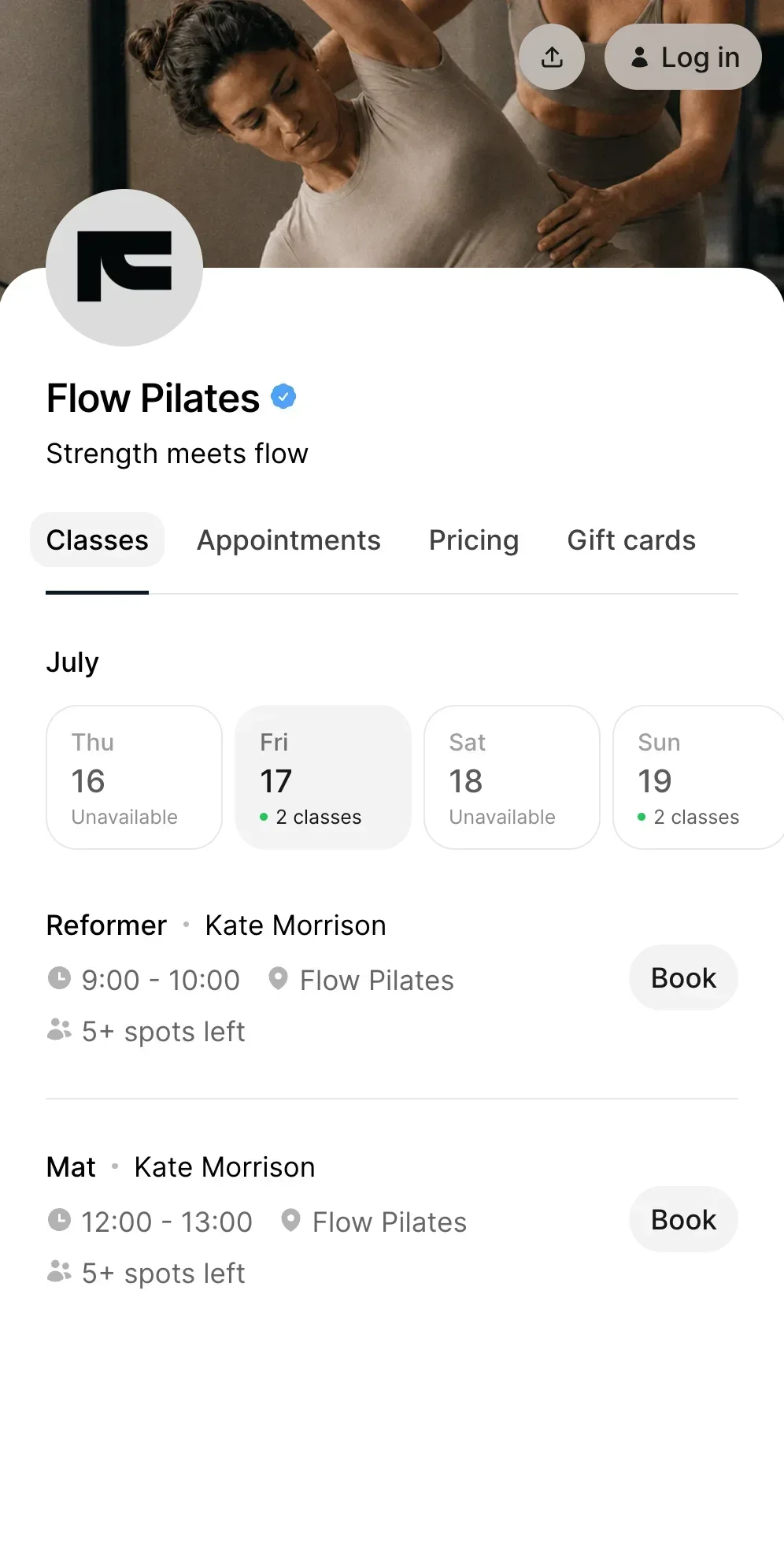
Manage bookings and payments easier
Get a free 7-day trial
No credit card required