Pilates Studio Profit Margin: What's a Good Margin in 2026?

Ignas Lunenas
Aug 31, 2026
11 min read

Running a busy Pilates studio does not automatically mean running a profitable one. A studio can have full evening classes, hundreds of active clients, and strong monthly revenue while still ending the year with surprisingly little profit after instructor pay, rent, equipment, software, payment fees, marketing, and other operating costs are deducted.
That is why Pilates studio profit margin is one of the most important numbers for owners to understand. Revenue tells you how much money enters the business, while profit margin shows how much of that revenue you actually keep.
As a practical target in 2026, a 15–20% net profit margin is healthy for an established Pilates studio, while 20% or more is strong. Studios above 25% are performing exceptionally well, although actual margins vary significantly depending on location, rent, staffing, pricing, class capacity, and how involved the owner is in day-to-day operations.
Time2book helps Pilates studios manage bookings, payments, memberships, class packs, clients, and business performance in one system, making it easier to see what is actually happening behind your revenue numbers.
Try Time2book free today and simplify your studio bookings, payments, and client management.
In this guide, we’ll break down what a good Pilates studio profit margin looks like in 2026, how to calculate yours, which expenses have the biggest impact, and what you can do to improve studio profitability.
What Is a Good Pilates Studio Profit Margin?
There is no single profit margin that every Pilates studio should achieve. A small owner-operated studio with six reformers has very different economics from a 16-reformer studio with a manager, front-desk staff, and several instructors.
Still, using broad margin ranges can help you understand where your studio sits financially.
Net profit margin | How to interpret it |
|---|---|
Below 5% | Very thin margin; small cost increases can create losses |
5–10% | Profitable, but with limited financial flexibility |
10–15% | Reasonable, particularly for a newer studio |
15–20% | Healthy Pilates studio profit margin |
20–25% | Strong profitability |
25%+ | Excellent performance with highly efficient operations |
A 20% margin should therefore be viewed as a strong target rather than an automatic industry average. Boutique fitness industry research has shown that studios reaching margins above 20% represent a smaller share of operators, while Pilates businesses tend to perform relatively well compared with several other boutique fitness categories.
The goal should also not be to maximize margin at the expense of everything else. A sustainable Pilates business still needs to pay instructors fairly, maintain equipment, invest in client experience, market the studio, and leave enough room for future growth.
How to Calculate Your Pilates Studio Profit Margin
The basic formula is: Net profit margin = Net profit ÷ Revenue × 100
For example, imagine your Pilates studio generates $500,000 in annual revenue and has $80,000 left in net profit after operating expenses.
Your calculation would be: $80,000 ÷ $500,000 × 100 = 16%
That means the studio keeps approximately $0.16 in profit for every $1 of revenue generated.
Pilates Studio Profit Margin Example
Here is a simplified example of what an established Pilates studio’s annual numbers could look like:
Category | Annual amount | % of revenue |
|---|---|---|
Revenue | $480,000 | 100% |
Instructor payroll | $150,000 | 31.3% |
Rent and occupancy | $84,000 | 17.5% |
Management/admin | $54,000 | 11.3% |
Marketing | $24,000 | 5.0% |
Software/payment costs | $18,000 | 3.8% |
Utilities, insurance, cleaning and maintenance | $42,000 | 8.8% |
Other expenses | $24,000 | 5.0% |
Profit | $84,000 | 17.5% |
In this example, the studio has a 17.5% net profit margin, which would generally be considered healthy.
The exact expense mix will vary from one studio to another. A central London reformer studio might spend far more on rent, while an owner-operated studio in a smaller city may have much lower occupancy costs but higher marketing expenses while building demand.
Pilates Studio Revenue vs. Profit
One of the most common mistakes when discussing Pilates studio profitability is confusing revenue with profit.
If a studio generates $500,000 in annual sales, that does not mean the owner makes $500,000. The revenue first needs to cover instructor wages, rent, equipment, utilities, insurance, booking software, payment processing, marketing, cleaning, accounting, and other operating expenses.
Only what remains after those costs represents business profit.
This becomes especially important when comparing your studio with larger Pilates businesses or franchise locations. A studio reporting $800,000 or $1 million in annual revenue may sound extremely profitable, but that number tells you very little without knowing payroll, rent, franchise fees, equipment financing, management salaries, marketing costs, and other expenses.
For that reason, always compare profit with profit, not your profit with another studio’s revenue.
Owner Salary vs. Pilates Studio Profit
Owner involvement can also make Pilates studio margins difficult to compare.
Imagine two studios each report $100,000 in annual profit. At the first studio, the owner works 50 hours per week, manages the business, teaches 20 classes, handles client questions, and does not pay themselves a formal salary. At the second studio, instructors and a studio manager handle daily operations while the owner works only a few hours per week.
The reported profit is the same, but the businesses are clearly not producing the same economic return.
For a more accurate picture of your studio’s profitability, assign a realistic cost to the work you perform. If you teach classes, estimate what another qualified instructor would need to be paid. If you manage the studio full time, include the salary you would need to offer someone else to take over that role.
Once owner labor is accounted for, the remaining profit gives you a much clearer picture of whether the studio itself is financially strong.
What Are the Biggest Pilates Studio Expenses?
Most Pilates studios have dozens of small expenses, but profitability is usually determined by a few major cost categories. Instructor payroll, rent, equipment, marketing, and administration typically have the greatest influence on the final margin.
Understanding these costs individually makes it easier to see where profitability is being lost.
Instructor Payroll
For many studios, instructor payroll is the largest operating expense. However, instructor cost cannot be judged properly without also looking at class attendance.
Imagine an eight-reformer class where the average realized revenue is $30 per client. With seven clients attending, the class generates $210 in revenue, and a $50 instructor payment represents about 24% of class revenue.
If only three clients attend, the same class generates just $90, while the same $50 instructor payment now represents more than half of the revenue. Rent, utilities, equipment costs, software, and administration still need to be covered from what remains.
This is why low class occupancy can damage Pilates studio profit margins even when instructor compensation itself is completely reasonable.
If you are reviewing instructor costs, our guide to Pilates instructor pay covers common compensation structures and how much studios should consider paying instructors.
Rent and Studio Space
Rent is another major fixed expense because it does not decrease when classes are quiet. Whether a Monday afternoon class has two clients or eight, the lease still costs the same amount that month.
This means studio owners should be careful about choosing space based on maximum potential capacity. A large, beautiful studio can support a premium brand, but it can also become a financial burden if demand takes longer than expected to develop.
A smaller studio with strong occupancy can often be more profitable than a larger studio with more reformers but significant unused capacity.
Pilates Equipment
Reformer studios also face equipment costs that mat-based fitness businesses may not have. Reformers, chairs, towers, props, replacement parts, servicing, and equipment financing can all affect profitability.
The key question is whether each additional piece of equipment creates enough additional revenue to justify its cost. Buying two more reformers only improves the economics of the studio if there is enough demand to consistently fill those additional spaces.
Marketing
Marketing should be measured by the clients and revenue it produces, not simply by clicks, impressions, or social media activity.
For example, spending $100 to acquire a client who purchases one $25 class is unlikely to be sustainable. Spending the same $100 to acquire a client who stays on a $180 monthly membership for two years creates very different economics.
The more accurately you understand client acquisition cost and client lifetime value, the easier it becomes to decide how much the studio can afford to spend on growth.
Software, Payments and Administration
Booking software and payment processing are usually much smaller expenses than payroll or rent, but inefficient systems can create hidden administrative costs.
If staff spend hours each week manually managing bookings, answering membership questions, fixing payment issues, moving clients between classes, or maintaining spreadsheets, administration becomes another payroll expense.
Time2book combines Pilates studio scheduling, payments, memberships, class packs, client management, and analytics in one system, helping studios reduce manual work while keeping important business data together.
Class Occupancy Has a Major Impact on Pilates Studio Profitability
For a reformer Pilates studio, class occupancy is one of the most important profitability metrics to track.
The calculation is simple:
Class occupancy = Booked spaces ÷ Available spaces × 100
For an eight-reformer studio, occupancy would look like this:
Average attendance | Occupancy |
|---|---|
3 clients | 37.5% |
4 clients | 50% |
5 clients | 62.5% |
6 clients | 75% |
7 clients | 87.5% |
8 clients | 100% |
The difference between five and seven clients can dramatically improve class economics because many operating costs remain almost identical. You still need one instructor, the same room, the same reformers, similar heating and electricity, and the same booking infrastructure.
That means increasing attendance inside existing classes is often much more profitable than simply adding more classes to the timetable.
Before expanding your schedule, check whether your current timetable is being used efficiently. If several sessions regularly run below half capacity, adding more classes may spread existing demand across even more time slots and reduce overall profitability.
Know Your Average Revenue Per Pilates Visit
Studio owners often look at their advertised drop-in price when estimating class revenue. In reality, clients may be attending through memberships, class packs, intro offers, discounts, promotions, or unlimited plans.
That means the advertised price may be very different from the average revenue actually generated per visit.
For example, your drop-in price may be $35, but after memberships and packages are taken into account, the studio might average only $27 for each attended session.
If an eight-reformer class averages six clients, that gives you:
6 clients × $27 = $162 average class revenue
If the instructor is paid $45, then $117 remains to contribute toward rent, equipment, payment fees, software, marketing, management, and profit.
Looking at your studio at the class level makes it much easier to understand whether profitability problems are being caused by low occupancy, low pricing, high instructor costs, or a combination of all three.
How to Improve Your Pilates Studio Profit Margin
Improving profitability does not always mean cutting expenses. For many studios, the biggest opportunities come from generating more revenue from the space, timetable, equipment, and client base they already have.
1. Fill Existing Classes Before Adding More
Adding another class creates another instructor cost and another time slot that needs to be filled. If several existing sessions are already running at 40–50% capacity, expanding the timetable may simply spread the same clients across more classes.
Before adding sessions, look for opportunities to consolidate weak time slots and direct demand toward stronger ones. Fuller classes generally create better economics and can also improve the energy and social experience for clients.
2. Increase Recurring Membership Revenue
Recurring memberships make revenue more predictable and reduce the need to constantly sell individual classes.
A common journey might look like:
Intro offer → class pack or starter membership → recurring higher-frequency membership
A strong membership structure also helps studios estimate future revenue more accurately, which makes staffing, marketing, and scheduling decisions easier.
3. Review Low-Demand Time Slots
Look at occupancy by day, time, instructor, and class type rather than judging the schedule as a whole.
A 6 p.m. class running at 95% capacity may be one of the most profitable sessions on your timetable. A 1 p.m. class averaging two clients may consistently lose money even if the instructor and clients enjoy having it available.
Sometimes removing or moving a low-demand session improves both margin and occupancy because demand becomes concentrated into fewer classes.
4. Raise Prices When Demand Supports It
If your strongest classes consistently sell out or have waitlists, your pricing may be too low for the level of demand.
Even a small increase can have a significant impact because many of your operating costs remain unchanged. For example, if your studio completes 1,500 visits each month and average realized revenue increases by just $2 per visit, that creates an additional $3,000 per month, or $36,000 per year in revenue.
If those visits were already happening, much of the additional revenue can flow directly toward improving your margin.
5. Improve Client Retention
Acquiring new clients is usually more expensive than retaining existing ones. A client who stays on a membership for 18 months is therefore considerably more valuable than someone who buys an intro offer and never returns.
Studios should pay close attention to the full client journey, from the first enquiry through onboarding, early attendance, membership conversion, regular bookings, and renewal.
Your intro offer should not simply generate cheap trial visits. It should be designed to help new clients build a routine and naturally move toward a longer-term membership.
6. Track Financial and Operational Numbers Every Month
A healthy bank balance does not tell you enough about the performance of your business.
At minimum, studio owners should regularly review:
- Total revenue
- Operating expenses
- Net profit
- Profit margin
- Number of bookings
- Average class occupancy
- Active clients
- Average revenue per visit
- Membership revenue
- Client retention
Time2book gives Pilates studios one place to track bookings, clients, payments, memberships, and business performance without having to maintain separate spreadsheets for every part of the business.
How Much Profit Can a Pilates Studio Make?
The amount of profit a Pilates studio can make depends on both revenue and margin.
Here is a simple comparison:
Annual studio revenue | 10% margin | 15% margin | 20% margin | 25% margin |
|---|---|---|---|---|
$250,000 | $25,000 | $37,500 | $50,000 | $62,500 |
$400,000 | $40,000 | $60,000 | $80,000 | $100,000 |
$500,000 | $50,000 | $75,000 | $100,000 | $125,000 |
$750,000 | $75,000 | $112,500 | $150,000 | $187,500 |
$1,000,000 | $100,000 | $150,000 | $200,000 | $250,000 |
This table also demonstrates why focusing only on revenue can be misleading.
A studio generating $750,000 at a 10% margin produces $75,000 in profit, while a smaller studio generating $500,000 at a 20% margin produces $100,000 in profit.
The smaller studio generates less revenue but creates a stronger financial result.
What Profit Margin Should a New Pilates Studio Target?
A newly opened Pilates studio should not expect to immediately operate at the same margin as an established studio with a loyal membership base.
During the first year, the business may need to absorb launch marketing, low initial occupancy, introductory discounts, staff training, equipment repayments, and instructor costs before classes become consistently full. The timetable itself may also need several months of experimentation before the owner understands which times and class types generate the strongest demand.
For that reason, reaching break-even can be a meaningful first milestone.
After the studio becomes established, a reasonable progression might be to move toward a 10–15% net margin, followed by 15–20% or higher as occupancy, recurring membership revenue, retention, and operational efficiency improve.
If you are still planning your studio, our Pilates Studio Business Plan guide can help you think through pricing, startup costs, equipment, memberships, operations, and financial projections before opening.
Frequently Asked Questions About Pilates Studio Profit Margins
What is a good profit margin for a Pilates studio?
A 15–20% net profit margin can be considered healthy for an established Pilates studio, while a margin above 20% is strong. Studios reaching 25% or more are performing exceptionally well, although the exact result depends on rent, payroll, pricing, occupancy, location, and owner involvement.
New studios may operate below these levels while building a client base and improving class utilization.
Are Pilates studios profitable?
Yes, Pilates studios can be profitable businesses, particularly when they combine premium pricing, strong class occupancy, recurring memberships, and good client retention.
However, reformer studios also have significant expenses including equipment, instructor payroll, rent, and maintenance. Profitability depends on how efficiently the studio converts its available class capacity into revenue.
How much profit does a Pilates studio make?
A studio generating $500,000 per year with a 15% net profit margin would produce approximately $75,000 in annual profit. At a 20% margin, the same studio would produce approximately $100,000.
Actual results vary significantly depending on revenue, payroll, rent, equipment costs, staffing, and other expenses.
What is the biggest expense for a Pilates studio?
Instructor payroll and rent are usually among the largest expenses for Pilates studios.
Which one is higher depends on the studio’s location, schedule, compensation model, and whether the owner teaches classes themselves. Reformer equipment can also be a significant startup and ongoing cost.
How can a Pilates studio increase its profit margin?
The most effective strategies usually include improving class occupancy, increasing average revenue per visit, building recurring membership revenue, improving client retention, reviewing prices, and removing consistently underperforming classes.
Studios should look for opportunities to generate more revenue from existing capacity before simply adding more classes or expanding the space.
Question
Answer
What class occupancy should a Pilates studio aim for?
There is no universal target, but classes consistently running below 50% capacity deserve closer analysis.
For an eight-reformer studio, increasing average attendance from four clients to six raises occupancy from 50% to 75%, while many of the costs associated with running the class remain almost identical.
Is a 20% Pilates studio profit margin good?
Yes. A 20% net profit margin is a strong result for a Pilates studio. It means the studio retains approximately $20 in profit from every $100 in revenue after operating expenses are paid.
Does the Pilates studio owner's salary count as profit?
Not necessarily. If the owner teaches classes, manages the studio, or performs administrative work, it is useful to assign a realistic cost to that labor before calculating true business profit. Otherwise, the studio may appear more profitable simply because the owner is doing unpaid work.
Final Thoughts: What Is a Healthy Pilates Studio Profit Margin?
For most established Pilates studios, a 15–20% net profit margin is a healthy target, while 20–25% represents strong profitability and anything above 25% is an excellent result.
A simple way to think about the ranges is:
- 10–15%: reasonable
- 15–20%: healthy
- 20–25%: strong
- 25%+: excellent
The most profitable Pilates studios are not necessarily the ones with the biggest spaces, most reformers, or busiest-looking schedules. Strong profitability usually comes from consistently filling available capacity, maintaining sensible pricing, controlling payroll and rent, retaining clients, and building predictable recurring membership revenue.
Studio owners should therefore track both financial and operational numbers rather than focusing only on total revenue. Class occupancy, average revenue per visit, instructor cost, retention, recurring revenue, and profit margin together provide a much clearer picture of how healthy the business really is.
Time2book helps Pilates studios manage classes, bookings, payments, memberships, class packs, clients, and analytics in one modern system.
Try Time2book free today and simplify your studio bookings, payments, and client management.
Pilates studio software
Learn more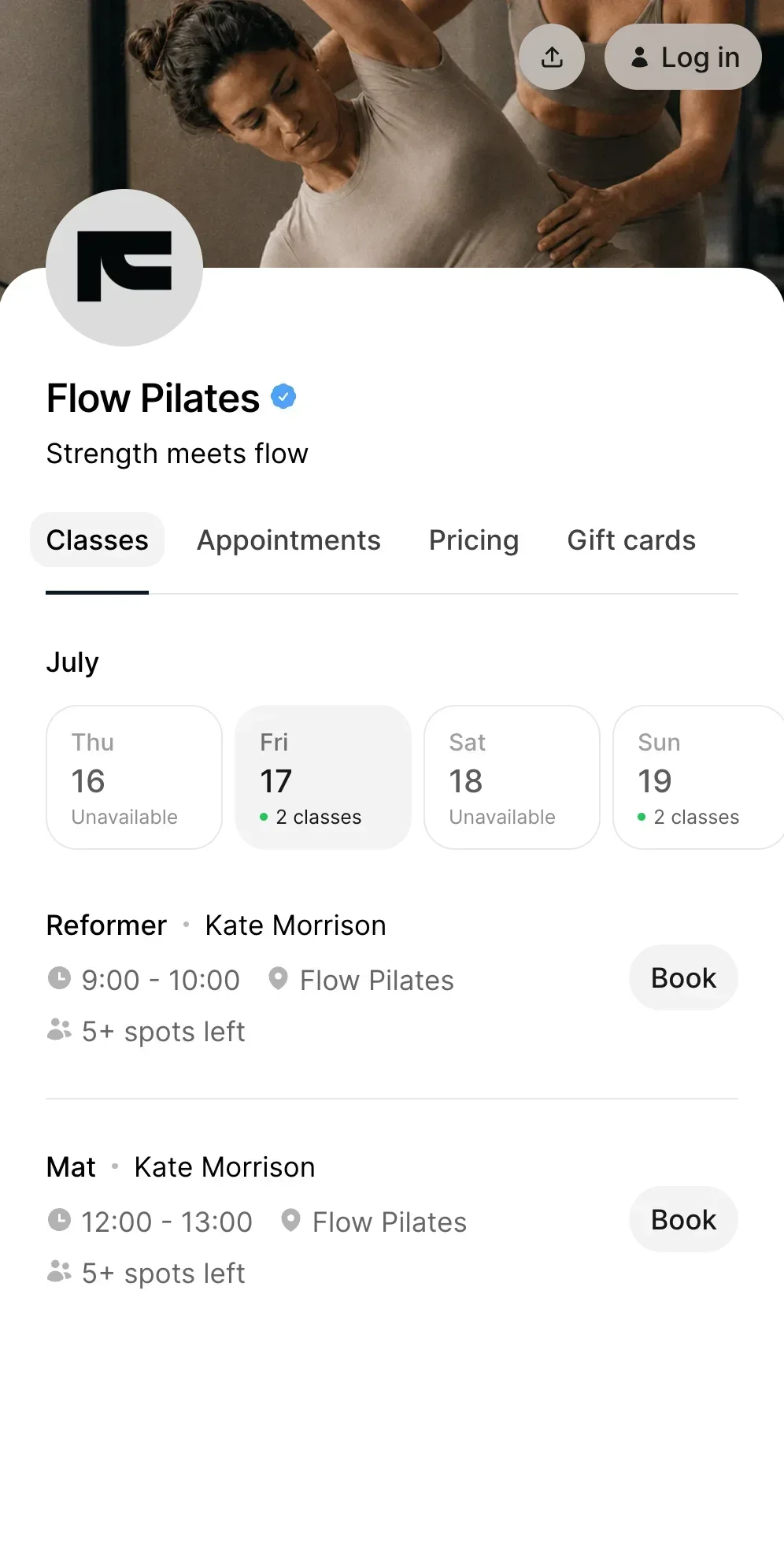
Manage bookings and payments easier
Get a free 7-day trial
No credit card required