Dance studio pricing is more than choosing a number for a drop-in class. A children's dance school may sell a reserved place for a full season, while an adult studio may sell flexible class packs, monthly memberships, private lessons, and workshops. Each offer has different costs and attendance patterns.
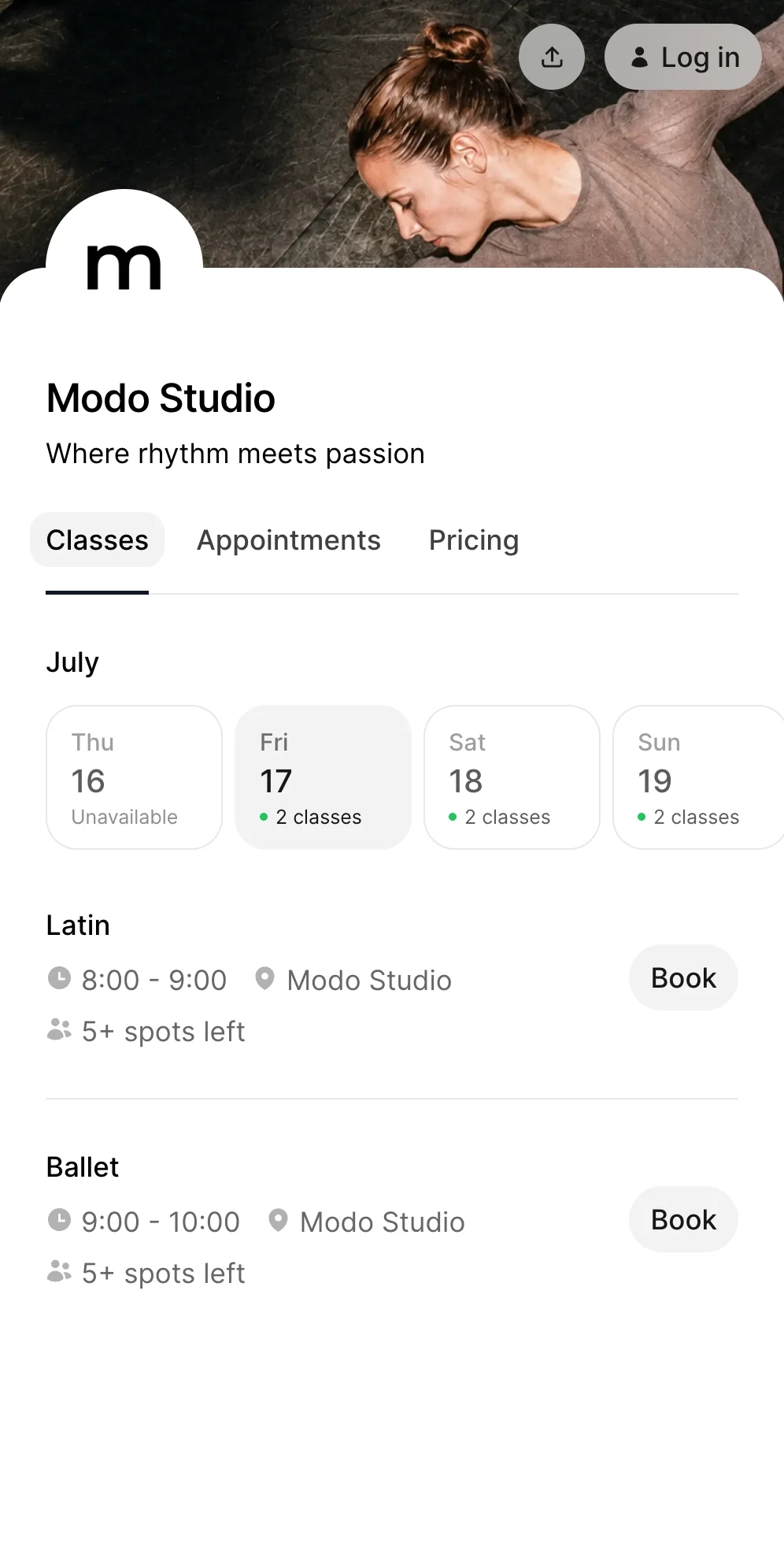
The right price needs to cover instruction, space, administration, payment costs, and the owner's work at a realistic enrollment level. It also needs to be easy for students and parents to understand before they book. Time2book's dance studio software lets studios present individual classes, memberships, and packs together, so the pricing structure can follow the way the studio actually teaches.
In this guide, we'll break down dance studio pricing in 2026, show published rates from real studios, and calculate what you should charge for your own classes. If you already know your prices, you can set up dance class bookings and plans with Time2book.
Dance Studio Pricing in 2026: A Quick Answer
For a weekly recreational class, several published US studio rate cards show roughly $60–$100 per month for one class per week. For open adult classes, the observed examples here range from a €15 drop-in in Vilnius to a $25 drop-in in New York. These are examples from different markets, currencies, class lengths, and studio models, not a global average or a recommended price for your location.
Your starting point should be the price required at your expected paid attendance. Compare that figure with three to five genuinely comparable local studios. Then choose a simple pricing structure for your audience:
| Studio offer | Common way to charge | What the customer buys |
|---|---|---|
| Children's weekly program | Seasonal tuition paid monthly or by term | A recurring place in a scheduled class |
| Open adult classes | Drop-in, class pack, or limited membership | Flexibility across a timetable |
| Beginner course | Fixed fee for a four- to eight-week block | A progressive course with a defined start and end |
| Private lesson | Per session or short package | Dedicated teaching and studio time |
| Workshop or intensive | Per event | A longer or specialist experience |
| Competition program | Tuition plus clearly disclosed additional fees | Training and program participation |
A useful rule: calculate your price floor first, choose the payment model second, and publish the full cost clearly. A lower price that fills a room can work; a low price based on every class being full can create a loss.
What Do Dance Studios Actually Charge?
Published rate cards are useful reality checks, but they should not replace a local competitor review. For example, Northern Force Dance lists $62 per month over ten payments for a weekly 45-minute class in its 2026–27 schedule. Empire Dance Center lists $80 per month for one weekly class, $144 for two, and a $25 single-class rate. Define Dance & Arts lists $80 for a weekly 30-minute class, $90 for 45 minutes, and $100 for 60 minutes. These are published US prices, not a representative sample of all US studios.
For adult drop-ins, Steps on Broadway lists $25 for a single in-studio class and $220 for a ten-class series, or $22 per class. In Vilnius, SKILLZ Dance Studio's published pricing lists a €15 drop-in and monthly plans of €80, €135, and €180 for different amounts of access. Those two markets should not be averaged together.
UK and Canadian examples show why currency and program format matter. The City Dance Academy lists £41.75 per month for a weekly 30- to 45-minute children's class in 2026–27, and £55 for a 60-minute private lesson. Bella Dance Academy lists CAD $59, $73, and $82 per month plus GST for weekly 30-, 45-, and 60-minute classes in its 2026–27 season. Both describe a season-based tuition model rather than four identical weekly purchases every month.
When gathering your own benchmarks, record the age group, duration, weekly frequency, teacher-to-student ratio, location, commitment, and extra fees beside each price. A $25 open class in a major city and a $62 monthly children's class in a suburban school answer different pricing questions.
How to Price Dance Classes: Calculate Your Floor
1. Add the full cost of running a class
Include the instructor's pay, employer costs where applicable, room hire or allocated rent, utilities, administration, software, insurance allocation, marketing, and supplies. If you teach the class yourself, assign a teaching wage to your time. Owner pay cannot be treated as free labor just because it does not appear on a payroll report.
Separate fixed costs per class from variable costs per student. Rent and instructor pay are usually fixed for a scheduled session; payment processing or materials may rise with each booking. Allocate shared costs consistently, such as by total teaching hours or usable room hours, so the same rent is not accidentally counted twice.
2. Use expected paid attendance, not maximum capacity
Suppose a 60-minute class has 15 places and the following illustrative costs:
| Cost | Amount per class |
|---|---|
| Instructor pay | $55 |
| Room and utilities allocation | $25 |
| Admin, software, and other overhead allocation | $10 |
| Fixed cost | $90 |
| Variable cost per paid student | $2 |
At ten paid students, the break-even realized price is ($90 ÷ 10) + $2 = $11 per student. At eight students, it is ($90 ÷ 8) + $2 = $13.25. The 15-place room is irrelevant to the floor unless you can consistently fill those places.
If you want a 20% operating margin on revenue from this class, use:
Required realized price per student = (fixed cost ÷ expected paid students + variable cost per student) ÷ (1 − target margin)
That produces $13.75 at ten paid students or about $16.57 at eight. This is a planning calculation, not an industry benchmark. It assumes the allocated costs above include the relevant work and that paid attendance and revenue are measured on the same class.
3. Check the price customers actually pay per visit
A posted $20 drop-in does not mean every participant produces $20. A five-class pack at $85 yields $17 per redeemed class. An eight-class monthly plan at $120 yields $15 per class if all eight are used. For a weekly youth class priced at $80 per month over ten payment months and 36 teaching weeks, the scheduled-session equivalent is $800 ÷ 36 = $22.22 per class, before missed sessions or extra charges.
For an existing studio, divide revenue attributable to the class by the paid or redeemed visits that generated it, and keep season tuition and open-class packs separate. Check processing fees, refunds, unused credits, and taxes using your own records. A student who misses a tuition class may still have paid for their reserved place; an unused pack credit may create a future service obligation under your terms and local rules.
4. Compare your result with the local market
Look at at least three to five nearby offers serving the same customer and class format. Record their visible price and the total the customer will pay across the season. If your required price is well above those offers, investigate your occupancy, timetable, class size, rent, and positioning before discounting. If it is below the market, you have room to improve the experience or protect margin.
Choose the Right Dance Studio Pricing Model
Monthly tuition for children's dance classes
Tuition is a natural fit when a child keeps the same place in ballet, jazz, tap, or hip-hop throughout a season. You can set an annual or term price and split it into predictable monthly payments. This is why a five-Monday month does not necessarily cost more than a four-Monday month: the payments can be installments toward a season total.
Publish the number of teaching weeks, payment dates, holiday treatment, joining policy, withdrawal notice, and what happens after an absence. Define Dance & Arts explicitly says its annual tuition is divided into equal monthly installments; Fringe Dance Studio explains that its monthly price does not change with the number of classes in a month. Those explanations prevent confusion at checkout.
Drop-ins and class packs for adult dance studios
Open adult timetables benefit from a visible single-class price for new students and irregular attendees. Packs lower the per-class price for repeat visits without requiring an ongoing subscription. Put an expiration date, included class types, transfer rules, and cancellation window next to the pack price.
For example, a studio might test $20 for a drop-in, $85 for five classes, and $150 for ten. Those figures are an illustrative ladder, not market data. The effective prices are $20, $17, and $15 per class. Check the expected mix of purchases against your $13.75 or $16.57 planning floor before publishing the offer.
Limited memberships before unlimited access
A four- or eight-class monthly membership gives frequent students a predictable routine and lets the studio forecast demand. Unlimited access can make sense when there is sufficient schedule capacity, but its economics depend on how often members attend and whether their visits displace full-price bookings.
At $150 per month, an unlimited member attending ten times produces $15 per visit; at 15 visits, only $10. Estimate visits from actual member behavior, then set booking and cancellation rules that protect scarce places. You can also restrict the plan to particular class types or locations where that matches the promise you make to members.
Term courses, private lessons, and workshops
A progressive beginner course is often easier to sell as a fixed block: customers know the dates, learning goal, and total price. A private lesson should cover teaching time, preparation, room use, booking gaps, and any specialist choreography. A workshop should cover guest-instructor fees, marketing, extra staffing, and a realistic minimum attendance.
If an event needs $360 in fixed costs plus $5 per participant, it breaks even at $41 per person with ten paid attendees. At a 20% margin on revenue, the calculated price is ($360 ÷ 10 + $5) ÷ 0.8 = $51.25. Price from that threshold and your audience, rather than using a regular 60-minute class as the only comparison.
An Example Dance Studio Pricing Structure
Here is a starting structure for a studio that teaches recurring children's classes and flexible adult classes. Every number below is illustrative and needs a local cost and demand check.
| Offer | Example price | Effective price or explanation |
|---|---|---|
| Youth class, once weekly | $80/month for ten payments | $800 for the season; about $22.22 per class if 36 sessions run |
| Youth class, twice weekly | $144/month for ten payments | $1,440 for the season; $20 per class if 72 sessions run |
| Adult drop-in | $20 | One eligible class |
| Adult five-class pack | $85 | $17 per redeemed class if all five are used |
| Adult eight-class monthly plan | $120/month | $15 per class if all eight are used |
| 60-minute private lesson | $70 | One instructor and one room for one booking |
| Two-hour guest workshop | $55 | One scheduled event; validate minimum attendance |
Do not force every program into one pricing menu. Youth tuition sells continuity and a reserved place; adult packs sell flexibility. The prices should still form a coherent ladder: a committed student should understand the benefit of committing, while a casual student should understand the flexibility premium.
Before publishing, calculate whether discounts stack. A 10% sibling discount plus a 15% multi-class discount applied to an $80 class creates a different result depending on the order and eligibility rules. Write one rule in plain language, show the final amount at checkout, and check the margin on your most discounted family.
Fees, Discounts, and Policies That Affect the Real Price
Dance studio tuition often sits alongside registration, costumes, recitals, competitions, exams, and private coaching. If these are required, families need an estimate of the full season cost, including when each charge is due. Northern Force Dance publishes separate competition and costume charges alongside tuition. The City Dance Academy lists its annual registration fee and private lesson prices separately.
A useful pricing page makes these items clear:
- What's included: class duration, weekly frequency, program dates, and any performance opportunities.
- What's extra: registration, costume, recital, competition, exam, and transaction charges where applicable.
- When payment happens: monthly billing date, term payment deadline, and late-join treatment.
- What happens when a class is missed: make-up availability, credit rules, and how to request one.
- How plans end: notice periods, renewals, pack expiration, and any limits on refunds, in line with applicable local requirements.
Discounts can support enrollment when they encourage additional classes or siblings, but assess them against the incremental cost of the extra place. Filling a spare spot for less may be worthwhile; discounting a class with a waitlist may simply reduce revenue. Keep special offers time-bound and measure whether trial students later buy a full-price plan.
When and How to Raise Dance Class Prices
Review prices before each season and after a material change in rent, instructor pay, capacity, or demand. Look at occupancy by class and time slot, gross revenue per scheduled class, realized revenue per redeemed visit, instructor cost as a share of class revenue, retention, and the share of families using discounts.
If a class is consistently full, test a modest increase for new enrollments or the next season and watch conversion. If a class is half empty, a price increase alone may not solve the problem; changing its time or combining groups may have a larger effect. Compare revenue and contribution across your whole schedule, since popular classes may subsidize less popular ones.
Tell customers the new amount, effective date, reason, and options. For a season program, give notice before re-enrollment and show the full season cost. For an ongoing adult membership, state when the new recurring amount begins and how members can change plans. Avoid framing an annual increase as an emergency: a clear, predictable review is easier to understand.
Time2book can help you publish class prices and eligible plans, take online payments, track plan usage, and see bookings and revenue in one place. That makes it easier to compare your intended price with what students actually buy and use. For a practical setup walkthrough, see how to set up recurring payments for a dance studio.
Frequently Asked Questions About Dance Studio Pricing
There is no universal per-class rate. Published examples include $25 for an open class at Steps on Broadway in New York and €15 for a drop-in at SKILLZ Dance Studio in Vilnius. Start with your fixed class cost, variable cost per student, expected paid attendance, and target margin; then check comparable local studios.
Several published US rate cards in this guide list roughly $60–$100 per month for one weekly recreational class, with substantial variation by duration and market. Calculate a season price from your costs and planned teaching weeks, then state how many monthly payments families will make and which additional fees apply.
Monthly or term tuition suits reserved weekly places in a children's program. Per-class pricing suits flexible adult drop-ins, while packs and limited monthly memberships suit returning adult students. A mixed studio can use more than one model as long as each plan's included classes and terms are clear.
Divide fixed cost per session by expected paid students, then add variable cost per student. For example, $90 in fixed costs, $2 per student, and ten paid students gives an $11 break-even price per student. To include a target operating margin, divide that amount by one minus the margin rate.
Set a drop-in anchor, offer a modest per-class discount for a pack, and check the realized price if every credit is used. State how many classes are included, which sessions are eligible, when the pack expires, and what happens after a late cancellation. Check that the discounted price still covers costs at realistic attendance.
It can work when your schedule has enough capacity and member visit frequency is predictable. Divide the monthly fee by the expected number of visits, then check that amount against your costs and the value of seats a member may occupy. A limited four- or eight-class membership is often easier to forecast when capacity is tight.
A studio can itemize these costs, but required charges should be visible before enrollment. Show the expected full-season cost and due dates so families can compare offers fairly. Keep the purpose of each fee clear and follow applicable local consumer and tax rules.
Build Prices That Work for Your Studio
Good dance studio pricing combines a cost-based floor, evidence from comparable local offers, and a payment model that suits your students. Keep the public menu short, explain the full cost, and revisit the numbers as enrollment and attendance change.
Time2book helps you run classes, private lessons, memberships, packs, bookings, payments, and client management from one place. Try Time2book free today and simplify your studio bookings, payments, and client management.