Running the same weekly timetable is great for consistency, but workshops give your dance studio something different to promote. A well-planned workshop can bring new people through the door, give existing students a reason to attend more often, introduce new dance styles, and create additional revenue without permanently changing your schedule.
The best dance workshop ideas do more than fill an empty Saturday afternoon. They can help students improve specific skills, introduce beginners to your studio, create excitement around a guest instructor, or turn quieter periods into profitable events.
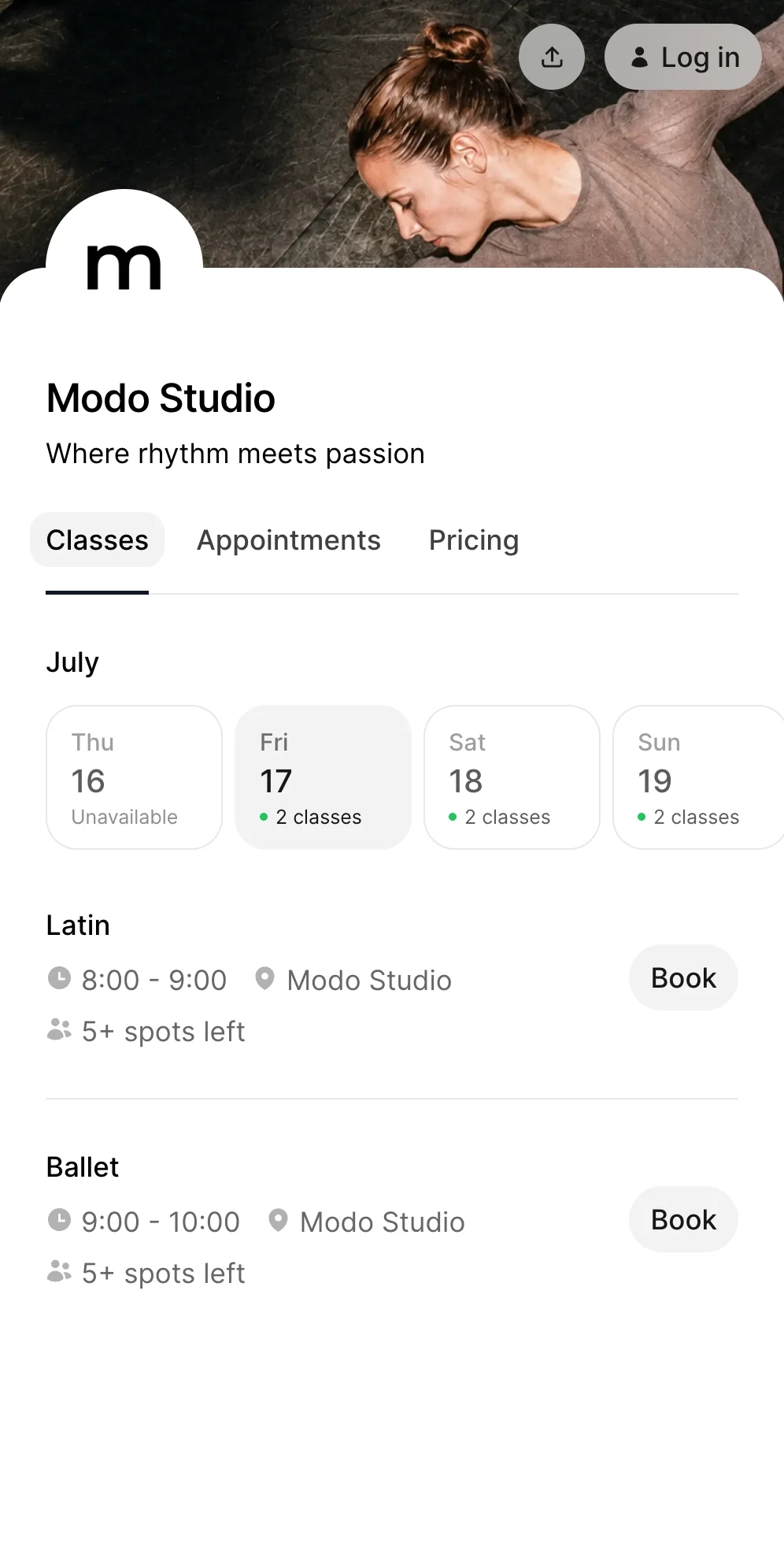
With a platform like Time2book, dance studios can create workshops as bookable classes, set capacity limits, take payments online, manage students, and keep regular classes and special events in the same schedule.
Whether you run a ballet school, contemporary studio, hip-hop academy, ballroom school, or multi-style dance studio, here are 30 dance workshop ideas for 2026 that you can adapt to your audience.
30 Dance Workshop Ideas at a Glance
| Dance workshop idea | Best for | Main goal |
|---|---|---|
| Beginner dance workshop | New dancers | New clients |
| Choreography workshop | All levels | Engagement |
| Guest instructor masterclass | Intermediate–advanced | Revenue + visibility |
| Technique intensive | Existing students | Skill development |
| Flexibility workshop | All dancers | Add-on revenue |
| Turns and pirouettes | Ballet, jazz, contemporary | Technique |
| Jumps and leaps | Intermediate dancers | Technique |
| Floorwork workshop | Contemporary dancers | Skill development |
| Musicality workshop | All styles | Performance |
| Improvisation workshop | Contemporary, jazz | Creativity |
| Commercial dance workshop | Teens and adults | New audience |
| Heels dance workshop | Adults | New clients |
| Hip-hop fundamentals | Beginners | Acquisition |
| Ballet for adults | Adult beginners | New clients |
| Contemporary dance workshop | Teens and adults | Acquisition |
| Partner dance workshop | Adults | Community |
| Musical theatre workshop | Kids, teens, adults | Engagement |
| Dance conditioning workshop | Serious dancers | Skill development |
| Audition preparation | Teens and professionals | Premium workshop |
| Performance workshop | Existing students | Confidence |
| Parent and child dance | Families | New audience |
| Kids holiday workshop | Children | Seasonal revenue |
| Dance camp | Kids and teens | Revenue |
| TikTok choreography workshop | Teens | Awareness |
| Wedding dance workshop | Adults | New service |
| Dance photography workshop | Teens and adults | Community |
| Choreography creation lab | Advanced dancers | Creativity |
| Teacher training workshop | Instructors | Premium revenue |
| Open studio sampler | New students | Lead generation |
| Dance style weekend | All levels | Revenue + retention |
Technique-Focused Dance Workshop Ideas
Technique workshops are particularly useful because they complement regular classes rather than compete with them. Instead of teaching an entire dance style, you can spend 60–120 minutes focusing on one skill students want to improve.
1. Beginner Dance Workshop
Create a completely beginner-friendly workshop for people who have always wanted to dance but feel uncomfortable joining an established class.
Keep the choreography simple, explain basic terminology, and make it clear in your marketing that no previous dance experience is required. This can work especially well as an introduction to ballet, hip-hop, contemporary, jazz, salsa, or commercial dance.
At the end, offer attendees an introductory class pack or membership so the workshop becomes a pathway into your regular timetable.
2. Choreography Workshop
A choreography workshop is one of the easiest special events to add to almost any dance studio.
Choose one song and teach a complete routine during a 90-minute or two-hour session. Instead of spending weeks developing the choreography, students leave feeling like they have learned something complete.
You can also film the final run-through for students who want content to share on Instagram or TikTok.
3. Guest Instructor Masterclass
Invite a respected local dancer, choreographer, performer, or teacher to lead a one-off workshop.
Guest workshops can attract dancers who do not normally attend your studio while giving current members access to a different teaching style. They can also justify a higher ticket price than a normal class.
Promote the instructor's background clearly and encourage both your studio and the guest teacher to share the event with their audiences.
4. Technique Intensive
Instead of covering one choreography, dedicate two or three hours to improving core technique.
Your intensive could focus on ballet fundamentals, contemporary technique, jazz technique, hip-hop foundations, ballroom technique, or another style your studio specializes in.
For serious students, you could turn this into a half-day or multi-day intensive during school holidays.
5. Flexibility Workshop
Flexibility is relevant across many dance disciplines, which makes this workshop suitable even for studios offering several different styles.
Cover safe stretching techniques, active flexibility, mobility, splits, hip flexibility, shoulder mobility, and routines students can continue at home.
Keep the focus on progressive movement rather than promising extreme flexibility results in one session.
6. Turns and Pirouettes Workshop
Build an entire workshop around turns.
Students can work on spotting, balance, preparation, body alignment, single and multiple turns, pirouettes, chainé turns, and combinations depending on their level.
You can run separate beginner and advanced sessions so students are training alongside dancers with similar experience.
7. Jumps and Leaps Workshop
Leaps look impressive, but many students rarely get enough time to break them down during normal classes.
Use a dedicated workshop to focus on take-off technique, landing, strength, flexibility, timing, and common jumps used within your dance style.
This works particularly well for ballet, jazz, contemporary, lyrical, and competition dance students.
8. Contemporary Floorwork Workshop
Teach dancers how to move smoothly between standing and floor-based movement.
A floorwork workshop can include weight transfer, rolling, slides, spirals, transitions, momentum, and short combinations.
Floorwork and movement-quality workshops are also common within current contemporary intensives, making this a natural format for studios wanting to offer more specialized training.
9. Musicality Workshop
Instead of focusing primarily on choreography, teach students how to understand and respond to music.
Explore rhythm, accents, tempo changes, pauses, different layers within a track, and how the same choreography can feel completely different depending on interpretation.
This can be valuable for dancers who know the movements technically but want to become more expressive performers.
10. Improvisation Workshop
Improvisation helps students become more comfortable creating movement rather than simply copying choreography.
Use prompts involving speed, direction, levels, emotions, space, shapes, music, or interaction with other dancers. The goal is not necessarily to produce polished choreography but to help dancers become more confident making creative decisions.
Dance Workshop Ideas for Adults and Teens
Workshops can also help your studio reach audiences who may not want to commit to a weekly dance class immediately.
11. Commercial Dance Workshop
Create a commercial choreography session inspired by the movement commonly seen in music videos, concerts, and live performances.
This format can be especially appealing to teenagers and young adults. Use current music, make the session energetic, and consider filming the completed choreography at the end.
12. Heels Dance Workshop
An introductory heels workshop can attract an adult audience that may not currently take traditional dance classes.
Cover walking technique, balance, posture, basic movement, confidence, and choreography. Clearly state the recommended footwear and experience level before participants book.
You could eventually turn a successful one-off workshop into a recurring course.
13. Hip-Hop Fundamentals Workshop
Many adults want to try hip-hop but may feel intimidated joining an established class.
Create a fundamentals workshop covering basic grooves, rhythm, bounce, foundational movements, and a simple combination.
Marketing it specifically as “Hip-Hop for Complete Beginners” can remove much of the anxiety associated with trying a new style.
14. Adult Beginner Ballet Workshop
Adult ballet has a different audience from traditional children's ballet programs.
Design a welcoming session that introduces positions, basic barre work, posture, terminology, and simple centre exercises without assuming previous training.
Consider running it monthly if there is enough demand and using it as an entry point into a regular adult ballet program.
15. Contemporary Dance Workshop
Run an open-level contemporary workshop combining technique, movement exploration, and choreography.
You can offer different versions throughout the year with different themes or instructors. Contemporary workshops can also work particularly well as longer intensives because students have more time to explore movement rather than simply memorize combinations.
16. Partner Dance Workshop
Host a beginner-friendly session for couples, friends, or individuals who want to learn partner dancing.
Depending on your instructors, this could focus on salsa, bachata, ballroom, swing, tango, or general partner movement.
Allowing people to attend without bringing a partner can make the event accessible to a much larger audience.
17. Musical Theatre Dance Workshop
Combine dancing with performance and storytelling.
Choose choreography inspired by a musical and spend time working on character, facial expression, movement, and stage presence.
You could collaborate with a vocal coach or acting teacher to turn it into a broader musical theatre workshop.
18. Dance Conditioning Workshop
Create a workshop specifically around the physical requirements of dancing.
Cover strength, core stability, balance, mobility, endurance, and exercises that support common dance movements.
This can work as a recurring monthly workshop or as part of an intensive program for more advanced students.
19. Audition Preparation Workshop
Help students prepare for dance school, company, university, performance, or commercial auditions.
Cover learning choreography quickly, entering the room confidently, performing in small groups, improvisation, presentation, and handling mistakes.
You could also include mock auditions so dancers experience the pressure of an audition environment before attending a real one.
20. Performance Skills Workshop
Some technically strong dancers struggle once they need to perform in front of an audience.
Create a workshop around stage presence, confidence, projection, facial expression, musical interpretation, eye line, and performing choreography rather than simply executing it.
Film dancers before and after exercises so they can see how small performance changes affect the overall result.
Creative and Community Dance Workshop Ideas
Not every workshop needs to focus on serious technical training. Some of the best events exist primarily to bring people together and give students a new experience.
21. Parent and Child Dance Workshop
Invite parents or caregivers to dance with their children.
Keep the movement accessible and focus on coordination, music, creativity, and having fun together rather than formal technique. Parent-and-child formats can introduce completely new families to your studio while also creating an easy-to-share community event.
Current 2026 open dance programs include dedicated child-and-caregiver sessions alongside traditional workshops, showing how broad the workshop format can be.
22. Kids Holiday Dance Workshop
Run special sessions during summer, Easter, winter, or school holidays.
Combine dancing with games, creative movement, choreography, and a small performance for parents at the end.
For working parents, a three-hour or half-day format can be particularly useful while creating additional daytime revenue for your studio.
23. Dance Camp
Take the holiday-workshop idea further with a multi-day dance camp.
Each day can combine several styles such as ballet, jazz, contemporary, hip-hop, conditioning, improvisation, and choreography. Multi-style formats are already widely used by dance intensives because they give dancers variety within one program.
Sell the complete camp rather than requiring students to book every individual class.
24. TikTok Choreography Workshop
Create a social, low-pressure workshop built around learning short choreography suitable for vertical video.
The purpose does not have to be producing viral content. Instead, use the format to reach younger dancers, introduce new people to your studio, and create something participants can film together at the end.
Always make filming optional, particularly when working with younger students.
25. Wedding Dance Workshop
Instead of only selling private wedding choreography, try running a group wedding dance workshop.
Couples can learn basic movement, simple turns, how to move comfortably together, and a few adaptable combinations for their first dance.
Participants who want personalized choreography can then upgrade to private lessons.
26. Dance Photography Workshop
Partner with a local photographer to teach dancers how to create strong dance photographs.
You can cover poses, lines, movement photography, preparation, and how choreography translates to still images.
Include several professional photos in the ticket price or offer optional photo packages afterward.
27. Choreography Creation Lab
Instead of teaching your own choreography, let students create theirs.
Start with improvisation and movement-generation exercises before asking individuals or small groups to create short pieces.
At the end, everyone can share their work in an informal studio showing. This format is particularly suitable for advanced teenagers, adults, and aspiring choreographers.
Dance Workshop Ideas That Can Generate Additional Revenue
Workshops can become a meaningful revenue stream when they serve a clear audience rather than simply adding more classes to the timetable.
28. Dance Teacher Training Workshop
Your customers do not always have to be students.
If your studio has experienced instructors, offer workshops for other dance teachers covering lesson planning, teaching children, choreography, class structure, injury prevention, cueing, student retention, or running group classes.
Because this is professional development rather than a recreational class, the price can be considerably higher than your normal drop-in rate.
29. Open Studio Dance Sampler
Run several short classes in one afternoon and let prospective students try different styles.
For example:
- 20 minutes of ballet
- 20 minutes of contemporary
- 20 minutes of hip-hop
- 20 minutes of jazz
- 20 minutes of commercial dance
Charge a small fee or make the event free as a lead-generation activity. Have your memberships, class packs, and introductory offers ready so interested participants can continue immediately.
30. Dance Style Weekend
Create a complete weekend around one dance style or theme.
A contemporary weekend, for example, could include technique on Saturday morning, floorwork in the afternoon, and choreography on Sunday. A ballet weekend could combine technique, turns, repertoire, conditioning, and performance.
Bringing several sessions together increases the perceived value and gives you the opportunity to sell a higher-priced workshop package rather than individual classes.
How to Choose the Right Dance Workshop Ideas for Your Studio
You do not need to run all 30 ideas. Start with workshops that fit naturally with your current audience, instructors, and available studio time.
Ask Your Students
Your existing clients are one of your best sources of workshop ideas. Ask what they would like to learn through an announcement, email, Instagram Story, or quick poll after class.
You may discover that students are interested in something surprisingly specific, such as turns, flexibility, heels, performance skills, or trying another style.
Look at Your Empty Studio Hours
Workshops are especially useful for periods when your studio would otherwise be empty.
Saturday afternoons, Sunday mornings, school holidays, and quieter summer periods can become workshop slots without disrupting your regular timetable.
Start With One-Off Events
You do not need to immediately create a permanent new class.
Run a workshop first. If 20 people book and several ask when the next one is happening, you have useful evidence that the idea could work as a regular class.
This makes workshops a simple way to test demand before committing an instructor and studio slot every week.
How Much Should You Charge for a Dance Workshop?
Workshop pricing should reflect the length of the event, instructor cost, studio capacity, target audience, and whether the instructor is a specialist or guest teacher.
A simple starting framework might look like this:
| Workshop format | Example positioning |
|---|---|
| 60-minute workshop | Similar to or slightly above a normal drop-in |
| 90-minute workshop | Premium single session |
| 2–3 hour workshop | Specialist workshop |
| Half-day intensive | Premium event |
| Full-day intensive | High-value training |
| Multi-day camp | Package pricing |
| Guest masterclass | Premium pricing based on instructor |
| Teacher training | Professional-development pricing |
Do not automatically compete on price. A specialized workshop with limited spaces, a strong instructor, and a clear learning outcome can justify charging more than your normal class.
You can also offer early-bird pricing, member discounts, bring-a-friend offers, or multi-workshop bundles.
How to Promote Dance Workshops
Start promoting your workshop several weeks before the event rather than relying on last-minute Instagram posts.
Create a dedicated booking page showing:
- Workshop name
- Instructor
- Dance style
- Experience level
- Date and time
- Duration
- Price
- Studio location
- Capacity
- What participants should bring
- What they will learn
Promote it to your existing clients first, then use Instagram, TikTok, email, your website, instructors' social channels, and relevant local communities to reach people outside your studio.
If you regularly organize workshops, having proper [dance studio software] makes registrations easier to manage. Time2book lets studios manage recurring classes, private lessons, payments, memberships, class packs, attendance, and special bookable classes from one system.
You can also read our Best Dance Studio Software in 2026 comparison if you are deciding how to manage your studio schedule, registrations, and payments.
Frequently Asked Questions About Dance Workshop Ideas
Good dance workshop ideas include choreography workshops, guest masterclasses, turns and leaps training, flexibility workshops, contemporary floorwork, beginner dance sessions, commercial dance, heels classes, musical theatre workshops, dance camps, and audition preparation.
The best choice depends on your existing students and the type of new audience you want to attract.
Beginner choreography, adult beginner ballet, hip-hop fundamentals, partner dancing, beginner contemporary, and dance sampler workshops are all suitable options.
Make the experience level extremely clear in your marketing. Phrases such as “complete beginners welcome” and “no previous dance experience required” can make joining feel much less intimidating.
Workshops can create extra revenue, introduce potential students to your studio, increase engagement among existing members, and let you test new class concepts before adding them permanently.
They can also bring different audiences into your business. Someone who would never immediately buy a monthly dance membership may be comfortable booking a one-off Saturday workshop.
Most studio workshops can work well between 60 minutes and three hours.
A focused beginner or choreography workshop might need 90 minutes, while technique intensives, dance camps, and guest-teacher programs can run for several hours or across multiple days.
For many studios, one workshop per month is enough to create variety without overwhelming the normal schedule. You can also organize workshops seasonally around school holidays, summer breaks, performances, competitions, or quieter periods in your calendar.
Popular dance workshop ideas for adults include beginner ballet, heels, commercial dance, salsa, bachata, hip-hop fundamentals, contemporary dance, wedding dance, flexibility, and choreography workshops.
Adult-focused workshops work especially well when they feel welcoming to people who have little or no formal dance experience.
Yes. Workshops can generate additional revenue because they can be sold separately from regular memberships and often command a higher price when they provide specialist training or access to a guest instructor.
Profitability depends on instructor costs, venue costs, capacity, pricing, and how many places you sell, so calculate your break-even point before launching the event.
Final Thoughts: Turn Dance Workshop Ideas Into Studio Growth
The best dance workshop ideas are not necessarily the most complicated ones. A two-hour beginner workshop, guest masterclass, choreography session, or technique intensive can give existing students something new while introducing completely new people to your dance studio.
Start by testing one or two ideas that fit your audience. Track which workshops sell quickly, which attract non-members, and which lead participants into regular classes. Over time, workshops can become a reliable part of your studio calendar rather than occasional special events.
And make booking them simple. With Time2book, you can manage your dance classes, workshops, payments, memberships, class packs, attendance, and clients in one place.
Try Time2book free today and simplify your dance studio bookings, payments, and client management.