Hiring great barre instructors can have a direct impact on client retention, class attendance, and the overall experience your studio delivers. But for studio owners, deciding how much to pay barre instructors is not always straightforward.
Pay too little and experienced instructors may move to another studio, reduce their availability, or decide that teaching is not worth the preparation time. Pay too much without understanding your class economics and payroll can quickly consume a large share of revenue.
Current 2026 data shows why there is no single correct barre instructor pay rate. ZipRecruiter reports average barre instructor pay of around $21.20 per hour in the United States, while Salary.com estimates approximately $25 per hour. Indeed reports average instructor pay at Pure Barre of about $26.97 per hour, while Barre3 instructors average around $29.46 per hour based on a smaller sample.
Those figures are useful benchmarks, but studio owners need to go further. The right instructor rate depends on your city, class pricing, instructor experience, class capacity, employment structure, and how much revenue each class actually generates.
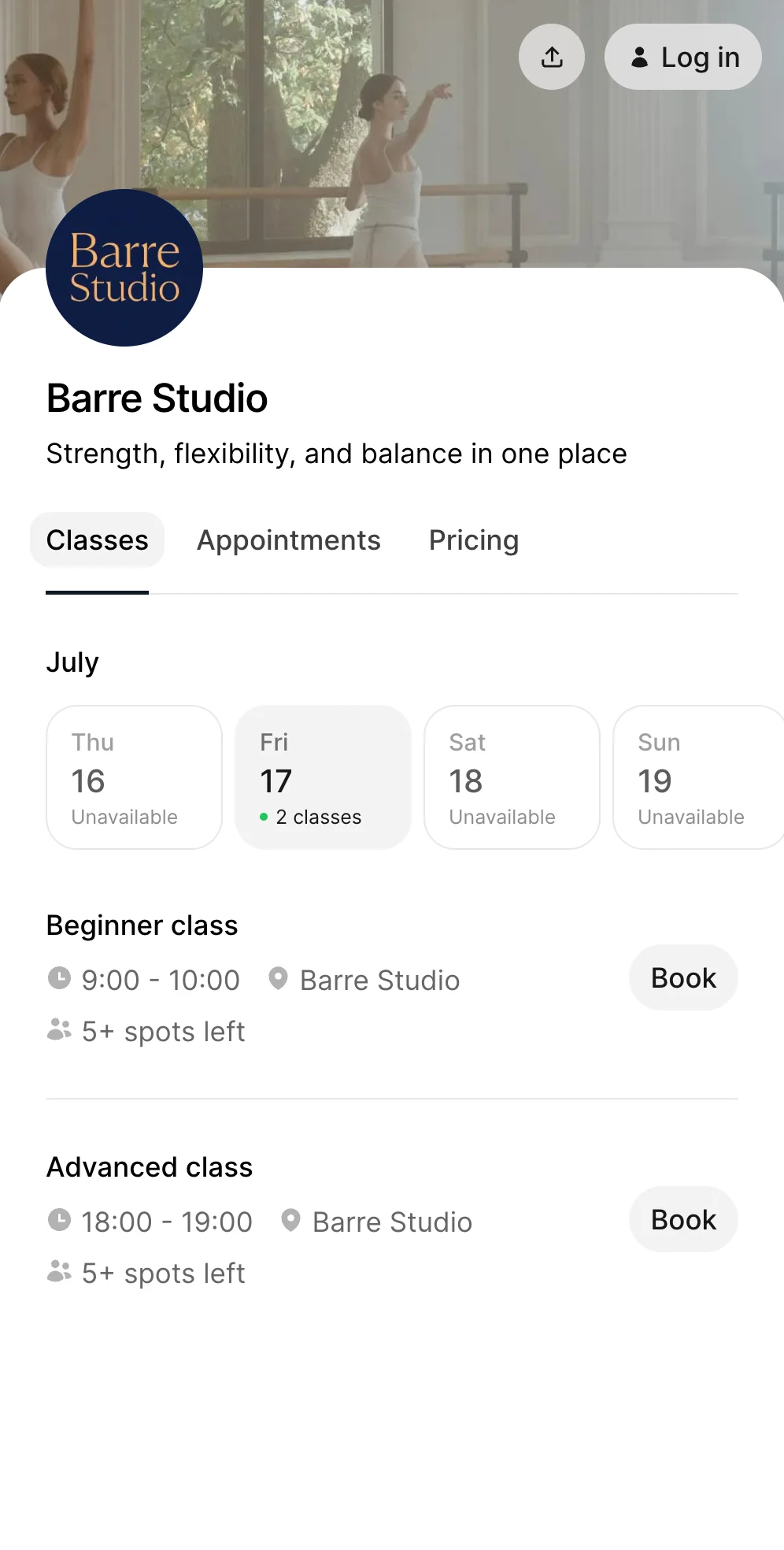
Time2book helps barre studios manage classes, instructors, bookings, memberships, payments, and clients in one place, making it easier to understand how your schedule is performing. Explore Time2book barre studio software
Try Time2book free today and simplify your barre studio bookings, payments, and client management.
In this guide, we’ll break down barre instructor pay in 2026, how much studios should consider paying per class, the most common compensation structures, and how to build a pay model that works for both your instructors and your business.
How Much Should You Pay a Barre Instructor in 2026?
For a U.S. barre studio, a practical starting range for a standard 45–60 minute group class is approximately $25–$45 per class. Experienced instructors, lead teachers, or instructors working in expensive metropolitan markets may earn $40–$60+ per class.
These should be treated as planning ranges rather than fixed industry standards.
| Instructor type | Practical US planning range |
|---|---|
| New / recently certified barre instructor | $25–$30 per class |
| Established barre instructor | $30–$40 per class |
| Experienced / high-demand instructor | $40–$50+ per class |
| Senior / lead instructor | $45–$60+ per class |
| Private barre session | $40–$80+ per session |
| Base + attendance bonus | $25–$35 base + bonus |
Current job listings support the lower-to-middle end of these ranges. Pure Barre instructor roles in California have recently advertised around $25–$35 per hour, while a Crunch Fitness posting for Pilates, yoga, and barre instructors listed $25–$35 per class hour. Other advertised barre positions can reach $40–$50 per hour depending on the facility and market.
The important question is therefore not simply:
“What do other barre studios pay?”
Instead, ask:
“What can our studio sustainably pay while still attracting and retaining great instructors?”
Average Barre Instructor Pay in 2026
National salary websites provide a useful starting point when setting your rates, although they measure compensation differently.
| Source | Reported US barre instructor pay |
|---|---|
| ZipRecruiter | ~$21.20/hour |
| Salary.com | ~$25/hour |
| Pure Barre via Indeed | ~$26.97/hour |
| Barre3 via Indeed | ~$29.46/hour |
| BLS: all fitness trainers & instructors | $22.67/hour median |
ZipRecruiter reported an average barre instructor hourly rate of $21.20 as of September 2026, with most listed wages falling roughly between $15.87 and $24.04 per hour. Salary.com placed average barre instructor pay closer to $25 per hour.
The U.S. Bureau of Labor Statistics does not publish a separate category specifically for barre instructors. For the broader category of fitness trainers and instructors, the median wage was $47,160 per year, or $22.67 per hour, in May 2025. The highest 10% earned more than $83,100 annually.
Brand-specific numbers can be somewhat higher. Indeed estimates Pure Barre instructor pay at approximately $26.97 per hour, while its estimate for Barre3 instructors is $29.46 per hour. The Barre3 figure is based on only a handful of postings, so it should be treated as one data point rather than a national industry average.
Why salary averages can be misleading
Most barre instructors are not working a traditional 40-hour teaching week.
An instructor might teach four classes at your studio, five at another, run private sessions, and have another job entirely. Some compensation data also mixes teaching time with preparation, reception work, sales duties, or studio management.
This means barre instructor pay per class is often more useful for a studio owner than an annual salary estimate.
An instructor earning $35 for a 50-minute class is also not necessarily earning $35 for only 50 minutes of work. They may arrive 15 minutes early, prepare equipment, speak with clients after class, and spend additional time planning programming.
That should be considered when setting your rates.
Barre Instructor Pay Per Class
Paying a fixed amount per class is one of the simplest compensation structures for boutique barre studios.
For example:
Barre instructor rate: $35 per class
The instructor earns $35 regardless of whether six clients attend or the class is completely full.
The model is simple, predictable, and easy to include in your payroll calculations. But studio owners need to understand what that $35 represents relative to the revenue being generated.
Example: A 12-Person Barre Class
Imagine your studio has capacity for 12 people.
Your average realized revenue per booking is $24 after taking memberships, class packs, intro offers, and discounts into account.
With 10 clients attending:
10 clients × $24 = $240 class revenue
If your instructor receives $35:
$35 ÷ $240 = 14.6% of class revenue
That leaves $205 before rent, payment processing, software, cleaning, marketing, insurance, taxes, and other expenses.
Now imagine only four clients attend:
4 clients × $24 = $96 class revenue
The same $35 instructor cost now represents:
$35 ÷ $96 = 36.5% of class revenue
The instructor hasn't suddenly become more expensive. Your class has simply generated less revenue.
This is why barre studios should evaluate instructor pay together with occupancy and average revenue per visit rather than looking at payroll in isolation.
5 Common Barre Instructor Pay Models
There is no compensation structure that works for every studio. Your best option depends on the size of your team, class schedule, pricing, and how established your business is.
1. Flat Rate Per Class
The instructor receives the same amount every time they teach.
For example:
$35 per barre class
This is probably the easiest structure to administer.
Advantages:
- Predictable instructor income
- Simple payroll
- Easy to communicate
- Instructors are not penalized for quiet classes
- Works well for new studios
Disadvantages:
- The studio carries most of the risk when attendance is low
- Very popular instructors receive no additional reward
- There is no direct incentive connected to attendance
For many smaller barre studios, a flat rate is a good place to start.
2. Base Pay + Attendance Bonus
Another option is guaranteeing a base rate and adding bonuses as attendance increases.
For example:
$30 base + $3 for every client above eight attendees
For a 12-person class:
| Attendance | Instructor pay |
|---|---|
| 5 clients | $30 |
| 8 clients | $30 |
| 9 clients | $33 |
| 10 clients | $36 |
| 11 clients | $39 |
| 12 clients | $42 |
This gives instructors predictable minimum compensation while allowing them to share in the upside when classes perform particularly well.
However, avoid making compensation too dependent on attendance. An instructor teaching Wednesday at 6:00 p.m. may naturally attract more people than someone assigned Monday at 11:00 a.m.
Marketing, location, schedule placement, seasonality, and membership size all influence attendance too.
3. Tiered Instructor Pay
A tiered compensation system creates clear progression as instructors develop.
For example:
| Instructor level | Example rate |
|---|---|
| New instructor | $25–$30 |
| Established instructor | $30–$40 |
| Senior instructor | $40–$50 |
| Lead instructor | $45–$60+ |
You could base progression on factors including:
- Barre certification
- Years of teaching experience
- Teaching quality
- Reliability
- Client feedback
- Class retention
- Ability to teach multiple formats
- Additional fitness qualifications
- Mentoring newer instructors
- Lead instructor responsibilities
The advantage is transparency.
Instead of every instructor negotiating individually, they can understand what is required to move to the next compensation level.
4. Revenue Share
With revenue share, instructors receive a percentage of the revenue generated by their class.
Imagine a class produces:
$220 in revenue
At a 20% instructor share:
Instructor receives $44
At $120 in revenue:
Instructor receives $24
This automatically connects instructor expense to the financial performance of the class.
However, it can also create unpredictable income for your instructors. Someone may teach an excellent class but earn less simply because they were assigned a newly launched time slot or because the studio is running an introductory promotion.
For regular group classes, a guaranteed base rate with an optional attendance incentive can often provide a better balance.
5. Hourly Pay
Hourly compensation may make more sense when instructors perform work beyond teaching classes.
For example, someone might teach classes but also:
- Work reception
- Answer client questions
- Clean or reset the studio
- Handle sales consultations
- Train new instructors
- Manage schedules
- Create programming
- Help with events or workshops
In that situation, you could separate teaching compensation from administrative compensation.
For example:
$35 per class + $18/hour for scheduled admin work
This makes the value of each type of work much clearer.
What Percentage of Class Revenue Should Go to Instructor Pay?
There is no universal percentage that every barre studio should use.
But calculating instructor compensation as a percentage of class revenue is one of the easiest ways to understand whether your current rates are sustainable.
Use:
Instructor pay percentage = Instructor pay ÷ Class revenue × 100
For example:
- Average class revenue: $200
- Instructor pay: $35
- Instructor pay percentage: 17.5%
That number becomes useful when you compare it across your schedule.
One class might generate $280 and cost $40 to teach, while another generates only $90 but still costs $40.
The problem in the second example may not be that the instructor earns too much. Instead, you may have a problem with:
- Low class occupancy
- Poor class timing
- Memberships priced too cheaply
- Too many scheduled classes
- Excessive discounts
- Low client retention
- Weak demand for that class format
Cutting instructor compensation should not automatically be your first response.
Sometimes getting just two additional clients into each class has a much larger effect on profitability than reducing instructor pay by $5.
What Determines Barre Instructor Pay?
Two instructors teaching the same 50-minute format do not necessarily need to earn exactly the same amount.
Several factors can justify different rates.
Experience
A newly certified instructor will generally start toward the lower end of your compensation range.
Someone who has taught hundreds or thousands of classes, can comfortably manage different experience levels, and consistently delivers a polished client experience can justify a higher rate.
Certifications
Barre-specific certification can be an important consideration, particularly if your studio follows a specific teaching method.
Additional qualifications in Pilates, yoga, strength training, prenatal fitness, mobility, or personal training can also increase an instructor's value to the studio.
Location
Instructor rates in New York, Los Angeles, San Francisco, London, or other expensive markets may be substantially higher than rates in smaller cities.
Salary websites can therefore be useful, but always compare them against local job listings rather than relying solely on a U.S.-wide average.
Class Demand
An instructor who builds loyal classes and regularly contributes to client retention is valuable.
That doesn't necessarily mean you should pay purely based on attendance, but consistent demand can form part of a wider compensation review.
Additional Responsibilities
An instructor who mentors new teachers, runs workshops, helps design programming, manages the teaching team, or takes on administrative responsibilities should not necessarily be compensated the same as someone whose only responsibility is teaching their scheduled class.
Separate responsibilities clearly when possible.
Should Popular Barre Instructors Get Paid More?
They can, but popularity should not be your only measurement.
A consistently full barre class can certainly indicate that clients enjoy the instructor and want to return. Client loyalty has real financial value to the studio.
But occupancy is affected by many factors.
Your Thursday 6:00 p.m. instructor might consistently get 14 clients while the instructor teaching Tuesday at 10:30 a.m. averages seven. That doesn't automatically mean the first instructor is twice as good.
Consider a combination of:
Teaching quality + reliability + qualifications + client retention + class performance + contribution to the studio
This creates a much more sustainable compensation structure than ranking instructors purely by attendance.
Employee vs. Independent Contractor Barre Instructor Pay
Some barre studios hire instructors as employees, while others engage independent contractors.
These arrangements can have different implications for taxes, benefits, payroll costs, insurance, and how much control the studio has over how instructors work.
Importantly, you generally cannot decide someone is an independent contractor simply because paying them that way is easier. In the United States, the IRS considers factors including behavioral control, financial control, and the overall relationship between the studio and worker when determining classification.
Rules also differ between countries and states, so studio owners should check local employment requirements or speak with an accountant or employment professional.
From a budgeting perspective, remember that the instructor's advertised wage is not always the studio's full employment cost. Employee payroll taxes, insurance, benefits, paid training, and other costs may need to be included when calculating your true instructor expense.
A Simple Barre Instructor Pay Structure for a New Studio
If you're opening a boutique barre studio and want to keep compensation straightforward, you could start with something like this.
Group Classes
New instructor: $28 per class
Established instructor: $35 per class
Senior instructor: $42 per class
Once the studio has enough attendance data, you could introduce an optional performance bonus.
For example:
+$3 for each attendee above 80% capacity
This keeps instructor income predictable while creating some upside when consistently busy classes generate more revenue.
Private Sessions
If you also offer one-to-one barre, mobility, Pilates, or strength sessions, private compensation may be structured differently.
You could use:
Fixed rate: $40–$70 per session
or a percentage-based model.
For example:
- Client pays $100
- Instructor receives 50%
- Instructor earns $50
- Studio retains $50 before overhead
The appropriate split depends heavily on who brings in the client and what the studio provides.
If your studio handles the marketing, booking system, payment processing, facility, equipment, client acquisition, and administration, it is reasonable for the business to retain a meaningful share of the session revenue.
When Should You Raise Barre Instructor Pay?
Rather than negotiating compensation class by class, set regular review periods.
For example, review instructor pay every 6–12 months.
Consider:
| Factor | What to review |
|---|---|
| Experience | Has their teaching improved significantly? |
| Certifications | Have they completed additional education? |
| Reliability | Do they consistently arrive prepared and on time? |
| Client retention | Do clients continue booking their classes? |
| Attendance | Are their classes performing well relative to similar slots? |
| Responsibilities | Are they mentoring or managing others? |
| Market rates | Have local instructor rates increased? |
| Studio finances | Can the business sustainably support an increase? |
You can also define pay levels in advance.
For example:
Level 1 → $28
Level 2 → $34
Level 3 → $40
Lead instructor → $48
Then clearly explain how instructors progress between levels.
This makes compensation feel much less arbitrary.
Know Your Numbers Before Changing Instructor Pay
Studio owners often focus heavily on class price, but your advertised drop-in rate isn't necessarily what you earn from every visit.
Someone paying $30 for a drop-in generates $30.
But a member paying $149 for 10 classes effectively generates around $14.90 per visit if they use every credit.
Intro offers and unlimited memberships can reduce the realized revenue per visit even further.
Before changing instructor rates, track:
| Metric | What to measure |
|---|---|
| Class capacity | Maximum available spaces |
| Average attendance | Typical clients per class |
| Occupancy | Attendance ÷ capacity |
| Revenue per visit | Actual average revenue per booking |
| Class revenue | Revenue generated by each class |
| Instructor cost | Compensation for teaching |
| Instructor cost % | Instructor cost ÷ class revenue |
| Remaining revenue | Revenue after instructor compensation |
These numbers give you a much stronger basis for compensation decisions than looking at instructor pay alone.
Time2book's barre class scheduling tools let studios create classes, assign instructors, set capacity limits, manage waitlists, and keep bookings connected with memberships and payments.
You can also use Time2book's barre payment tools to manage memberships, packages, drop-ins, and revenue in the same system.
That makes it easier to see whether the real issue is instructor payroll—or whether you simply need to fill more of the classes already on your schedule.
Frequently Asked Questions About Barre Instructor Pay
For U.S. studios in 2026, approximately $25–$45 per standard group barre class is a practical planning range. Experienced, senior, or high-demand instructors may earn $40–$60 or more, particularly in higher-cost markets.
Your actual rate should take local wages, qualifications, class pricing, capacity, and average class revenue into account.
Current 2026 salary estimates vary. ZipRecruiter reports average U.S. barre instructor pay of around $21.20 per hour, while Salary.com estimates approximately $25 per hour. Indeed reports Pure Barre instructors averaging approximately $26.97 per hour.
The broader U.S. fitness trainer and instructor category had a median wage of $22.67 per hour in May 2025, according to the Bureau of Labor Statistics.
Indeed currently estimates average Pure Barre instructor pay at approximately $26.97 per hour in the United States, based on past and present job postings. Current individual franchise postings also show positions around $25–$35 per hour, although rates vary by studio and location.
Because Pure Barre locations are franchised, compensation should not be assumed to be identical across every studio.
Per-class compensation works well when an instructor primarily arrives, teaches their class, and leaves.
Hourly compensation can make more sense when instructors also perform reception, sales, cleaning, programming, client management, or other scheduled work. Some studios use a class rate for teaching and a separate hourly rate for administrative responsibilities.
A base rate plus attendance bonus can be a good way to reward successful classes without making an instructor's entire income dependent on attendance.
However, class time, marketing, seasonality, membership size, and studio location all affect attendance, so fullness should not be the only factor used to determine compensation.
Reviewing compensation every 6–12 months gives studios a predictable opportunity to evaluate experience, certifications, reliability, responsibilities, retention, market rates, and studio financial performance.
Creating defined instructor levels can make this process more transparent.
Start by improving the economics of your existing classes.
Increasing average occupancy, improving member retention, adjusting underpriced memberships, reducing poorly attended time slots, and increasing average revenue per visit can create more room for instructor compensation.
Sometimes filling one additional space in every class generates considerably more revenue than reducing instructor pay.
Final Thoughts
There is no universal barre instructor pay rate that every studio should follow in 2026.
Current U.S. data generally places barre and group fitness instructor wages somewhere in the low-to-high $20s per hour, while individual studio rates can extend well above that depending on experience and market. For boutique studios, roughly $25–$45 per group class provides a useful starting framework, with experienced and senior instructors potentially earning $40–$60+.
But the best compensation structure is not necessarily the studio offering the highest class rate.
It is one where instructors feel fairly rewarded, understand how they can progress, and want to continue building relationships with your clients—while the studio still has enough revenue left to cover rent, marketing, software, insurance, taxes, and profit.
Before adjusting pay, understand your average class revenue, occupancy, revenue per visit, and instructor cost percentage. Once those numbers are clear, decisions about instructor compensation become much easier.
Time2book gives barre studios one place to manage classes, instructors, memberships, bookings, payments, and clients without piecing together multiple systems.
Try Time2book free today and simplify your studio bookings, payments, and client management.