Setting the right barre class pricing has a direct impact on your studio’s revenue, retention, and profitability.
Charge too little and even a busy studio can struggle to make money. Charge too much without a strong brand or client experience, and potential members may choose another boutique fitness studio nearby.
The goal is not simply to find the highest price clients will pay. Your pricing should:
- Cover your operating costs
- Pay instructors fairly
- Encourage regular attendance
- Reward longer-term commitment
- Create predictable recurring revenue
- Leave room for a healthy profit margin
In 2026, barre pricing varies significantly by location and studio positioning.
Pure Barre currently lists drop-in classes between $25 and $40, while four-class memberships range from $69 to $159 per month and eight-class memberships from $119 to $269, depending on location.
Independent studios and other boutique brands show a similarly wide range.
That means copying another studio’s pricing rarely works. Your rent, instructor payroll, capacity, local competition, and target client all matter.
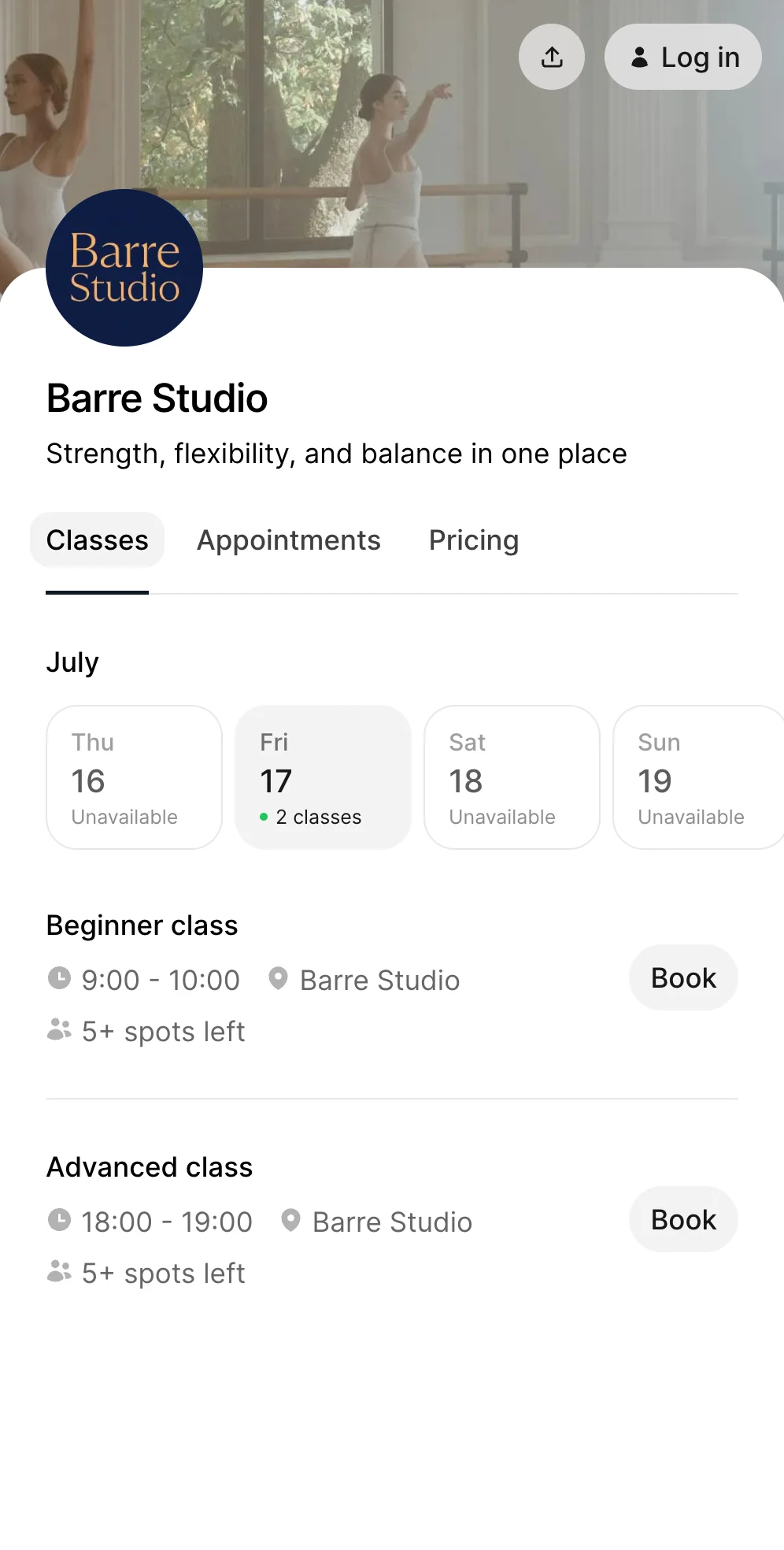
Time2book can help barre studios sell drop-ins, class packs, and recurring memberships while connecting payments directly with bookings.
Try Time2book free and manage your barre classes, memberships, payments, and clients in one place.
In this guide, we’ll break down barre class pricing for 2026, including drop-ins, class packs, memberships, intro offers, and private sessions.
Barre Class Pricing in 2026: Quick Guide
For an independent US barre studio, these ranges can be a useful starting point.
| Pricing option | Typical starting range |
|---|---|
| Intro class | Free–$15 |
| Single drop-in | $20–$35 |
| 4 classes/month | $69–$120 |
| 8 classes/month | $119–$190 |
| 12 classes/month | $150–$220 |
| Unlimited monthly | $140–$250+ |
| 5-class pack | $100–$150 |
| 10-class pack | $180–$280 |
| Private barre session | $60–$120+ |
| Online membership | $20–$40/month |
Premium studios in expensive cities can charge considerably more.
For example, Physique 57’s New York studios currently charge:
- Single class: $44
- 4 classes/month: $150
- 8 classes/month: $250
The Bar Method also shows how much geography can affect pricing:
- Highland Park, Illinois: $169/month unlimited
- Wellesley: $205/month unlimited
- New York NoHo: $295/month unlimited
Your own pricing should come from your economics and positioning, not from a national average.
How Much Do Barre Classes Cost?
For clients, a boutique barre drop-in class commonly falls somewhere around:
- Budget / lower-cost studios: $15–$20
- Mid-market studios: $20–$35
- Premium city studios: $35–$45+
Looking at actual studios gives useful context.
Barre44
Current pricing includes:
- Drop-in: $26
- 5 classes: $125
- 10 classes: $230
- Unlimited monthly: $179
- New-client unlimited month: $99
Breaking Barre
Current pricing includes:
- Drop-in: $24
- 8 classes/month: $99
- Unlimited monthly: $145
- 1 week unlimited for new clients: $29
- 2 weeks unlimited: $49
Physique 57
At the premium end:
- Drop-in: $44
- 5-class pack: $200
- 10-class pack: $390
The key lesson is simple:
There is no universal barre class price.
A $25 class might feel expensive in one market and underpriced in another.
1. Drop-In Barre Class Pricing
A drop-in is the simplest pricing option.
The client:
- Pays once
- Books one class
- Makes no ongoing commitment
For many independent studios, a reasonable starting range is:
$20–$35 per class
Premium urban studios may charge more.
Keep the drop-in price highest
Your drop-in should usually have the highest price per class.
For example:
- Drop-in: $28
- 5-class pack: $130
- 10-class pack: $240
- 8-class membership: $176
- Unlimited: $199
This creates a clear incentive to commit.
The client journey becomes:
Intro offer → drop-in → class pack → recurring membership
That is usually healthier than allowing regular clients to remain on drop-ins forever.
2. Four-Class Monthly Membership
A four-class membership is essentially:
One barre class per week
This can work well for clients who also:
- Run
- Lift weights
- Practice Pilates
- Attend yoga
- Train at another gym
A common range is:
$69–$120/month
Example
If your membership is:
$89/month
Then the effective price is:
$89 ÷ 4 = $22.25 per class
If your drop-in is $28, the client saves $5.75 per class.
The client gets better value while your studio receives predictable monthly revenue.
3. Eight-Class Monthly Membership
For many studios, eight classes per month can become the core membership.
It works well because two visits per week is frequent enough to build a habit without requiring an unlimited commitment.
A common starting range is:
$119–$190/month
Example
If you charge:
$159/month
Then:
$159 ÷ 8 = $19.88 per class
Compared with a $28 drop-in, the member saves more than $8 per class.
This gives clients a strong reason to upgrade.
4. Unlimited Barre Membership
Unlimited memberships are simple to understand:
Pay one monthly price and attend as often as you want.
Typical pricing can range from:
$140–$250+ per month
Current examples include:
- Breaking Barre: $145/month
- The Bar Method Highland Park: $169/month
- Barre44: $179/month
- The Bar Method Wellesley: $205/month
- The Bar Method NYC NoHo: $295/month
Check the revenue per visit
Suppose your unlimited membership costs:
$179/month
If a member attends:
- 8 times/month → $22.38 per visit
- 12 times/month → $14.92 per visit
- 16 times/month → $11.19 per visit
- 20 times/month → $8.95 per visit
Unlimited memberships can still work well because many members attend less often than they expect.
But usage matters, especially in smaller studios.
Should You Offer Unlimited Barre Memberships?
Unlimited memberships tend to work best when you have:
- Plenty of classes each week
- Strong schedule availability
- Enough room in peak-time classes
- Multiple instructors
- A larger studio capacity
They may be less suitable when:
- Your studio is small
- Prime-time classes regularly sell out
- You only run a few classes each day
- Instructor costs are high
- You want to maximize revenue per spot
For example, a 12-person studio with full evening classes has very different economics from a 25-person studio running six sessions per day.
Capacity should influence pricing.
5. Barre Class Packs
Class packs sit between drop-ins and memberships.
Clients pay upfront for several sessions without committing to recurring billing.
Common options include:
- 5 classes
- 10 classes
- 20 classes
Example class-pack structure
| Option | Total price | Price per class |
|---|---|---|
| Drop-in | $28 | $28.00 |
| 5-class pack | $130 | $26.00 |
| 10-class pack | $240 | $24.00 |
| 20-class pack | $440 | $22.00 |
The value gets better as commitment increases.
Give class packs an expiration date
Common expiration periods include:
- 5 classes → 2–3 months
- 10 classes → 3–6 months
- 20 classes → 6–12 months
This helps:
- Encourage consistent attendance
- Reduce inactive balances
- Keep client accounts cleaner
- Prevent packs from staying open indefinitely
The goal is not to make clients lose classes. It is to create a structure that encourages regular use.
6. New Client and Intro Offers
Your first-time-client pricing does not need to match your standard pricing.
A strong intro offer helps new clients experience the studio before committing to a membership.
Popular options include:
Free first class
Example:
- First class: Free
Simple and easy to understand.
Discounted first class
Example:
- First class: $10
This can attract more serious prospects than a completely free offer.
One week unlimited
Example:
- 7 days unlimited: $29
This gives the client enough time to try several instructors or class times.
Two weeks unlimited
Example:
- 14 days unlimited: $39–$59
Often a strong balance between accessibility and commitment.
First month unlimited
Example:
- 30 days unlimited: $79–$109
This gives clients more time to build a routine.
What matters most
Do not judge an intro offer only by how many people buy it.
Track:
- Intro offer purchases
- Classes attended during the offer
- Membership conversions
- Revenue generated after the offer
- Retention after 30–90 days
The most important number is:
Intro offer → recurring membership conversion
7. Private Barre Session Pricing
Private barre sessions can create another useful revenue stream.
They are particularly suitable for:
- Beginners
- Prenatal clients
- Postnatal clients
- Technique coaching
- Clients returning from injury
- Small private groups
- Clients who prefer 1:1 attention
A useful starting range may be:
$60–$120+ per private session
Example private-session pricing
| Option | Example |
|---|---|
| Single private | $90 |
| 3 sessions | $255 |
| 5 sessions | $400 |
| 10 sessions | $750 |
The larger the package, the better the effective per-session price.
Time2book lets studios offer both recurring classes and private appointments in the same booking system. Learn more about Time2book’s barre studio software.
How to Set Barre Class Pricing for Your Studio
Competitor research is useful, but your own costs matter more.
Use these four steps.
Step 1: Calculate monthly fixed costs
Include:
- Rent
- Utilities
- Insurance
- Software
- Internet
- Cleaning
- Accounting
- Marketing
- Equipment financing
- General administration
Example:
Fixed costs: $10,000/month
Step 2: Add instructor payroll
Suppose you run:
- 120 classes/month
- Average instructor pay: $45/class
Then:
120 × $45 = $5,400/month
Your current operating cost is now:
$10,000 + $5,400 = $15,400/month
Step 3: Add your profit target
Suppose you want:
$5,000/month operating profit
Then your target revenue becomes:
$15,400 + $5,000 = $20,400/month
Step 4: Calculate available class capacity
Imagine you offer:
- 120 classes/month
- 14 spaces per class
Maximum capacity:
120 × 14 = 1,680 spots
At 65% average occupancy:
1,680 × 65% = 1,092 bookings
To generate $20,400:
$20,400 ÷ 1,092 = $18.68 average revenue per booking
That number is extremely useful.
If your memberships produce only $12 per visit, your pricing may not support the business.
Don't Compete on Price Alone
It is tempting for a new studio to undercut nearby competitors.
If other studios charge $28, you might consider charging $18.
But your costs do not decrease just because your price is lower.
Instead of asking:
How can we be cheaper?
Ask:
Why should clients choose us at this price?
You can justify stronger pricing through:
- Better instructors
- Smaller classes
- Better studio design
- Convenient location
- More personal coaching
- Easier booking
- Better class times
- Premium equipment
- Strong community
- Specialty programming
- Better client communication
Boutique fitness clients are not always looking for the cheapest class.
They are often looking for the studio they want to keep coming back to.
Build a Simple Barre Pricing Ladder
Too many pricing options make the decision harder.
A simple structure can work better.
Example pricing ladder
Intro offer
- 14 days unlimited — $49
Drop-in
- 1 class — $28
Class packs
- 5 classes — $130
- 10 classes — $240
Memberships
- 4 classes/month — $89
- 8 classes/month — $159
- Unlimited — $199
This creates a clear progression.
Casual clients pay more per class.
Committed clients get better value.
The studio gets more predictable revenue.
Class Packs vs Memberships
Both have a role.
Class packs are better for:
- Occasional clients
- Travelers
- Irregular schedules
- Clients who dislike subscriptions
- Seasonal visitors
Memberships are better for:
- Predictable revenue
- Regular attendance
- Long-term retention
- Building routine
- Forecasting revenue
For example:
100 clients on a $159/month membership generate:
$15,900 in recurring monthly revenue
before you sell:
- Drop-ins
- Private sessions
- Retail
- Workshops
- Additional packs
That makes staffing and budgeting much easier.
Class packs should still exist, but recurring memberships can become the financial foundation of the studio.
For a comparison of current tools, see our guide to the best barre studio software in 2026.
Example Pricing for a New Barre Studio
If you are opening a new mid-market studio, a simple structure could look like this.
Intro offer
- 14 days unlimited — $39
Drop-in
- Single class — $25
Class packs
- 5 classes — $115
- 10 classes — $210
Memberships
- 4 classes/month — $79
- 8 classes/month — $139
- Unlimited — $179
This is only an example.
A premium studio in Manhattan may need to charge substantially more. A studio in a smaller city with lower rent may be able to charge less.
Before finalizing your pricing, compare at least five nearby studios.
Record:
- Drop-in price
- Intro offer
- 4-class membership
- 8-class membership
- Unlimited membership
- 10-class pack
- Private-session price
- Cancellation policy
Then decide whether you want to position your studio:
- Below the local market
- Around the local market
- Above the local market
Make the decision intentionally.
Should Barre Studios Raise Their Prices?
Eventually, many studios will need to.
Costs increase over time, including:
- Rent
- Instructor pay
- Utilities
- Insurance
- Software
- Cleaning
- Payment-processing fees
Signs your pricing may be too low
- Prime-time classes regularly have waitlists
- You have not raised prices for several years
- Instructor payroll has increased
- Rent has increased
- Profit margins are shrinking
- Competitors charge significantly more
- Demand exceeds your available capacity
You do not need to raise every price equally.
For example:
- Keep drop-in at $28
- Increase 8-class membership from $149 → $159
- Increase unlimited from $179 → $195
You can also keep existing members on their current rate for a period while introducing new pricing for new clients.
Clear communication matters more than trying to hide the increase.
Frequently Asked Questions About Barre Class Pricing
Many US boutique barre studios charge around $20–$35 for a standard drop-in. Premium studios in major cities can charge $40 or more.
Your own price should consider:
- Local competition
- Rent
- Instructor pay
- Class capacity
- Brand positioning
- Client experience
A useful starting range is:
- 4 classes/month: $69–$120
- 8 classes/month: $119–$190
- Unlimited: $140–$250+
Location can have a major impact.
Yes, if your studio has enough capacity.
Unlimited memberships work best when:
- You offer many classes
- Prime-time sessions are not constantly full
- High-frequency members do not block capacity
- Your average revenue per visit remains sustainable
Class packs offer flexibility. Memberships create more predictable recurring revenue. Most studios benefit from offering both while making memberships the better value for regular clients.
A 10-class pack should usually reduce the per-class price compared with your drop-in.
For example:
- Drop-in: $28
- 10-class pack: $230–$250
That works out to roughly $23–$25 per class.
Common options include:
- Free first class
- $10 first class
- 7 days unlimited
- 14 days unlimited
- Discounted first month
A strong example might be:
14 days unlimited for $39–$49
Many studios do. Late-cancellation and no-show policies help protect limited class capacity.
The policy should be:
- Clear
- Visible before purchase
- Easy to understand
- Applied consistently
At least once per year.
Review:
- Revenue
- Occupancy
- Retention
- Instructor payroll
- Rent
- Payment fees
- Competitor pricing
- Profit margin
Even if you do not change prices, the review helps ensure your current pricing still works.
Final Thoughts
There is no single perfect barre class pricing structure.
A $150 unlimited membership may work well for one studio and be completely unsustainable for another.
Your ideal price depends on:
- Rent
- Instructor costs
- Class capacity
- Attendance
- Local competition
- Brand positioning
- Target profit margin
Start with your numbers.
Then build a simple pricing ladder where occasional clients can buy drop-ins or packs while regular clients receive better value through recurring memberships.
Keep the options easy to understand and review your pricing regularly.
Once your pricing is ready, Time2book makes it easy to sell drop-ins, class packs and recurring memberships, accept online payments, and let clients book directly into your barre classes.
Explore Time2book for barre studios.
Try Time2book free today and simplify your studio bookings, payments, memberships, and client management.