How Many Reformers Does a Pilates Studio Need in 2026?

Ignas Lunenas
Sep 7, 2026
12 min read
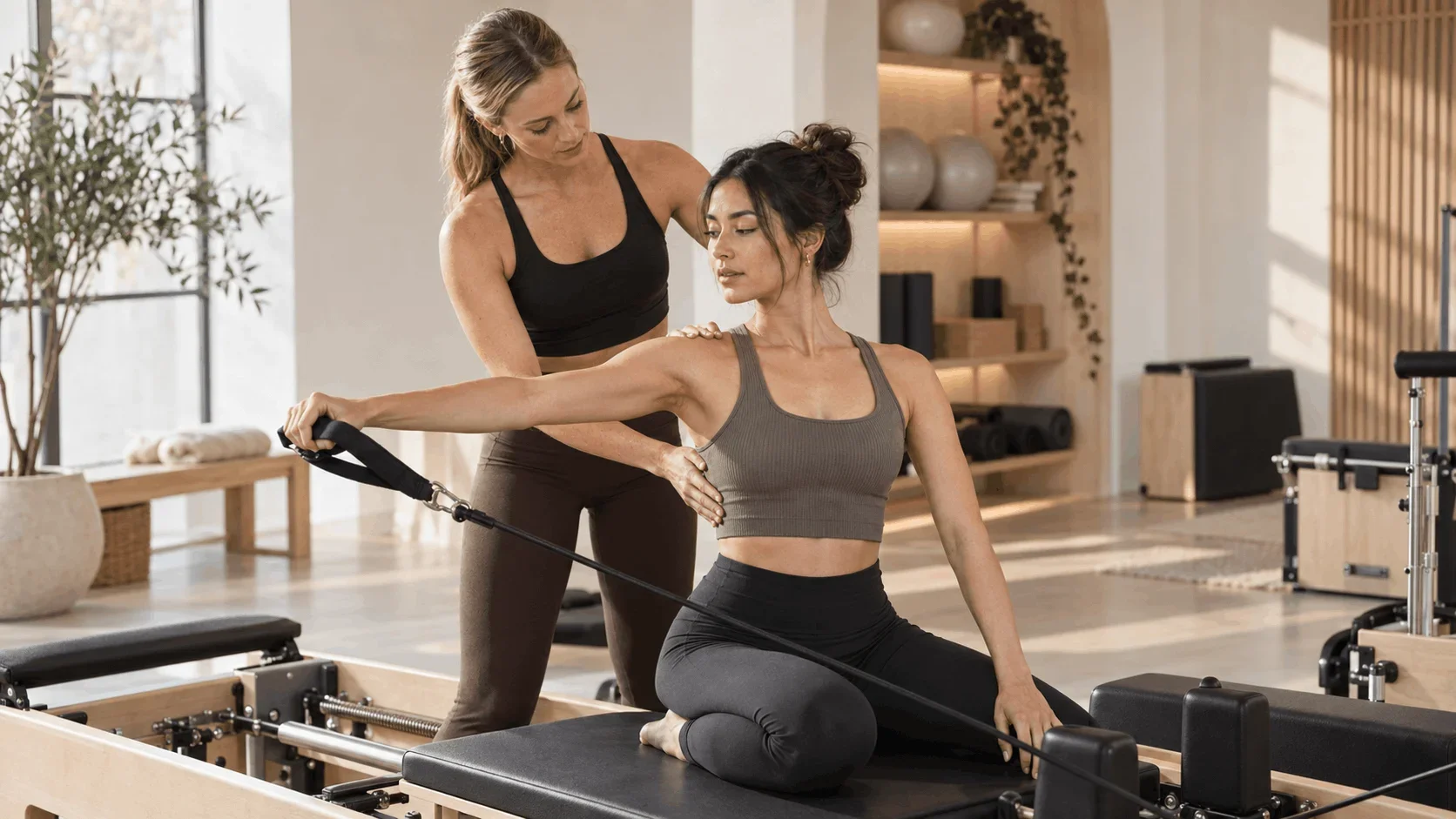
If you're opening a reformer Pilates studio, one of the biggest early decisions is how many reformers your Pilates studio needs.
Buy too few and you may limit class revenue, especially once popular sessions start filling up. Buy too many and you can spend tens of thousands of dollars on equipment and a larger lease before you have enough clients to fill the additional spaces.
For many new boutique Pilates studios, 6–10 reformers is a sensible starting range, with eight reformers being a particularly practical setup. A small owner-operated studio may work well with four to six machines, while an established group-class business may eventually operate with 10, 12, 14, or more.
The right number ultimately depends on your space, startup budget, class pricing, expected occupancy, target client experience, and how many clients you realistically expect to serve.
Time2book helps Pilates studios manage class capacity, bookings, memberships, payments, waitlists, clients, and instructors from one system, so you can build your schedule around the reformer capacity you actually have.
Try Time2book free today and simplify your Pilates studio bookings, payments, and client management.
In this guide, we'll break down how many reformers a Pilates studio needs in 2026, compare 4-, 6-, 8-, 10-, and 12-reformer setups, and show how your decision affects space requirements, startup costs, revenue, and break-even.
How Many Reformers Do You Need to Open a Pilates Studio?
For most new studios, a useful starting point is:
Studio model | Recommended starting range |
|---|---|
Private / semi-private studio | 2–4 reformers |
Very small boutique studio | 4–6 reformers |
Small group studio | 6–8 reformers |
Standard boutique reformer studio | 8–10 reformers |
Larger group-class studio | 10–14 reformers |
High-capacity studio | 14–20+ reformers |
These are planning ranges rather than rules. Pilates studios can operate successfully at almost every size when the pricing, rent, staffing, and client demand support the model.
For most first-time studio owners, however, eight reformers offers a useful middle ground. It creates enough class capacity to generate meaningful revenue while still keeping startup equipment costs, rent, and class sizes relatively manageable.
A small-studio model can be even leaner. Our guide to opening a small Pilates studio recommends starting with around four to six reformers when the goal is a personal, owner-operated studio rather than a high-volume group-class business.
Is 8 Reformers Enough for a Pilates Studio?
For many independent Pilates studios, yes.
An eight-reformer class is large enough to generate meaningful revenue while remaining small enough for instructors to give clients individual attention. It also gives the studio a simple capacity of eight bookings per class, making scheduling, memberships, and waitlists relatively easy to manage.
Suppose your average realized revenue is $30 per booking.
At different occupancy levels, an eight-reformer class could produce:
Clients | Occupancy | Revenue per class |
|---|---|---|
4 | 50% | $120 |
5 | 62.5% | $150 |
6 | 75% | $180 |
7 | 87.5% | $210 |
8 | 100% | $240 |
If your instructor costs $45–$50 per class, an eight-reformer setup creates enough capacity for strong class economics once attendance reaches six or more clients.
This is why eight reformers can be a particularly good starting configuration: you do not need a massive client base to create meaningful revenue, but you still have room to grow attendance before every class reaches capacity.
Is 6 Reformers Enough for a Pilates Studio?
Six reformers can absolutely be enough, particularly for an owner-operated studio.
A six-reformer model can work well when you want to create a more personal experience, keep rent low, launch with a smaller equipment investment, or combine group classes with private and semi-private sessions.
- At $30 average revenue per visit, a full six-person class produces: 6 × $30 = $180
- At 75% average occupancy, attendance would be approximately 4.5 clients per class, producing roughly: $135 average class revenue
That can still create a viable business when instructor costs and rent are controlled.
Smaller classes may also support higher pricing. If clients are receiving more instructor attention than they would in a 12- or 14-person group, a studio may position the experience as more premium rather than competing purely on class capacity.
For new owners with limited capital, six reformers can be a much safer starting point than immediately buying 12.
What About 10 or 12 Reformers?
Once you move into 10–12 reformers, the studio begins to operate more like a higher-volume group fitness business.
The benefit is obvious: every additional reformer creates another potential paid booking without requiring another instructor.
Imagine average revenue per booking remains $30.
Reformers | Revenue at 75% occupancy | Revenue when full |
|---|---|---|
6 | $135 | $180 |
8 | $180 | $240 |
10 | $225 | $300 |
12 | $270 | $360 |
14 | $315 | $420 |
Going from eight to 12 reformers increases full-class revenue from $240 to $360 — a 50% increase in revenue capacity per class.
But there is an important condition: You need enough clients to fill them.
An eight-reformer studio running at 90% occupancy generates approximately $216 per class at $30 per visit.
A 12-reformer studio running at 50% occupancy generates: 6 clients × $30 = $180
Despite having 50% more equipment and likely requiring more space, the larger studio earns less per class.
That is why utilization matters more than simply maximizing the number of reformers.
How Many Reformers Should a New Pilates Studio Start With?
For a new independent studio without an established client base, six to eight reformers is often the safest starting point.
Eight may make sense if you already have a client following, strong presales, good local demand, or enough capital to support a larger launch. Six can be more appropriate when you are entering an uncertain market or want to keep your fixed expenses low.
A useful rule is: Start with the smallest number of reformers that can support your financial model — not the largest number that physically fits into your space.
You can always expand later if your lease and layout allow it.
Buying 12 reformers because the room can hold 12 does not automatically create a 12-client class. Demand needs to be created through memberships, marketing, retention, referrals, and a strong schedule.
If you are still planning the entire business, our Pilates Studio Business Plan: Step-by-Step Guide for 2026 goes deeper into startup costs, pricing, memberships, revenue, and financial planning.
How Much Space Does Each Pilates Reformer Need?
A reformer itself takes up less room than the total area you need around it.
For example, Merrithew's V2 Max Reformer measures approximately 100.5 inches long by 29.25 inches wide, or around 255 × 74 cm.
Balanced Body's Studio Reformer is similarly sized at approximately 92.6 inches long and 26.5 inches wide, or around 235 × 67 cm.
But you cannot simply arrange machines edge-to-edge.
Clients and instructors need room to:
- Walk between reformers
- Adjust springs and footbars
- Perform exercises extending outside the machine
- Use boxes, balls, rings, and other props
- Enter and exit safely
- Move around the class
- Access emergency exits
You also need space outside the workout floor for reception, toilets, storage, changing areas, hallways, and potentially offices or retail.
One current studio-planning guide estimates approximately 45–50 sq ft of workout floor per reformer, with total studio requirements increasing significantly once reception and support spaces are included. Its example planning ranges put six reformers at roughly 700–900 sq ft total and eight at around 900–1,100 sq ft.
Treat these figures as early planning references rather than building-code requirements. Local accessibility, fire safety, occupancy, bathroom, and commercial-building rules should always be checked before signing a lease.
Estimated Studio Space by Number of Reformers
A practical early-stage planning table could look like this:
Reformers | Approx. workout area | Approx. total studio size |
|---|---|---|
4 | 180–220 sq ft | 450–650 sq ft |
6 | 270–320 sq ft | 700–900 sq ft |
8 | 360–420 sq ft | 900–1,100 sq ft |
10 | 450–520 sq ft | 1,100–1,400 sq ft |
12 | 540–620 sq ft | 1,400–1,600+ sq ft |
The exact floor plan matters just as much as total square footage. A 1,000 sq ft rectangular space with few columns may work much better than a 1,200 sq ft studio broken into several narrow rooms. Before leasing a location, place the exact reformer dimensions into a floor plan and account for the real circulation space around every machine.
How Much Do More Reformers Cost?
The equipment investment becomes significant very quickly.
As one current example, Merrithew lists its commercial V2 Max Reformer at $4,999 USD, before freight, duties, taxes, and optional accessories. Its V2 Max Reformer Bundle is currently listed at $5,299.
Using $5,000 per machine simply as an easy planning example:
Reformers | Approx. reformer investment |
|---|---|
4 | $20,000 |
6 | $30,000 |
8 | $40,000 |
10 | $50,000 |
12 | $60,000 |
14 | $70,000 |
That is before shipping, taxes, boxes, props, furniture, mirrors, flooring, renovation, deposits, branding, and other startup costs.
Buying four additional reformers can therefore mean far more than another $20,000 in equipment. You may also need a larger studio, higher rent, more cleaning, additional storage, and potentially more members to support the larger operating model.
This is why reformer count is both an equipment decision and a business-model decision.
Revenue Capacity by Number of Reformers
The financial upside of adding reformers becomes clearer when you calculate monthly class capacity.
Assume the studio runs:
- 6 classes per day
- 26 days per month
- 75% average occupancy
- $30 average realized revenue per visit
The estimated monthly group-class revenue becomes:
Reformers | Monthly bookings | Monthly revenue |
|---|---|---|
4 | 468 | $14,040 |
6 | 702 | $21,060 |
8 | 936 | $28,080 |
10 | 1,170 | $35,100 |
12 | 1,404 | $42,120 |
14 | 1,638 | $49,140 |
This illustrates the attraction of adding more machines. Under the same timetable and occupancy assumptions, every two additional reformers create significant additional revenue capacity.
But these figures assume 75% occupancy across the schedule.
If your market can only support 700 monthly bookings, it makes little difference whether the studio has eight, 10, or 14 reformers. The additional machines remain empty.
Our guide to How Much Does a Pilates Studio Make in 2026? explores the relationship between reformers, occupancy, pricing, and annual studio revenue in more detail.
More Reformers Can Lower Your Break-Even Occupancy
There is an interesting financial advantage to increasing class capacity.
Suppose a studio needs approximately 700 visits per month to cover expenses.
If you have six reformers and offer six classes per day for 26 days, monthly capacity is:
6 × 6 × 26 = 936 spaces
Your required occupancy would be:
700 ÷ 936 = approximately 75%
Now imagine you have eight reformers.
Monthly capacity becomes:
8 × 6 × 26 = 1,248 spaces
The same 700 visits represent:
700 ÷ 1,248 = approximately 56% occupancy
In theory, additional reformers make it easier to generate more revenue with the same instructor and timetable.
However, adding reformers may also increase rent, equipment financing, utilities, maintenance, and startup debt. Your actual break-even point can therefore increase at the same time.
That is why you need to calculate the entire model rather than looking at capacity alone.
How Many Clients Do You Need for 8 Reformers?
Suppose your eight-reformer studio runs six classes per day for 26 days each month.
At 70% occupancy, you would generate approximately:
8 × 6 × 26 × 70% = 874 visits per month
If the average active client attends six times each month:
874 ÷ 6 = approximately 146 active clients
At eight visits per client:
874 ÷ 8 = approximately 109 active clients
This gives you a rough sense of the membership base needed to support an eight-reformer timetable at healthy occupancy.
Importantly, you do not need every client to attend the same number of times. Some may visit twice per week, others once per week, and others occasionally through class packs.
What matters is the total number of visits generated relative to available class spaces.
How Many Clients Do You Need for 12 Reformers?
Using the same assumptions, a 12-reformer studio running six classes per day for 26 days has:
12 × 6 × 26 = 1,872 available monthly spaces
At 70% occupancy:
1,872 × 70% = approximately 1,310 monthly visits
If clients attend six times each month:
1,310 ÷ 6 = approximately 219 active clients
If clients average eight visits:
1,310 ÷ 8 = approximately 164 active clients
This shows the additional demand needed to operate a larger studio effectively.
A 12-reformer setup can produce significantly higher revenue than an eight-reformer studio, but it may also require dozens of additional active members to maintain the same occupancy.
Should You Buy Extra Reformers for Future Growth?
It depends on your lease, cash position, and layout.
There can be advantages to buying all equipment at once. Your machines match, the room is designed around the final configuration, and you avoid potentially reorganizing the studio later.
However, there is also a strong argument for launching lean.
For example, you might design the studio to eventually accommodate 10 reformers but initially open with eight. If classes consistently reach capacity and waitlists appear, you have clear evidence that the additional machines are likely to generate revenue.
This creates a much safer growth trigger than buying equipment based on optimistic forecasts.
A useful rule is:
Expand because classes are consistently full, not because empty floor space exists.
When Should You Add More Pilates Reformers?
Additional reformers make sense when demand is regularly exceeding existing capacity.
Look for signals such as:
- Peak classes consistently reach 90–100% occupancy
- Waitlists regularly form
- Clients cannot book preferred classes
- Membership growth remains strong
- You are turning away bookings
- The room can safely accommodate more equipment
- Additional capacity produces enough revenue to justify the investment
Do not judge demand from one busy Monday evening class.
Look at the schedule as a whole.
If your 6 p.m. classes are full but most daytime sessions are at 40% occupancy, the first solution may be improving the timetable and demand distribution rather than adding reformers.
Don't Add Reformers Before Filling Existing Capacity
One of the most expensive mistakes a Pilates studio can make is expanding capacity before demand exists.
Imagine an eight-reformer studio averaging only five clients per class.
Average occupancy is:
5 ÷ 8 = 62.5%
Adding two more reformers without increasing attendance changes occupancy to:
5 ÷ 10 = 50%
Revenue has not changed, but you have spent more money on equipment and potentially committed to a larger space.
Before expanding, consider whether you can first improve:
- Client acquisition
- Intro-offer conversion
- Membership sales
- Client retention
- Class scheduling
- Waitlist management
- Pricing
- Off-peak demand
A consistently full eight-reformer studio is often financially stronger than a half-empty 14-reformer studio.
Smaller Pilates Classes Can Be a Business Strategy
Not every studio should maximize capacity.
A studio may deliberately operate with four to six reformers because it wants to provide more personalized coaching.
This model can work particularly well for:
- Premium Pilates concepts
- Beginner-focused studios
- Rehabilitation-informed Pilates
- Older clients
- Private and semi-private training
- Instructor-led personalized programs
Instead of competing through volume, the studio competes through experience.
If six-person classes can command a higher average price, the economics may be just as attractive as a larger studio charging less per visit.
The ideal reformer count should therefore match your brand positioning, not simply the largest number that fits into the room.
How Reformers Affect Instructor Pay and Class Economics
Instructor cost is another reason larger classes can improve studio economics.
Suppose your instructor earns $50 per class and clients generate an average of $30 per visit.
With six clients:
Revenue: $180
Instructor cost: $50
Instructor cost as % of revenue: 27.8%
With eight clients:
Revenue: $240
Instructor cost: $50
Instructor cost as % of revenue: 20.8%
With 10 clients:
Revenue: $300
Instructor cost: $50
Instructor cost as % of revenue: 16.7%
The same instructor can supervise more revenue when class capacity increases, assuming the class remains safe and consistent with your teaching standards.
Our Pilates Instructor Pay guide covers instructor rates and class economics in more detail.
How Many Reformers Are Best for a Profitable Pilates Studio?
There is no single perfect number, but profitability usually comes from finding the balance between capacity and utilization.
A useful way to think about it is:
4–6 Reformers: Lean and Personal
Best for owner-operated studios, private sessions, premium small groups, and lower startup budgets.
The advantage is lower rent and equipment investment. The disadvantage is limited maximum group-class revenue.
8 Reformers: Strong Starting Point
Eight reformers work well for many independent boutique studios because they offer meaningful group revenue without immediately requiring a large facility or hundreds of members.
For many new studios, this is the most balanced setup.
10–12 Reformers: Growth-Focused Boutique
This range can work well when you have proven demand and want a larger group-class model.
Revenue potential improves significantly, but so do equipment investment, space requirements, and the number of active clients needed.
14+ Reformers: High-Volume Model
Larger classes can produce excellent revenue per instructor hour, but this model usually needs stronger marketing, larger membership numbers, experienced instructors, and a larger commercial space.
At this scale, you are building a high-volume fitness operation rather than a small intimate Pilates studio.
Frequently Asked Questions About Pilates Studio Reformer Numbers
How many reformers should a Pilates studio have?
Many new boutique Pilates studios can start with around 6–10 reformers, with eight being a strong general-purpose setup. Smaller premium studios may operate successfully with four to six, while larger group-class businesses may have 10–14 or more.
Is 6 reformers enough for a Pilates studio?
Yes. Six reformers can be enough for a profitable small Pilates studio, particularly when rent is controlled and classes maintain healthy occupancy. A six-person class can also support a more personalized client experience, which may allow the studio to charge premium pricing.
Is 8 reformers enough for a Pilates studio?
Yes. Eight reformers are a practical starting point for many boutique studios because they create meaningful class capacity without requiring the investment and space associated with a 12- or 14-reformer studio.
At $30 average revenue per booking, a full eight-person class generates $240.
How much space do I need for 8 Pilates reformers?
A useful early planning range is roughly 360–420 sq ft of workout floor, with approximately 900–1,100 sq ft of total studio space once reception, toilets, storage, and circulation are included.
Actual requirements depend on reformer dimensions, layout, local building regulations, accessibility requirements, and other facilities.
How many reformers do I need to make a Pilates studio profitable?
There is no minimum number that automatically makes a Pilates studio profitable.
A four- or six-reformer studio with low rent, high pricing, and strong occupancy can be profitable, while a 14-reformer studio with expensive rent and poor attendance can lose money.
Should I start with 6 or 8 reformers?
If you are opening with a limited budget or uncertain demand, six reformers can reduce your startup risk.
If you already have an audience, sufficient space, strong presales, or a larger membership target, eight reformers may provide better long-term class capacity without creating an excessively large studio.
When should a Pilates studio add more reformers?
Consider adding reformers when classes regularly sell out, waitlists are common, members struggle to find available spaces, and your overall occupancy is consistently strong.
Expansion should usually follow proven demand rather than anticipated demand.
How much does it cost to buy 8 Pilates reformers?
The cost depends heavily on the brand and model. As one current example, Merrithew lists its V2 Max commercial reformer at $4,999 USD, meaning eight machines alone would cost roughly $40,000 before shipping, taxes, accessories, and other studio equipment.
Final Thoughts: How Many Reformers Does Your Pilates Studio Need?
For most independent studio owners, 6–10 reformers is a sensible range, with eight reformers being a particularly strong starting point.
A simple framework is:
- 2–4 reformers: private and semi-private studio
- 4–6 reformers: small owner-operated studio
- 6–8 reformers: small boutique group studio
- 8–10 reformers: standard boutique reformer studio
- 10–14 reformers: established higher-volume studio
- 14+ reformers: large group-class operation
But do not choose your number based only on what fits into the room.
Consider how many clients you realistically expect, how much each visit generates, what your monthly expenses will be, what occupancy you need to break even, and how much money you are comfortable investing before demand is proven.
The best Pilates studio is not necessarily the one with the most reformers. It is the one that consistently fills the reformers it already has.
Start with a capacity you can realistically sell, design the space so you have room to grow, and add equipment once actual bookings prove that you need it.
Time2book helps Pilates studios manage classes, capacity, memberships, payments, clients, instructors, and waitlists from one modern system.
Try Time2book free today and simplify your Pilates studio bookings, payments, and client management.
Pilates studio software
Learn more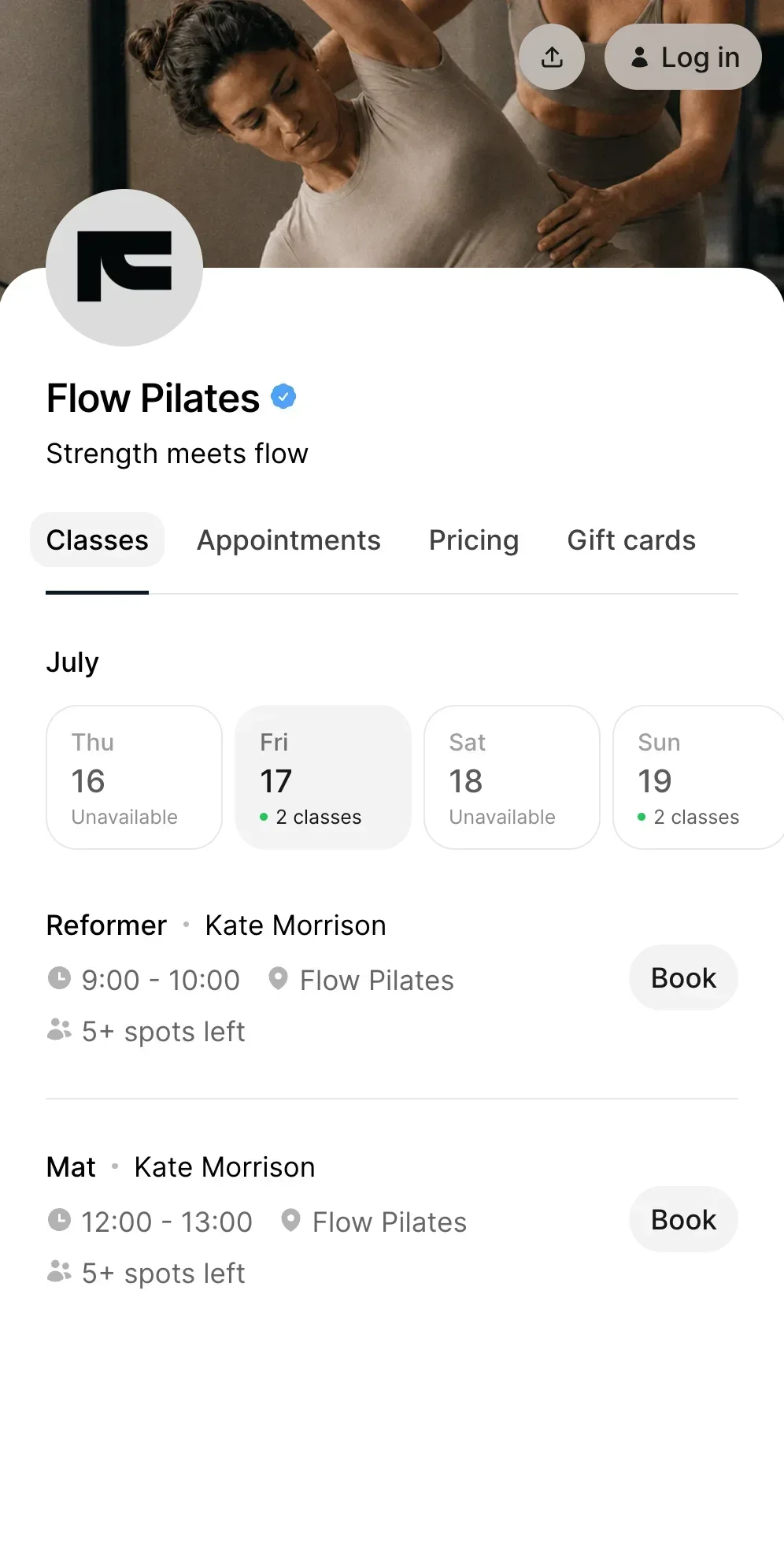
Manage bookings and payments easier
Get a free 7-day trial
No credit card required