How Much Does a Pilates Studio Make in 2026?

Ignas Lunenas
Sep 2, 2026
12 min read

Pilates can be a strong studio business, but there is a huge difference between a small owner-operated studio with six reformers and a mature location running classes throughout the day with hundreds of members. That makes answering how much does a Pilates studio make more complicated than giving one average number.
As a practical planning range, a smaller Pilates studio might generate $150,000–$300,000 per year, while an established boutique reformer studio can potentially reach $300,000–$600,000+ in annual revenue. Larger, high-volume studios in strong markets can approach or exceed $1 million per year, although reaching that level requires significant capacity, pricing, occupancy, and recurring membership revenue.
There is evidence that this level of revenue is possible. Club Pilates reported median gross revenue of approximately $978,300 for qualifying studios in 2025, according to its 2026 Franchise Disclosure Document. However, that figure represents mature locations within one of the world's largest Pilates franchise systems and should not be treated as the average revenue of an independent Pilates studio.
Demand for Pilates also remains strong. ClassPass reported that Pilates was its most-booked workout globally for the third consecutive year in 2025, with reservations increasing 66% year over year. Reformer Pilates bookings increased 71%, while mat Pilates increased 114%.
Time2book helps Pilates studios manage classes, bookings, payments, memberships, class packs, clients, waitlists, and business analytics in one simple system.
Try Time2book free today and simplify your studio bookings, payments, and client management.
In this guide, we'll break down how much a Pilates studio can make in 2026, show realistic monthly and annual revenue examples, explain how reformer capacity affects revenue, and look at how much of that money a studio owner may actually keep.
How Much Revenue Does a Pilates Studio Make?
There is no reliable single average that applies to every independent Pilates studio. Revenue depends heavily on the size of the studio, number of reformers, class schedule, pricing, occupancy, memberships, private sessions, and local market.
For planning purposes, these ranges illustrate how different Pilates studio models can look:
Pilates studio type | Illustrative annual revenue |
|---|---|
Small owner-operated studio | $150,000–$300,000 |
Established boutique studio | $300,000–$600,000 |
High-volume reformer studio | $600,000–$1,000,000+ |
Mature Club Pilates benchmark | ~$978,300 median |
The first three figures are planning ranges rather than published industry averages. The Club Pilates number, by comparison, comes from reported 2025 gross revenue for qualifying franchise studios and provides a useful benchmark for what a mature, high-volume Pilates operation can achieve.
The most useful approach for an independent studio owner is therefore not to ask what the "average Pilates studio" makes. Instead, calculate what your studio can make based on its actual capacity.
How Much Can a Pilates Studio Make Per Month?
A Pilates studio generating $300,000 per year averages approximately $25,000 in monthly revenue, while a $500,000 studio averages around $41,700 per month. A studio approaching $1 million in annual revenue needs to average roughly $83,300 per month.
Here is the same comparison across several revenue levels:
Annual Pilates studio revenue | Average monthly revenue |
|---|---|
$150,000 | $12,500 |
$200,000 | $16,667 |
$300,000 | $25,000 |
$400,000 | $33,333 |
$500,000 | $41,667 |
$600,000 | $50,000 |
$750,000 | $62,500 |
$1,000,000 | $83,333 |
Actual revenue will rarely be perfectly even throughout the year. January may be particularly strong, holidays can reduce attendance, and new studios often take time to build recurring memberships.
Still, converting annual goals into monthly targets makes the numbers much easier to manage.
Calculate Pilates Studio Revenue From Your Reformers
For a reformer Pilates studio, the number of reformers creates a natural limit on class revenue.
A simple formula is: Reformers × classes per day × operating days × average occupancy × average revenue per visit
Imagine you have:
- 8 reformers
- 6 classes per day
- 26 operating days per month
- 75% average occupancy
- $30 average realized revenue per visit
Your estimated monthly group-class revenue would be: 8 × 6 × 26 × 75% × $30 = $28,080 per month
That equals approximately: $336,960 per year
This calculation only includes group classes. Private sessions, retail, workshops, teacher training, online content, and other services could increase total studio revenue further.
Revenue by Number of Reformers
Using the same assumptions — six classes per day, 26 operating days per month, 75% average occupancy, and $30 average revenue per visit — capacity makes a significant difference:
Reformers | Monthly class revenue | Annual class revenue |
|---|---|---|
6 | $21,060 | $252,720 |
8 | $28,080 | $336,960 |
10 | $35,100 | $421,200 |
12 | $42,120 | $505,440 |
These numbers demonstrate why reformer capacity matters, but they also show why simply buying more equipment does not guarantee higher revenue. A 12-reformer studio running at 40% occupancy may generate less money than an eight-reformer studio consistently operating at 80–90%. Demand has to exist for the additional capacity.
Pilates Studio Revenue Example: Small 6-Reformer Studio
Consider a small owner-operated Pilates studio with six reformers.
The studio runs five group classes per day for 26 days each month. Its classes average 75% occupancy, meaning approximately 4.5 of the six spaces are filled, and average realized revenue is $30 per visit after memberships and packs are taken into account.
Group class revenue would be approximately: 6 reformers × 5 classes × 26 days × 75% × $30 = $17,550 per month
If the studio also generates around $3,000 each month from private sessions, total revenue would reach approximately $20,550 per month, or about $246,600 annually.
That is a meaningful business despite having only six reformers. The owner does not necessarily need a huge facility if they can keep the available capacity consistently occupied.
If you are considering this type of business, our guide to opening a small Pilates studio covers the equipment, space, costs, services, and systems needed for a leaner setup.
Pilates Studio Revenue Example: 10-Reformer Studio
Now imagine an established boutique studio with 10 reformers.
It operates six classes per day, 26 days each month, with average occupancy of 75% and average realized revenue of $30 per client.
Group class revenue becomes: 10 × 6 × 26 × 75% × $30 = $35,100 per month
If private sessions, workshops, and other services contribute another $5,000 each month, total monthly revenue would be approximately $40,100.
That equals: $481,200 in annual revenue
At this size, the business is approaching half a million dollars in annual sales without requiring every class to be completely full.
The key is consistency. A schedule that maintains healthy occupancy throughout the week is usually much stronger than one with several sold-out evening classes surrounded by poorly attended daytime sessions.
Pilates Studio Revenue Example: High-Volume Studio
Larger Pilates studios can move toward significantly higher revenue when they combine more reformers with a busy timetable.
Imagine a studio with:
- 14 reformers
- 8 classes per day
- 26 operating days per month
- 80% occupancy
- $30 average realized revenue per visit
Group-class revenue alone would be approximately: 14 × 8 × 26 × 80% × $30 = $69,888 per month
Add $8,000 per month from private sessions, workshops, retail, or other services, and total studio revenue reaches approximately $77,888 per month.
Annualized, that is roughly: $934,656
At this point, the revenue starts to resemble the Club Pilates benchmark. The 2026 Club Pilates FDD reported average gross revenue of approximately $987,800 and median revenue of approximately $978,300 among 1,005 qualifying studios during 2025.
Importantly, Club Pilates also reported that approximately 87% of revenue came from memberships, demonstrating how important recurring revenue can become as studios scale.
How Much Does a Pilates Studio Owner Make?
Studio revenue and owner income are not the same thing.
A Pilates studio generating $500,000 per year still needs to pay instructors, rent, utilities, equipment costs, marketing, insurance, payment processing, software, cleaning, administration, maintenance, taxes, and potentially loan repayments.
What remains after operating expenses is profit.
For an established Pilates studio, a 15–20% net profit margin can be considered healthy, while 20% or more represents strong profitability. We cover those numbers in detail in our guide to Pilates studio profit margins in 2026.
Using different profit margins shows how dramatically owner earnings can differ even when revenue stays the same:
Annual studio revenue | 10% profit | 15% profit | 20% profit | 25% profit |
|---|---|---|---|---|
$200,000 | $20,000 | $30,000 | $40,000 | $50,000 |
$300,000 | $30,000 | $45,000 | $60,000 | $75,000 |
$500,000 | $50,000 | $75,000 | $100,000 | $125,000 |
$750,000 | $75,000 | $112,500 | $150,000 | $187,500 |
$1,000,000 | $100,000 | $150,000 | $200,000 | $250,000 |
This is why a $1 million Pilates studio does not automatically mean a $1 million income for the owner.
The studio could generate $1 million in sales while leaving $150,000–$200,000 in profit after expenses. Conversely, a smaller owner-operated studio generating $350,000 with low overhead could potentially provide a very attractive income.
Owner Salary Can Make the Numbers More Complicated
There is another important distinction between owner salary and business profit.
If you own the Pilates studio and teach 20 classes each week, you are performing work that the business would otherwise need to pay an instructor to perform. If you also manage staff, answer client questions, handle marketing, and run daily operations, part of the money you receive is effectively compensation for your job.
For example, imagine a studio produces $100,000 after normal expenses, but the owner teaches and manages the business full time without paying themselves a formal wage. Calling the full $100,000 "profit" makes the studio appear more profitable than it really is.
A better approach is to separate: Compensation for the work you perform + return from owning the business
This becomes particularly important if your long-term goal is to build a studio that can operate without you.
What Determines How Much a Pilates Studio Makes?
The number of reformers matters, but capacity alone does not create revenue. Several variables work together to determine how much a Pilates studio can realistically make.
1. Class Occupancy
Occupancy is one of the biggest revenue drivers because most of the cost of running a class exists whether four clients attend or eight.
Consider an eight-reformer class with average realized revenue of $30 per booking:
Clients attending | Occupancy | Class revenue |
|---|---|---|
3 | 37.5% | $90 |
4 | 50% | $120 |
5 | 62.5% | $150 |
6 | 75% | $180 |
7 | 87.5% | $210 |
8 | 100% | $240 |
Increasing average attendance from four to seven clients increases revenue from $120 to $210 without requiring another instructor, another studio, or additional reformers.
That is why improving occupancy can sometimes be more valuable than expanding the timetable.
2. Pilates Class Pricing
Your revenue also depends on what each booking is worth.
Current Time2book pricing research places US reformer group classes broadly around $35–$60 for a drop-in, with memberships and class packs usually reducing the effective price per visit. Private sessions often command substantially higher prices.
Studio owners should therefore track average realized revenue per visit, not just the public drop-in price.
If your drop-in costs $40 but most members effectively pay $25 per class through memberships, using $40 in your financial projections will significantly overestimate revenue.
Our Pilates pricing guide covers drop-ins, memberships, class packs, private sessions, and different positioning strategies in more detail.
3. Number of Classes Per Day
A studio with 10 reformers running four classes per day has significantly less revenue capacity than the same studio running eight classes.
However, adding classes only works when there is enough demand. If clients who previously attended a 9 a.m. session become divided across 8 a.m., 9 a.m., and 10 a.m., the extra schedule may increase instructor payroll without materially increasing revenue.
Build the timetable around actual demand rather than simply trying to maximize the number of sessions offered.
4. Recurring Memberships
Recurring memberships can make Pilates studio revenue significantly easier to predict.
Instead of starting every month at zero, the studio enters the month knowing that a portion of revenue is already committed. This helps with instructor scheduling, cash-flow planning, marketing budgets, and decisions about when to add capacity.
The Club Pilates benchmark is a particularly strong example: its 2026 FDD reported that around 87% of qualifying studio revenue came from memberships.
For most independent studios, the goal does not need to be exactly 87%. The important point is that a strong base of recurring clients can create a much more predictable business than relying primarily on drop-ins.
5. Private Pilates Sessions
Private sessions can add meaningful revenue without requiring another large group class.
A studio might offer private sessions during periods when group-class demand is weaker or use a separate area of the studio alongside the group schedule. They can also support clients who need more personalized instruction or are not yet comfortable joining regular classes.
Private Pilates sessions commonly carry higher prices than group bookings, which makes them a useful premium layer within the studio's service mix.
6. Client Retention
A studio that attracts 50 new clients every month but loses 45 existing clients has a very different business from one that consistently keeps members for a year or longer.
Better retention increases lifetime value and reduces how much marketing is required simply to maintain revenue. It also creates stronger membership stability because more clients remain in the business from one month to the next.
For this reason, revenue growth should not be measured only through new sign-ups. Active memberships, repeat bookings, attendance frequency, cancellations, and retention matter just as much.
Can a Pilates Studio Make $1 Million a Year?
Yes, a Pilates studio can generate $1 million or more in annual revenue, but this should be viewed as a high-performing outcome rather than the default expectation.
The Club Pilates 2026 FDD provides real evidence that this revenue level is achievable. Its qualifying studios generated median 2025 gross revenue of approximately $978,300, with average revenue around $987,800. Individual studio results ranged considerably higher and lower.
For an independent studio, reaching $1 million could require a combination of:
- 10–16+ reformers
- High average occupancy
- Multiple classes throughout the day
- Premium pricing
- Hundreds of active clients
- Strong recurring memberships
- Private Pilates sessions
- Effective use of peak and off-peak capacity
- Good client retention
A studio does not need to reach $1 million to be successful, however. A smaller studio producing $400,000–$500,000 at a healthy margin may create a better business for the owner than a $1 million operation with significantly higher payroll, rent, debt, and management complexity.
How Much Can a New Pilates Studio Make in Its First Year?
New Pilates studios usually take time to reach mature revenue because memberships, referrals, local awareness, reviews, and repeat attendance need to build gradually.
A new studio might open with a strong launch and full introductory classes, but that does not mean those clients immediately become long-term members. Revenue during the first year can therefore fluctuate significantly while the owner identifies the best timetable, prices, instructors, marketing channels, and membership structure.
Rather than planning the first year around maximum capacity, create several scenarios:
Scenario | Average occupancy |
|---|---|
Conservative | 40–50% |
Realistic | 60–70% |
Strong | 75–85% |
Near capacity | 90%+ |
Build your financial model using the realistic scenario and make sure the business can survive the conservative one.
If you are still planning your studio, our Pilates Studio Business Plan: Step-by-Step Guide for 2026 explains how to plan your concept, pricing, startup costs, monthly expenses, memberships, and financial projections before opening.
Track Revenue Per Class, Not Just Total Revenue
Total monthly revenue is important, but it does not tell you which parts of your studio are actually working.
Studio owners should also look at performance at the class level. Track how many spaces were available, how many were booked, what clients actually paid for those visits, and what it cost to run the class.
Useful numbers include:
- Monthly revenue
- Recurring membership revenue
- Average revenue per visit
- Average class occupancy
- Revenue per class
- Revenue by instructor
- Revenue by service
- Active clients
- New clients
- Membership cancellations
- Client retention
Instructor costs should be considered alongside those numbers. Our guide to Pilates instructor pay in 2026 explains common pay structures and how instructor compensation interacts with class revenue.
Time2book helps Pilates studios manage schedules, memberships, class packs, payments, clients, and analytics in one system, making it easier to understand whether growth is coming from more clients, higher attendance, better pricing, or stronger recurring memberships.
Frequently Asked Questions About Pilates Studio Revenue
How much does a Pilates studio make per year?
A Pilates studio can potentially generate anywhere from around $150,000 to $1 million+ per year, depending on its size, pricing, capacity, occupancy, location, and service mix.
A smaller owner-operated studio may sit toward the lower end, while established multi-instructor reformer studios can generate several hundred thousand dollars annually. High-volume studios in strong markets can approach or exceed $1 million.
How much does a Pilates studio make per month?
A Pilates studio generating $300,000 annually averages approximately $25,000 per month, while a $500,000 studio averages around $41,700 per month.
A studio generating $1 million annually would need to average approximately $83,300 per month. Actual monthly revenue will vary because demand is rarely identical throughout the year.
How much does a reformer Pilates studio make?
Reformer Pilates studio revenue depends heavily on the number of machines and how often they are occupied.
For example, an eight-reformer studio running six classes per day for 26 days each month at 75% occupancy and $30 average realized revenue per booking would generate approximately $28,080 per month from group classes, or $336,960 annually before additional revenue from private sessions or other services.
How much does a Pilates studio owner make?
Owner income depends on how much revenue remains after business expenses.
For example, a studio generating $500,000 per year at a 15% net profit margin would produce approximately $75,000 in profit. At a 20% margin, profit would increase to approximately $100,000.
Owner salary should also be separated from business profit when the owner actively teaches or manages the studio.
Can a Pilates studio make $1 million per year?
Yes. Large, well-established Pilates studios can exceed $1 million in annual revenue.
Club Pilates reported median gross revenue of approximately $978,300 among qualifying studios for 2025, with some locations generating significantly more. However, these are mature franchise operations and should not be treated as guaranteed results for a new independent studio.
How many clients does a Pilates studio need to make money?
There is no fixed number because pricing, attendance frequency, capacity, and expenses differ between studios.
A better measurement is how many visits and memberships are required to cover monthly operating costs. A studio with 100 high-frequency recurring members could potentially generate more predictable revenue than one with 300 occasional drop-in clients.
Are Pilates studios profitable?
Pilates studios can be profitable when pricing, occupancy, payroll, rent, and client retention are managed effectively.
For an established studio, a 15–20% net profit margin can be considered healthy, while margins above 20% represent strong performance. Revenue alone should therefore never be used as the measure of whether a Pilates studio is financially successful.
What makes the most money in a Pilates studio?
For many studios, recurring reformer memberships provide the strongest foundation because they combine regular attendance with predictable monthly revenue.
Private sessions can generate high revenue per client, while workshops, class packs, retail, and online content can provide additional income. The strongest model is usually a combination rather than relying entirely on one service.
Final Thoughts: How Much Can a Pilates Studio Make in 2026?
There is no universal answer to how much a Pilates studio makes. A six-reformer owner-operated studio and a 14-reformer location running eight classes per day are fundamentally different businesses.
As a practical planning framework:
- $150,000–$300,000/year: smaller studio
- $300,000–$600,000/year: established boutique studio
- $600,000–$1 million+/year: high-volume studio
- ~$978,300/year: reported 2025 median revenue for qualifying Club Pilates studios
The biggest lesson is that studio size alone does not determine revenue. Capacity × occupancy × pricing × frequency is what creates the core economics of a Pilates studio.
A smaller studio with consistently full classes, sensible pricing, strong recurring memberships, and loyal clients can build an excellent business without becoming a huge operation. On the other hand, adding reformers, instructors, and classes before demand exists can increase expenses faster than revenue.
Track your classes, clients, memberships, occupancy, and revenue closely, then expand when the numbers justify it.
Time2book gives Pilates studios one modern system for managing classes, bookings, payments, memberships, class packs, clients, waitlists, and business analytics.
Try Time2book free today and simplify your studio bookings, payments, and client management.
Pilates studio software
Learn more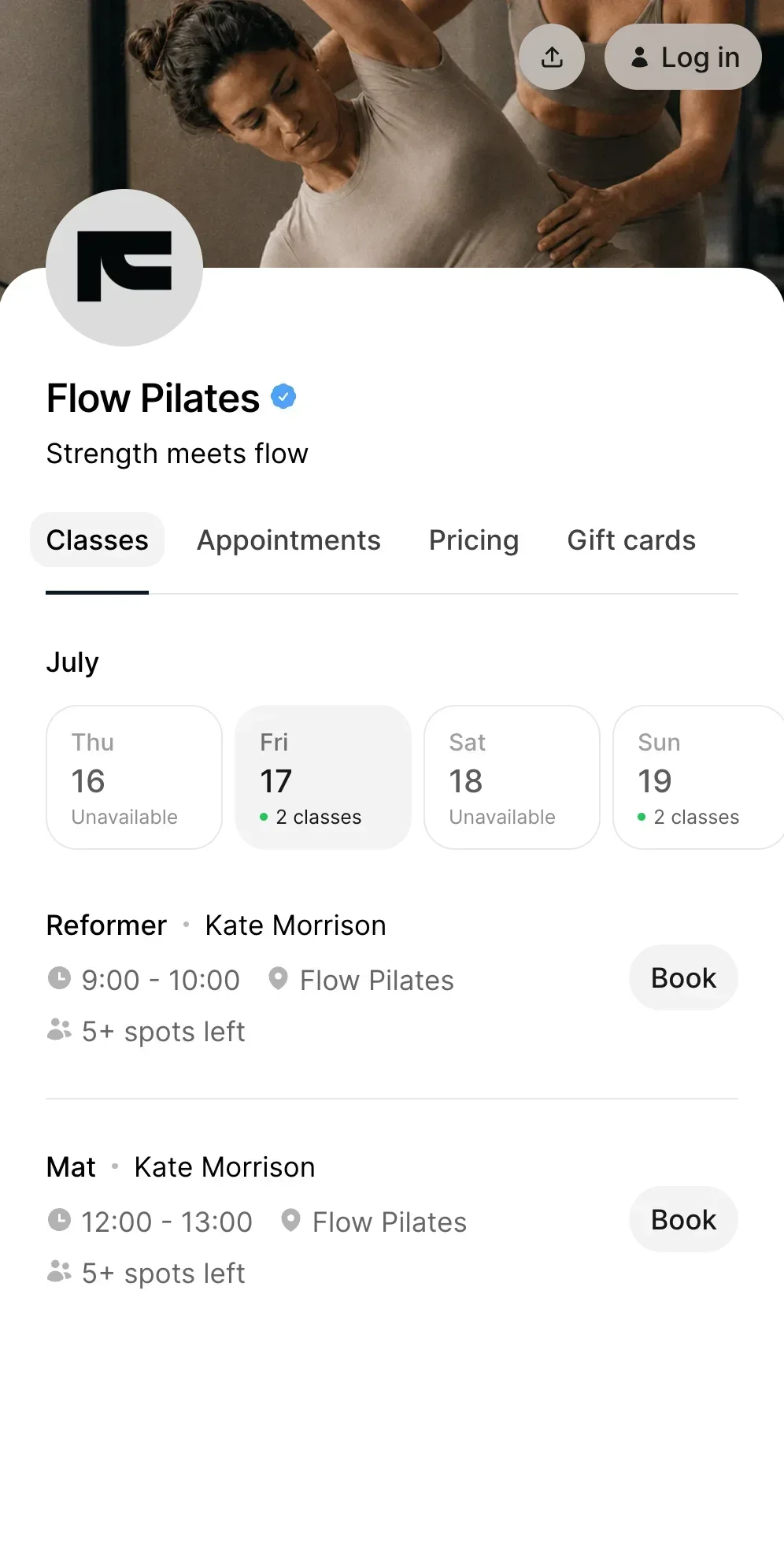
Manage bookings and payments easier
Get a free 7-day trial
No credit card required