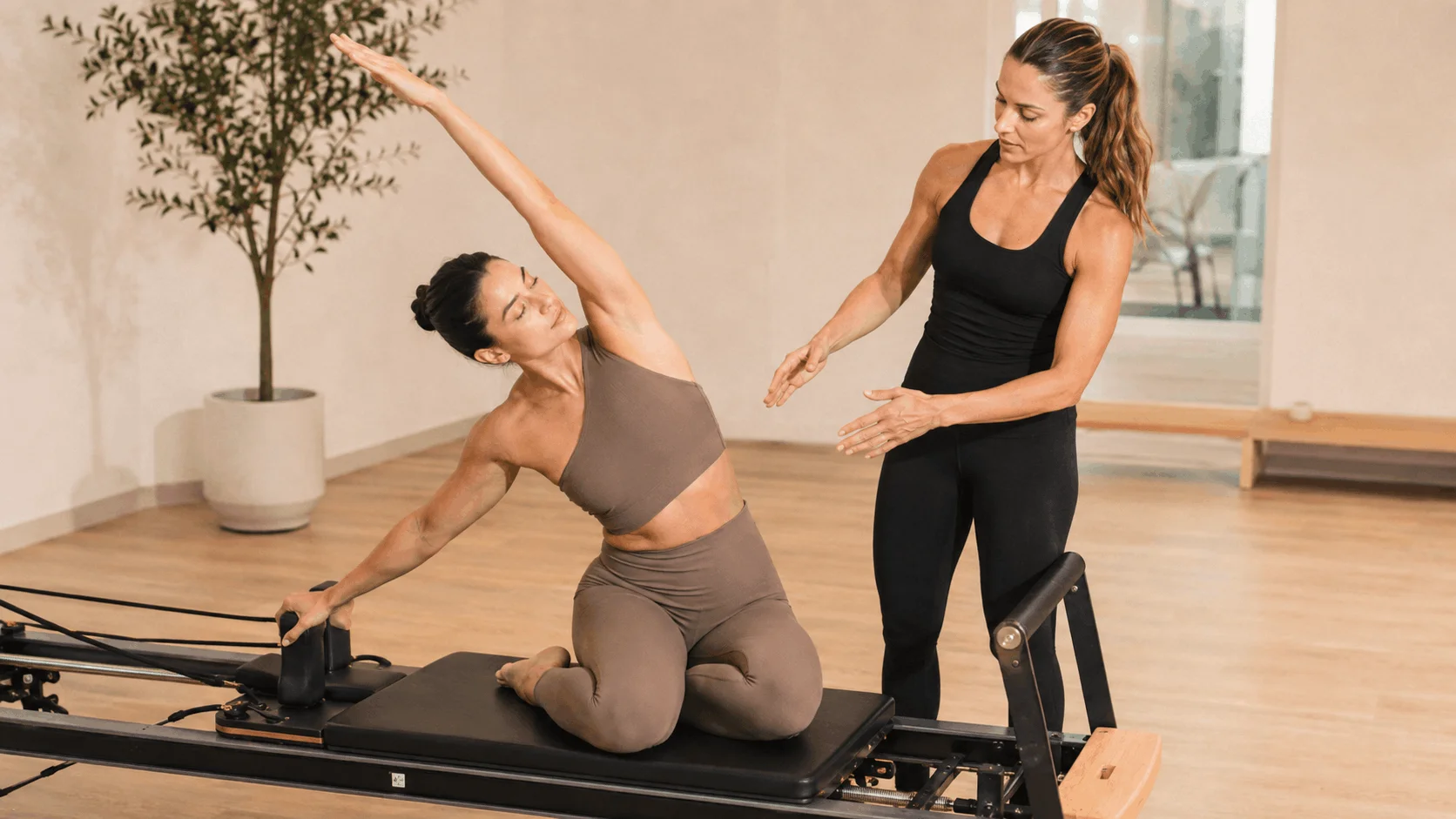
Writing good Pilates class descriptions can seem like a small task, but they have an important job. A class description helps a potential client understand what they are booking, whether the class matches their experience level, what equipment they will use, and what they can expect when they arrive.
This is especially important for Pilates studios with several class types. A new client may not immediately understand the difference between Reformer Foundations, Reformer Flow, Power Pilates, Mat Pilates, Tower, or an intermediate class. If the descriptions are unclear, clients may book the wrong session—or avoid booking altogether.
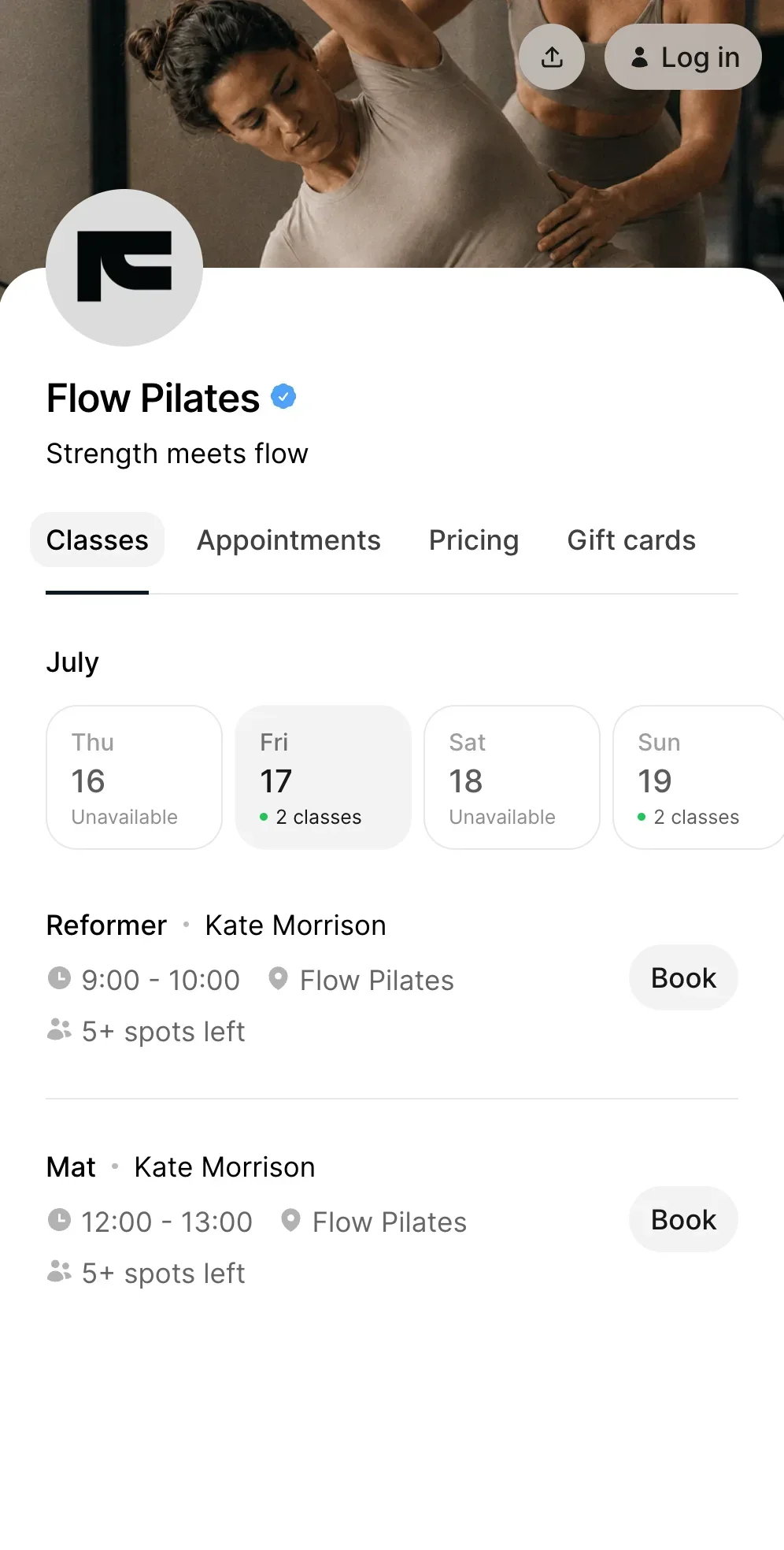
With Time2book Pilates studio software, studios can create classes, set capacity, assign instructors, sell memberships and class packs, accept payments, and let clients book online. Clear class descriptions make that booking experience even easier.
Try Time2book free today and create a simple online schedule where clients can understand, book, and pay for your Pilates classes.
In this guide, we’ll share 30 Pilates class descriptions you can adapt for reformer, mat, beginner, advanced, private, prenatal, and specialty Pilates classes.
What Is a Pilates Class Description?
A Pilates class description is a short explanation of what clients can expect from a specific class.
It normally appears on your:
- Online class schedule
- Booking page
- Pilates studio website
- Mobile booking page
- Intro offer page
- Membership information
- Studio timetable
A good Pilates class description answers a few basic questions:
- What type of Pilates is this?
- What equipment will be used?
- Who is the class for?
- What level of experience is required?
- What will clients focus on?
- How intense or fast-paced is the class?
- Are there any prerequisites?
For example, instead of writing:
Reformer Level 1
A great full-body Pilates workout.
You could write:
Reformer Foundations
A beginner-friendly reformer class focused on Pilates fundamentals, controlled movement, core strength, alignment, and confidence on the equipment. Perfect for clients who are new to reformer Pilates or want to revisit the basics.
The second description makes it much easier for a new client to know whether the class is right for them.
Current Pilates studios commonly use descriptions to differentiate beginners from more experienced clients and to communicate prerequisites for higher-level sessions. Some require introductory or foundation sessions before clients progress to more advanced classes.
What Should a Good Pilates Class Description Include?
You do not need a long paragraph for every class. Most Pilates class descriptions can communicate everything important in two to four sentences.
Class type
Start by identifying what the client will actually be doing.
For example:
- Reformer Pilates
- Mat Pilates
- Tower Pilates
- Classical Pilates
- Private Pilates
- Reformer and Tower
- Pilates strength
- Pilates stretch
Experience level
Make the level obvious.
Use terms such as:
- First-timers
- Beginner
- Beginner-friendly
- All levels
- Intermediate
- Advanced
- Experienced clients only
Avoid vague language if there are safety or experience requirements.
What clients can expect
Mention two or three of the main focuses of the class.
For example:
- Core strength
- Posture
- Mobility
- Full-body strength
- Stability
- Balance
- Flexibility
- Controlled movement
- Endurance
- Technique
Pace and intensity
A client choosing between two reformer classes may care more about pace than the exercise list.
Describe it as:
- Slow and controlled
- Steady-paced
- Flowing
- Dynamic
- Athletic
- Higher-intensity
- Technique-focused
Prerequisites
If clients need previous experience, say so clearly.
For example:
Recommended after completing at least five Reformer Foundations classes.
or:
This class is intended for experienced clients who are confident using the reformer and comfortable with faster transitions.
Specific descriptions help clients choose the appropriate class rather than simply booking whichever time fits their schedule.
30 Pilates Class Description Examples
Below are ready-to-use Pilates class description examples that you can adapt to match your studio, instructors, equipment, and teaching style.
Reformer Pilates Class Descriptions
1. Reformer Foundations
Best for: Beginners
New to reformer Pilates? Start here. This beginner-friendly class introduces the reformer, basic Pilates principles, spring settings, breathing, alignment, and controlled movement. You’ll build confidence while learning the foundations needed for our other reformer classes.
2. Beginner Reformer Pilates
Best for: New and newer clients
A supportive introduction to reformer Pilates with a focus on core strength, posture, stability, and correct technique. Exercises are taught at a comfortable pace with time to understand the equipment and movement patterns.
No previous reformer experience required.
3. Reformer Level 1
Best for: Beginners and clients returning to the basics
Build a strong Pilates foundation with controlled, full-body reformer exercises. This class focuses on alignment, core engagement, breathing, balance, and fundamental reformer movements.
Ideal for beginners or experienced clients who enjoy working on technique.
4. Reformer All Levels
Best for: Clients with mixed experience
A full-body reformer Pilates class designed to build strength, mobility, balance, and control. Your instructor will offer variations and progressions throughout the class so you can work at a level that feels appropriate for your body and experience.
Some previous reformer experience may be recommended depending on your studio format.
5. Reformer Flow
Best for: Beginner to intermediate clients
Move through a flowing sequence of reformer exercises designed to strengthen the whole body while improving mobility and control. Expect smooth transitions, focused core work, and a balanced combination of strength and movement.
Ideal for clients who enjoy a continuous, steady-paced class.
6. Reformer Level 2
Best for: Intermediate clients
Ready to progress beyond the foundations? Reformer Level 2 introduces more challenging exercises, longer sequences, balance work, and faster transitions while continuing to emphasize Pilates control and technique.
Previous reformer experience is required.
7. Advanced Reformer
Best for: Experienced Pilates clients
A challenging reformer class for experienced clients who are confident with Pilates fundamentals and equipment transitions. Expect advanced exercises, complex sequences, increased balance challenges, and a stronger emphasis on control, precision, and endurance.
This class is not suitable for first-time reformer clients.
8. Athletic Reformer
Best for: Clients looking for a more athletic class
A higher-energy reformer workout combining Pilates principles with challenging strength and endurance sequences. Expect full-body resistance work, dynamic transitions, core training, and exercises designed to challenge stability and control.
Previous reformer experience is recommended.
9. Reformer Strength
Best for: Clients who want more resistance work
Build full-body strength using the reformer’s spring resistance alongside controlled Pilates movement. This class focuses on legs, glutes, core, upper body, and stability while maintaining strong alignment and technique.
Expect a challenging but controlled workout.
10. Reformer Stretch & Mobility
Best for: All levels
Slow things down with a reformer class focused on mobility, flexibility, controlled movement, and releasing tension. Expect gentle strengthening alongside longer stretches and movements designed to help your body feel more open and balanced.
A great complement to regular Pilates, running, strength training, or a busy week.
Mat Pilates Class Descriptions
11. Beginner Mat Pilates
Best for: Beginners
Learn the foundations of Pilates without large equipment. This beginner-friendly mat class focuses on breathing, core engagement, posture, controlled movement, mobility, and basic Pilates exercises.
No previous Pilates experience is required.
12. Mat Pilates
Best for: All levels
A full-body Pilates class performed primarily on the mat. Expect controlled exercises designed to improve core strength, mobility, posture, balance, and body awareness.
Your instructor will offer modifications and progressions where appropriate.
13. Intermediate Mat Pilates
Best for: Clients with Pilates experience
Build on your Pilates foundations with more challenging mat sequences, longer holds, balance work, and progressive core exercises.
This class moves at a steadier pace and is best suited to clients who already understand basic Pilates technique.
14. Power Mat Pilates
Best for: Clients wanting a stronger workout
A dynamic mat Pilates class designed to challenge strength, endurance, core stability, and control. Expect faster transitions and progressive exercise variations while maintaining Pilates technique and precision.
Previous Pilates experience is recommended.
15. Mat Pilates With Props
Best for: All levels
A varied full-body Pilates class using small props such as resistance bands, Pilates rings, balls, blocks, or light weights. Props add resistance, support, and variety while helping you develop strength, balance, mobility, and body awareness.
Suitable for a range of experience levels.
Beginner Pilates Class Descriptions
16. Introduction to Reformer Pilates
Best for: Complete beginners
Never used a reformer before? This introductory class will help you feel comfortable before joining regular group classes.
You’ll learn how to safely use the carriage, footbar, springs, straps, and basic reformer positions while practicing a selection of beginner Pilates movements.
Some studios use introductory classes specifically to familiarise new clients with the reformer before they enter the standard timetable.
17. Pilates Fundamentals
Best for: Beginners and anyone refreshing their technique
Learn the building blocks of Pilates through slower, technique-focused movement. We’ll work on breathing, alignment, core engagement, posture, control, and fundamental exercises that support progression into other Pilates classes.
A great place to start—or restart—your Pilates practice.
18. First Pilates Class
Best for: First-time clients
Your first Pilates class should feel welcoming, not intimidating. This session introduces the basic principles of Pilates and gives you time to learn key movements, ask questions, and understand how our classes work.
No previous Pilates experience required.
Specialty Pilates Class Descriptions
19. Pilates Core & Glutes
Best for: All levels
A Pilates class with extra focus on core stability, glute strength, hips, and lower-body control. Expect a balanced workout combining targeted exercises with full-body movement.
Your instructor will provide options to adjust the challenge throughout the class.
20. Pilates Strength & Sculpt
Best for: Beginner to intermediate clients
A full-body Pilates workout with extra emphasis on strength and resistance. Using controlled Pilates exercises and optional props, this class targets the core, arms, legs, and glutes while improving stability and movement quality.
Expect to feel challenged while staying focused on form.
21. Pilates Mobility
Best for: All levels
Move better and feel less restricted with a Pilates class focused on mobility, flexibility, posture, and controlled movement.
This slower-paced session combines gentle strength work with exercises designed to improve movement through the spine, hips, shoulders, and whole body.
22. Pilates Stretch
Best for: All levels
A slower Pilates session designed to help you move, stretch, and reset. Expect gentle strengthening, mobility work, breathing, and longer controlled stretches.
Perfect as an active recovery class or complement to your regular reformer sessions.
23. Pilates for Runners
Best for: Runners of all levels
A Pilates class designed to complement running by developing core stability, hip strength, balance, mobility, and controlled movement.
Expect extra attention on the hips, glutes, legs, ankles, and trunk to support a strong and balanced body alongside your running routine.
24. Pilates for Seniors
Best for: Older adults
A supportive Pilates class focused on strength, mobility, posture, balance, and confidence in everyday movement. Exercises are taught at a controlled pace with options to accommodate different abilities.
Clients with specific medical conditions or movement restrictions should speak with the studio before booking so we can recommend the most appropriate class.
25. Prenatal Pilates
Best for: Pregnant clients
A Pilates class designed specifically for pregnancy, with movements adapted to support strength, posture, mobility, breathing, and changing movement needs throughout pregnancy.
Please let your instructor know how many weeks pregnant you are and share any relevant guidance from your healthcare professional before attending.
26. Postnatal Pilates
Best for: Clients returning to exercise after pregnancy
A supportive Pilates class designed to help clients gradually reconnect with movement after pregnancy. Sessions focus on breathing, controlled strength, posture, mobility, and rebuilding confidence.
Please check your studio’s individual requirements and seek appropriate medical guidance before returning to exercise after birth.
Equipment Pilates Class Descriptions
27. Tower Pilates
Best for: Beginner to intermediate clients
A full-body Pilates class using the Tower and its springs, bars, and straps to provide both support and resistance. Expect controlled exercises focused on core strength, mobility, posture, stability, and body awareness.
Tower classes can provide a different movement experience while maintaining the fundamental principles of Pilates.
28. Reformer & Tower
Best for: Clients with some Pilates experience
Experience two pieces of Pilates equipment in one session. This class combines reformer exercises with Tower spring work to create a varied full-body workout focused on strength, mobility, stability, and control.
Previous Pilates equipment experience is recommended.
Private Pilates Class Descriptions
29. Private Pilates Session
Best for: Individual attention
A one-to-one Pilates session designed around your goals, experience, and movement needs. Your instructor can adapt the exercises, equipment, pace, and progression specifically for you.
Private Pilates is ideal for beginners who want individual guidance, experienced clients working toward specific goals, or anyone who prefers personalised instruction.
30. Duet Pilates
Best for: Two clients training together
A semi-private Pilates session for two people who want more individual attention while training together. Your instructor will guide both clients through a session adapted to their experience and goals.
Perfect for partners, friends, family members, or clients who want a smaller alternative to group classes.
Pilates Class Description Template
If you are creating your own Pilates class descriptions, use this simple formula:
[Class name]
A [pace/level] Pilates class using [equipment] designed to improve [2–4 benefits or areas of focus]. Expect [brief description of experience or format]. Best suited to [experience level or client type]. [Prerequisite if required.]
Example
Reformer Flow
A steady-paced reformer Pilates class designed to improve full-body strength, mobility, balance, and control. Expect flowing sequences and smooth transitions with options to progress or modify exercises. Best suited to clients who already understand basic reformer movements.
You can reuse the same structure across your entire timetable.
How Long Should a Pilates Class Description Be?
For an online booking page, aim for approximately 40–100 words.
That is usually enough space to explain:
- Class format
- Level
- Equipment
- Main focus
- Prerequisites
You do not need to explain the entire workout.
Clients generally want to answer one question:
“Is this the right class for me?”
Make that answer easy to find.
How to Write Beginner Pilates Class Descriptions
Beginner descriptions deserve extra attention because these clients have the least existing knowledge.
Avoid writing:
Suitable for beginners.
Explain why it is suitable.
For example:
New to reformer Pilates? This class moves at a slower pace so you have time to learn the equipment, basic spring settings, fundamental movements, and Pilates technique.
Beginner clients should know whether:
- No experience is required
- Equipment will be explained
- The class moves more slowly
- Modifications are available
- They must attend an introductory class first
This distinction matters. Recent Pilates community discussions show that clients can become frustrated when classes labelled “beginner” actually move at a pace or complexity better suited to experienced participants. Clear class levels and descriptions help set expectations before someone books.
How to Write Intermediate and Advanced Pilates Class Descriptions
Higher-level descriptions should clearly communicate prerequisites.
Avoid:
A harder class for people looking for a challenge.
Instead, use something specific:
Designed for experienced reformer clients who are confident with spring changes, kneeling and standing work, faster transitions, and foundational reformer exercises.
You might also require:
- A minimum number of classes
- Instructor approval
- Completion of Level 1
- Familiarity with specific equipment
- No current movement restrictions incompatible with the class format
Some Pilates studios explicitly state a minimum number of previous classes or require clients to complete introductory sessions before progressing.
The goal is not to make advanced classes exclusive. It is to ensure everyone in the session can safely follow the class at the advertised level.
How to Add Pilates Classes to Your Booking Schedule
Once your Pilates class descriptions are ready, make it easy for clients to act on them.
A useful online class listing should display:
- Class name
- Description
- Instructor
- Date and time
- Duration
- Location
- Available spaces
- Experience level
- Price or eligible membership
- Booking button
With Time2book class scheduling software for Pilates studios, you can create recurring Pilates classes, set capacity limits, assign instructors, define booking policies, manage waitlists, and accept online payments.
If you are still deciding which classes to run and when, read our guide to setting up a Pilates studio schedule.
For instructors planning what actually happens inside each session, our Pilates class planning guide includes class structures, lesson planning tips, and a reusable Pilates class plan.
Frequently Asked Questions About Pilates Class Descriptions
A Pilates class description should explain the class type, equipment, experience level, pace, main areas of focus, and any prerequisites. Keep it concise enough to scan quickly while giving clients enough information to decide whether the class is appropriate for them.
Describe what the client will actually experience rather than listing only general benefits.
For example:
A beginner-friendly reformer Pilates class focused on core strength, alignment, mobility, and controlled movement. Learn fundamental reformer exercises at a comfortable pace with guidance from your instructor.
A good Reformer Pilates class description identifies the level and explains how the reformer will be used.
For example:
A full-body reformer Pilates class designed to build strength, mobility, stability, and control. Expect flowing sequences using spring resistance with modifications and progressions available throughout the session.
A beginner Pilates class description should reassure new clients that no previous experience is required and explain what they will learn.
For example:
New to Pilates? This beginner class introduces breathing, core engagement, alignment, and fundamental movements at a comfortable pace. No previous Pilates experience required.
Around 40–100 words is usually enough for an online booking page. The description should be easy to scan and answer the most important question: whether the class is suitable for the client.
Longer explanations can be placed on dedicated class pages if your studio needs them.
Popular approaches include combining the equipment or style with a descriptive word, such as Reformer Foundations, Reformer Flow, Reformer Strength, Pilates Restore, Mat Fundamentals, or Reformer Power.
Creative names work best when the class level and format remain clear.
If the exercises, pace, experience requirements, or equipment knowledge differ significantly, separating classes by level can make the schedule easier to understand. Beginner, all-level, intermediate, and advanced classes should have clearly different descriptions and prerequisites.
Pilates booking software can organize recurring classes by type, instructor, duration, capacity, and schedule while letting clients reserve and pay online. Time2book lets studios manage group classes, memberships, class packs, payments, waitlists, and client bookings from one platform.
Final Thoughts
Good Pilates class descriptions make your timetable easier to understand.
A new client should not have to guess whether Reformer Flow, Foundations, Power, or Level 2 is the right place to start. Your descriptions should clearly explain the class format, level, equipment, pace, and what clients can expect.
You do not need to make every description complicated. Keep them clear, consistent, and focused on the person making the booking.
Use the 30 Pilates class description examples above as a starting point, adapt the wording to your teaching style, and make sure your class schedule gives clients a simple path from reading about a class to booking it.
Try Time2book free today and create a simpler Pilates studio schedule with online bookings, payments, memberships, class packs, waitlists, and client management in one place.