Pilates Studio Break-Even: How Many Clients Do You Need in 2026?

Ignas Lunenas
Sep 4, 2026
11 min read

How many clients does a Pilates studio need before it actually starts making money?
For a studio spending $20,000 per month and generating an average of $200 in monthly revenue per active client, the simple answer is around 100 active paying clients. If average client spend is only $150, that same studio would need roughly 134 clients. At $250 per client, it would need around 80.
But there is no universal Pilates studio break-even number. Your real break-even point depends on monthly expenses, pricing, memberships, class attendance, number of reformers, instructor payroll, and how often each client visits.
That is why studio owners should calculate break-even in several ways: revenue needed, active clients needed, bookings needed, and class occupancy needed.
Time2book helps Pilates studios manage classes, memberships, class packs, payments, clients, waitlists, and business analytics in one system, making it easier to see whether your studio is moving toward break-even.
Try Time2book free today and simplify your studio bookings, payments, and client management.
In this guide, we'll calculate how many clients a Pilates studio needs to break even in 2026 and show realistic examples for different studio sizes, pricing levels, and class capacities.
What Is the Break-Even Point for a Pilates Studio?
Your Pilates studio break-even point is the point where revenue covers your operating expenses.
If your studio costs $20,000 per month to operate and generates exactly $20,000 in revenue, you have reached break-even. The studio is no longer losing money, but it is not generating profit either.
If revenue increases to $25,000 while expenses remain at $20,000, approximately $5,000 is left before taxes and any additional costs.
At a basic level: Break-even revenue = Monthly operating expenses
So if your monthly expenses are:
Monthly studio expenses | Revenue needed to break even |
|---|---|
$10,000 | $10,000 |
$15,000 | $15,000 |
$20,000 | $20,000 |
$25,000 | $25,000 |
$30,000 | $30,000 |
The calculation becomes more useful when we translate that revenue into clients and bookings.
How Many Clients Does a Pilates Studio Need to Break Even?
The simplest formula is: Monthly expenses ÷ average monthly revenue per client = clients needed to break even
Imagine your Pilates studio costs $20,000 per month to operate.
If the average active client spends $200 per month: $20,000 ÷ $200 = 100 clients
Your rough break-even point is therefore 100 active paying clients.
Change average client spend and the answer changes quickly.
Monthly expenses | $150/client | $200/client | $250/client |
|---|---|---|---|
$10,000 | 67 clients | 50 clients | 40 clients |
$15,000 | 100 clients | 75 clients | 60 clients |
$20,000 | 134 clients | 100 clients | 80 clients |
$25,000 | 167 clients | 125 clients | 100 clients |
$30,000 | 200 clients | 150 clients | 120 clients |
This table shows why asking how many clients a Pilates studio needs without knowing pricing and expenses can be misleading.
Two studios can have exactly 100 active clients and completely different financial results. If one averages $140 per client and another averages $240, there is a $10,000 difference in monthly revenue between them.
Average Revenue Per Client Matters More Than Total Client Count
Studio owners sometimes focus heavily on reaching milestones such as 100, 200, or 300 clients.
But client count alone does not tell you whether the studio can break even.
Imagine two studios each have 100 active clients.
Studio A
Average monthly revenue per client: $140
100 × $140 = $14,000 monthly revenue
Studio B
Average monthly revenue per client: $220
100 × $220 = $22,000 monthly revenue
Studio B generates $8,000 more every month despite having exactly the same number of clients.
This is why memberships, class-pack pricing, attendance frequency, private sessions, discounts, and intro offers all influence your break-even point.
Instead of simply asking:
"How many clients do we have?"
Track:
- Active paying clients
- Average monthly revenue per client
- Average revenue per visit
- Visits per client
- Membership revenue
- Total monthly revenue
Those numbers tell you much more about the financial health of the business.
How Many Pilates Bookings Do You Need to Break Even?
Another way to calculate your break-even point is through paid visits.
The simplified formula is:
Monthly expenses ÷ average revenue per visit = bookings needed to break even
Imagine your studio has $20,000 in monthly operating expenses and generates an average of $30 for every attended booking after memberships, class packs, and discounts are taken into account.
You need:
$20,000 ÷ $30 = approximately 667 paid bookings per month
Here is how the number changes at different revenue-per-visit levels:
Monthly expenses | $25/visit | $30/visit | $35/visit |
|---|---|---|---|
$10,000 | 400 | 334 | 286 |
$15,000 | 600 | 500 | 429 |
$20,000 | 800 | 667 | 572 |
$25,000 | 1,000 | 834 | 715 |
$30,000 | 1,200 | 1,000 | 858 |
These are simplified planning calculations. Instructor payroll may change as additional classes are added, payment fees increase with revenue, and private sessions may contribute additional income.
Still, this gives studio owners a much more useful target than simply saying, "We need more bookings."
Turn Break-Even Bookings Into Active Clients
Once you know how many bookings you need, you can estimate the number of clients required based on attendance frequency.
Using our previous example: 667 bookings needed per month
Now consider how often each active client attends.
Average visits per client/month | Active clients needed |
|---|---|
4 visits | 167 clients |
5 visits | 134 clients |
6 visits | 112 clients |
8 visits | 84 clients |
10 visits | 67 clients |
This is why a studio with 80 highly engaged members can potentially generate more revenue than a studio with 200 people who attend occasionally.
Recurring memberships can be particularly valuable because they encourage regular attendance while also making monthly revenue easier to predict.
The goal is not simply to accumulate the largest client database possible. You want enough active, paying, retained clients to support your studio's operating costs.
Calculate Break-Even Occupancy for a Reformer Pilates Studio
For reformer Pilates, there is another important limit: capacity.
Imagine your studio has:
- 8 reformers
- 6 classes per day
- 26 operating days per month
Your total monthly capacity is: 8 × 6 × 26 = 1,248 available class spaces
If you need 667 monthly bookings to break even: 667 ÷ 1,248 = 53.4% average occupancy
So this studio would need to fill approximately 53% of available class spaces to reach the simplified break-even point.
Here is what different occupancy levels would mean:
Average occupancy | Monthly bookings | Revenue at $30/visit |
|---|---|---|
40% | 499 | $14,970 |
50% | 624 | $18,720 |
60% | 749 | $22,470 |
70% | 874 | $26,220 |
80% | 998 | $29,940 |
90% | 1,123 | $33,690 |
For a studio with approximately $20,000 in monthly costs, somewhere between 50% and 60% occupancy would therefore represent break-even under these assumptions.
This does not mean 53% should become a universal Pilates studio occupancy target. A studio with higher rent, lower pricing, more instructors, or fewer classes may need a much higher occupancy rate.
Pilates Studio Break-Even Example: Small 6-Reformer Studio
Consider a small owner-operated studio with six reformers.
- Its monthly operating expenses are approximately: $12,000
- Average realized revenue per visit is: $30
- The studio therefore needs approximately: $12,000 ÷ $30 = 400 paid bookings per month
- If the average client attends six times per month: 400 ÷ 6 = approximately 67 active clients
Now assume the studio runs five classes per day for 26 days per month.
- Total capacity is: 6 reformers × 5 classes × 26 days = 780 spaces
- The studio needs to fill: 400 ÷ 780 = approximately 51% of available capacity
Under this simplified scenario, the small studio could reach break-even with approximately:
- 67 active clients
- 400 monthly visits
- 51% average class occupancy
That is very different from assuming every Pilates studio needs hundreds of members to survive. A smaller space with controlled rent and a lean operating model can have a relatively low break-even point.
Pilates Studio Break-Even Example: 10-Reformer Studio
Now consider an established studio with 10 reformers.
- Monthly expenses are: $25,000
- Average realized revenue per visit is: $32
- The studio needs approximately: $25,000 ÷ $32 = 782 visits per month
- If the average active client attends six times each month: 782 ÷ 6 = approximately 131 active clients
- If the studio operates six classes per day for 26 days: 10 × 6 × 26 = 1,560 available spaces
- Break-even occupancy would therefore be: 782 ÷ 1,560 = approximately 50%
This example shows something important: a larger studio does not automatically need dramatically higher occupancy. The larger studio has higher costs, but it also has more available spaces and potentially higher pricing. The relationship between costs, pricing, capacity, and occupancy determines break-even.
A More Accurate Pilates Studio Break-Even Formula
The simple calculations above are useful for planning, but businesses also have variable expenses.
For example, payment processing fees increase when revenue increases. Some instructors receive attendance bonuses or revenue shares, and consumable costs may rise as more clients attend.
A more accurate calculation uses contribution margin.
- First calculate: Contribution per client = Average client revenue – variable costs associated with that client
- Then calculate: Break-even clients = Fixed monthly costs ÷ contribution per client
Imagine:
- Fixed monthly costs: $15,000
- Average monthly revenue per client: $200
- Variable costs per client: $20
Each client contributes: $200 – $20 = $180
Your break-even point becomes: $15,000 ÷ $180 = approximately 84 clients
This is more accurate than simply dividing fixed costs by the full $200 because not every dollar of additional revenue becomes available to cover rent and other fixed expenses.
For most small studio owners, however, the simpler monthly-expenses approach is usually sufficient for an initial forecast.
What Costs Should Be Included in Pilates Studio Break-Even?
Your break-even calculation is only useful if your expense number is realistic.
Include all normal operating costs, not just rent and instructors.
Typical Pilates studio expenses include:
- Rent
- Instructor payroll
- Studio manager or reception payroll
- Equipment financing
- Equipment maintenance
- Insurance
- Utilities
- Cleaning
- Laundry
- Booking software
- Payment processing
- Marketing
- Accounting
- Legal expenses
- Business licenses
- Supplies
- Loan repayments
- Other recurring administration
A studio that calculates break-even using $8,000 in obvious monthly expenses but actually spends $12,000 will reach its supposed break-even point and still lose money.
Our Pilates Studio Monthly Expenses: Complete Cost Breakdown for 2026 guide goes deeper into the major expenses that should be included when building your studio budget.
Should the Owner's Salary Be Included in Break-Even?
Yes, particularly if you want to know whether the business itself is sustainable.
Suppose the owner teaches 20 classes every week, manages the schedule, handles marketing, answers clients, and works at reception without taking a formal salary.
The studio may appear to break even while actually relying on a significant amount of unpaid labor.
One useful approach is to calculate two break-even points:
Operating Break-Even
The minimum revenue required to keep the studio open and pay immediate operating expenses.
Sustainable Break-Even
The revenue required to cover operating expenses plus reasonable compensation for the owner's work.
The second number provides a more realistic picture of whether the Pilates studio can eventually operate as an independent business rather than simply creating a full-time job for its owner.
Break-Even Is Not Your Profit Target
Reaching break-even is an important milestone, particularly for a new Pilates studio.
But it should not be the final financial goal.
At break-even:
Revenue = Expenses
That leaves no meaningful profit for:
- Business growth
- Unexpected repairs
- Equipment replacement
- New reformers
- Studio improvements
- Cash reserves
- Owner return
- Future locations
Once your studio consistently covers its expenses, the next goal should be creating a sustainable profit margin.
For example, suppose monthly expenses are approximately $20,000.
- To generate a 20% margin, the studio would need roughly: $20,000 ÷ 80% = $25,000 monthly revenue
- That creates approximately: $5,000 monthly profit
So your financial milestones might look like:
Stage | Monthly revenue |
|---|---|
Operating expenses | $20,000 |
Break-even | $20,000 |
10% margin | ~$22,222 |
15% margin | ~$23,529 |
20% margin | $25,000 |
For a deeper look at profitability after break-even, see our Pilates Studio Profit Margin: What's a Good Margin in 2026? guide.
How Long Does It Take a Pilates Studio to Break Even?
There is no standard number of months because every studio launches with different costs, pricing, demand, marketing, and existing audiences.
A Pilates instructor opening a small studio with an established client base may reach break-even relatively quickly. A larger studio opening with 12 reformers, expensive rent, several instructors, and no existing audience may need much longer to build enough recurring memberships.
Instead of trying to predict one exact break-even month, create three scenarios.
Scenario | Example occupancy |
|---|---|
Conservative | 35–45% |
Realistic | 50–65% |
Strong | 70–80%+ |
Then calculate revenue under each scenario and compare it with your monthly expenses.
This gives you a much clearer idea of whether the studio has enough cash to survive while demand develops.
How Much Cash Should You Have Before Reaching Break-Even?
A new Pilates studio should not assume it will operate at full capacity from the first month.
You may have the same rent, equipment repayments, utilities, and minimum staffing expenses while classes are still only 30–50% occupied.
- For example, if your studio loses: $5,000 per month during its early growth period
- and you expect that period could last six months, you may need: $30,000 simply to cover operating losses
That is separate from your initial renovation, equipment, deposit, branding, and other startup costs.
Building a cash reserve into your Pilates studio business plan gives you more time to build memberships without making desperate pricing or marketing decisions.
How to Reach Pilates Studio Break-Even Faster
If your studio is below break-even, increasing total client count is only one possible solution.
Often, improving the economics of your existing schedule can move the business toward break-even faster.
1. Improve Class Occupancy
Look at classes individually.
If several sessions consistently run at 30–40% capacity, adding more classes may make the situation worse. Consolidating demand into fewer time slots can increase average occupancy without requiring additional clients.
2. Increase Average Revenue Per Client
Review how your clients actually pay.
If most clients remain on heavily discounted introductory offers or low-value packs, total client numbers can look healthy while revenue remains weak.
Membership structure, class-pack pricing, private sessions, and sensible price increases can all improve average monthly revenue per active client.
3. Convert Intro Clients Into Members
Intro offers should create a path toward longer-term attendance.
Track how many clients purchase an introductory offer and what percentage then move into a membership or regular class pack.
Improving this conversion rate means your marketing generates more recurring revenue without necessarily increasing advertising spend.
4. Remove Persistently Unprofitable Classes
Every additional class creates instructor cost and uses studio capacity.
If a session consistently has one or two attendees and shows no sign of growing, consider moving, combining, or removing it.
The goal is not to offer the biggest timetable. The goal is to create a schedule clients want to book and the business can afford to run.
5. Track Instructor Cost Against Class Revenue
Instructor pay should not be evaluated in isolation.
A $50 instructor rate may work comfortably when a class generates $220. The same rate becomes much harder to sustain when average class revenue is $90.
Our Pilates Instructor Pay: How Much Should Pilates Studios Pay Instructors in 2026? guide explains how to compare compensation with class capacity and realized revenue.
6. Keep Fixed Costs Under Control
Rent is particularly important because it must be paid regardless of attendance.
A smaller studio that consistently fills six or eight reformers can sometimes reach break-even much faster than a larger studio carrying expensive rent and unused capacity.
7. Track the Numbers Every Month
Your break-even calculation should change as the business changes.
Review:
- Monthly expenses
- Monthly revenue
- Active clients
- Recurring memberships
- Revenue per client
- Revenue per visit
- Monthly visits
- Class occupancy
- Instructor cost
- Client retention
Time2book gives Pilates studios one place to manage the underlying bookings, memberships, payments, clients, instructors, and business activity that feed these numbers.
How Revenue, Expenses and Break-Even Work Together
The financial side of your Pilates studio becomes much easier to understand when you connect four numbers.
Revenue
How much money your studio generates. Our How Much Does a Pilates Studio Make in 2026? guide covers monthly and annual Pilates studio revenue in more detail.
Expenses
How much it costs to keep the studio operating each month.
Break-Even
The point where revenue becomes high enough to cover those expenses.
Profit
What remains after the studio passes break-even.
A studio can generate impressive revenue and still struggle if its break-even point is too high. Another studio can generate much less revenue but become profitable quickly because it operates with lower fixed costs and better class utilization.
That is why understanding your own break-even point is more useful than comparing your studio's revenue with another business.
Frequently Asked Questions About Pilates Studio Break-Even
How many clients does a Pilates studio need to break even?
There is no fixed number, but a studio spending $20,000 per month and averaging $200 in monthly revenue per active client would need approximately 100 active paying clients to cover those expenses.
At $150 per client, the same studio would need roughly 134 clients. At $250 per client, it would need around 80.
How do you calculate the break-even point for a Pilates studio?
A simple calculation is to divide monthly operating expenses by average monthly revenue per client. For example, $15,000 in monthly expenses divided by $200 average monthly revenue per client gives a break-even point of approximately 75 active clients.
How many Pilates bookings do you need to break even?
Divide monthly operating expenses by average realized revenue per visit.
A studio spending $20,000 per month and averaging $30 per booking would need approximately 667 paid bookings per month to reach a simplified break-even point.
What occupancy does a Pilates studio need to break even?
The required occupancy depends on pricing, costs, reformer capacity, and timetable size.
For example, an eight-reformer studio offering six classes per day for 26 days has 1,248 monthly spaces. If it needs 667 bookings to break even, average occupancy would need to be approximately 53%.
Can a small Pilates studio be profitable with 50 clients?
Potentially, yes. If the studio has low expenses and those 50 clients spend enough each month, a small owner-operated studio may reach break-even with around 50 clients. A studio with higher rent, more staff, or lower pricing may require considerably more.
Should owner salary be included when calculating Pilates studio break-even?
Ideally, yes. If the owner teaches classes or manages the studio, including reasonable compensation for that work gives a more realistic picture of whether the business is financially sustainable without relying on unpaid owner labor.
Is break-even the same as being profitable?
No. Break-even means revenue is equal to expenses. Profit begins only after revenue exceeds the studio's operating costs. A healthy established Pilates studio should ultimately aim beyond break-even and work toward a sustainable profit margin.
How can a Pilates studio reach break-even faster?
Focus on increasing class occupancy, improving average revenue per client, converting intro clients into recurring memberships, removing consistently underperforming classes, controlling fixed expenses, and retaining existing clients.
Adding more classes or reformers only helps when enough demand exists to fill the additional capacity.
Final Thoughts: How Many Clients Does a Pilates Studio Need?
There is no magic client number that makes every Pilates studio profitable.
For many boutique studios, break-even could fall somewhere around 50–150+ active clients, but the real number depends entirely on your expenses and how much revenue each client generates.
- The simplest calculation is: Monthly expenses ÷ average monthly revenue per client = break-even clients
- For example: $20,000 monthly expenses ÷ $200 per client = 100 active clients
But do not stop there. Convert that target into monthly bookings and required class occupancy so you know whether it is realistic for your number of reformers and timetable.
A sustainable Pilates studio needs the four numbers to work together: Clients → bookings → revenue → profit
If you know your monthly expenses, average revenue per client, attendance frequency, and class capacity, you can calculate exactly what your studio needs instead of relying on vague industry averages.
Time2book helps Pilates studios manage classes, memberships, class packs, payments, clients, instructors, waitlists, and analytics from one modern system.
Try Time2book free today and simplify your studio bookings, payments, and client management.
Pilates studio software
Learn more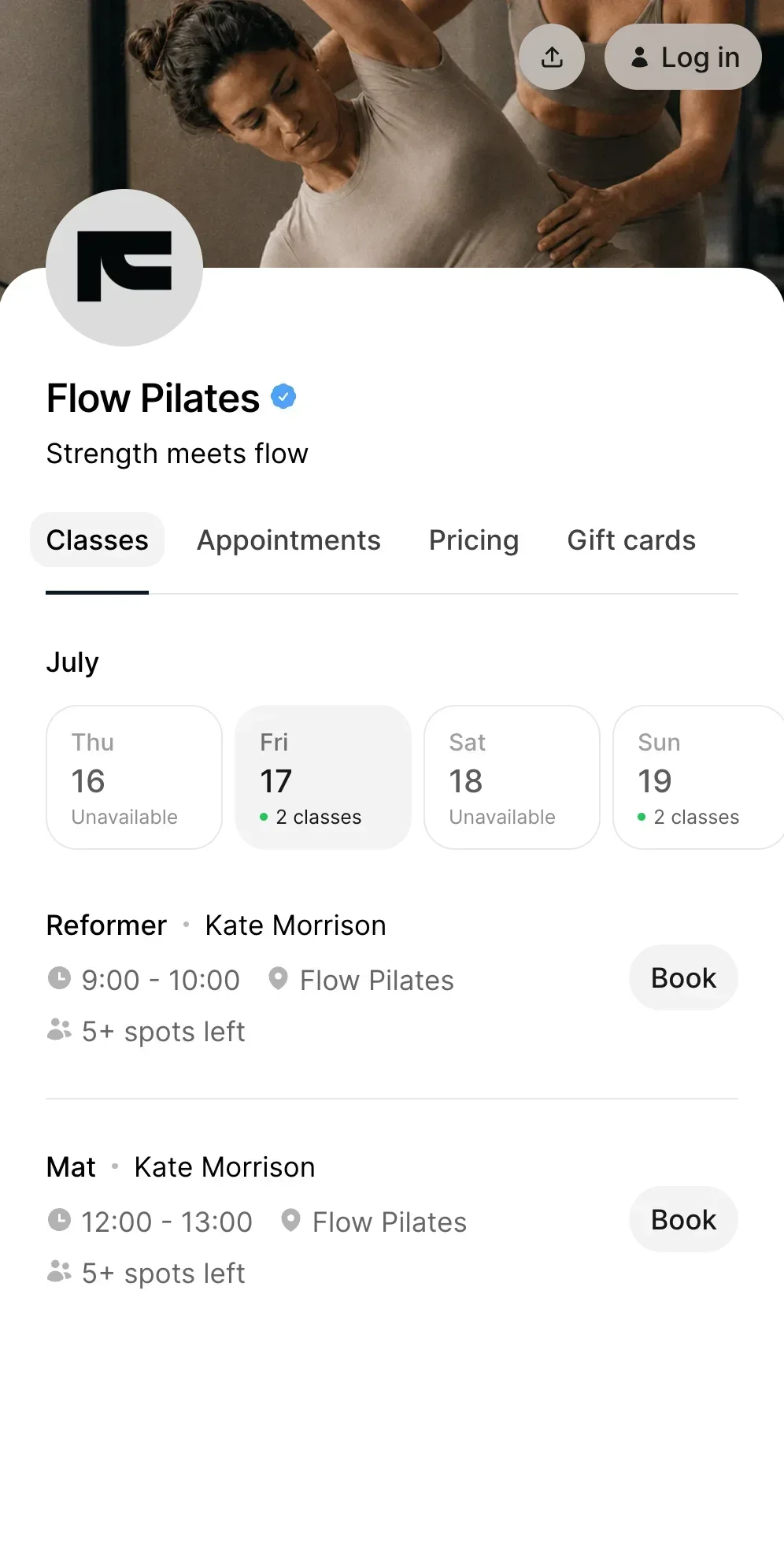
Manage bookings and payments easier
Get a free 7-day trial
No credit card required