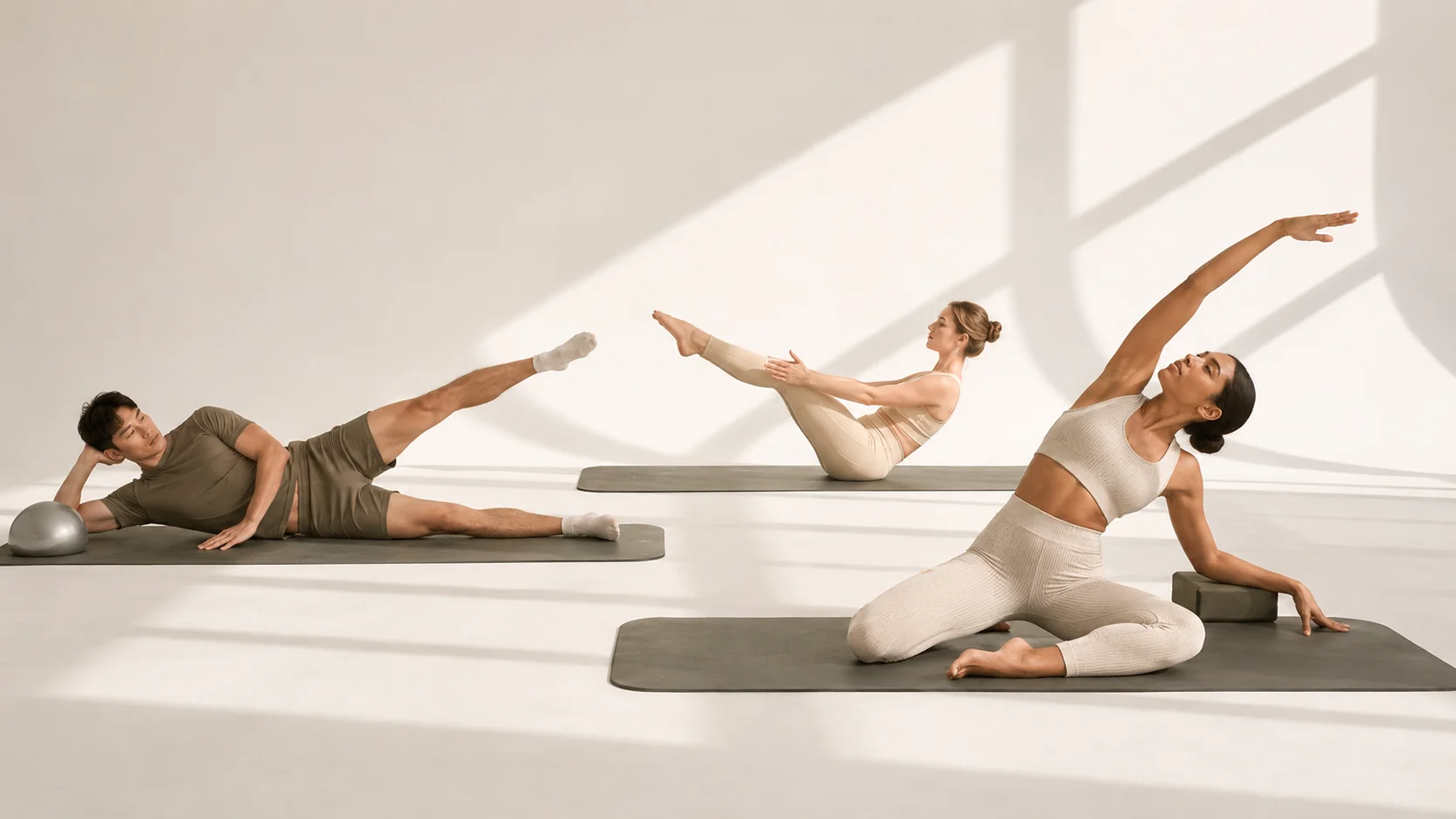
If you’re opening, managing, or growing a Pilates studio, learning the language of Pilates is more than a nice extra. It helps you understand class types, equipment, instructor notes, client questions, scheduling categories, and how to present your services clearly online.
Pilates has its own vocabulary. New studio managers quickly run into terms like Reformer, mat Pilates, powerhouse, neutral spine, Contrology, footwork, springs, flow, articulation, and many more. Some terms describe exercises. Others describe body positions, equipment, teaching principles, or class levels.
For studio owners and managers, this glossary is designed to make Pilates terminology easier to understand from a business and client experience point of view. You do not need to be a master instructor to run a great studio, but you do need to understand the words your instructors and clients use every day.
Modern studio software like Time2book can help you organize your Pilates classes, memberships, payments, client bookings, and schedules in one simple place. But before you set up your services, pricing plans, and class descriptions, it helps to know the core Pilates terms you’ll be using across your website, booking page, and studio operations.
In this guide, we’ll break down the most important Pilates terms for new studio managers in 2026 and explain how each term connects to classes, clients, equipment, and daily studio management.
What Are Pilates Terms?
Pilates terms are the words used to describe Pilates exercises, equipment, body positions, teaching principles, movement cues, and class styles.
For example, a client might ask:
- “What is the difference between mat Pilates and Reformer Pilates?”
- “Is neutral spine the same as neutral pelvis?”
- “What does powerhouse mean?”
- “What is classical Pilates?”
- “Is Pilates good for beginners?”
As a studio manager, knowing these terms helps you answer client questions with confidence. It also helps you write clearer class descriptions, train front-desk staff, create better website content, and avoid confusing beginners.
Pilates terminology usually falls into five main categories:
- Pilates methods and styles
Terms like classical Pilates, contemporary Pilates, Contrology, mat Pilates, and Reformer Pilates. - Pilates principles and concepts
Terms like breath, control, precision, concentration, flow, and centering. - Pilates body positions and alignment terms
Terms like neutral spine, neutral pelvis, prone, quadruped, lateral flexion, and axial elongation. - Pilates equipment terms
Terms like Reformer, Chair, Wunda Chair, Tower, Magic Circle, mat, footbar, carriage, and straps. - Pilates exercise names
Terms like Hundred, Roll Up, Teaser, Swan, Spine Stretch, Crisscross, Double Leg Stretch, and Leg Circles.
Why Pilates Terminology Matters for Studio Managers
New Pilates studio managers often focus on the big things first: rent, equipment, instructors, pricing, scheduling, and getting clients through the door.
But terminology also matters because it shapes how clients understand your studio.
Clear language helps with:
- Writing beginner-friendly class descriptions
- Creating accurate booking categories
- Explaining the difference between class levels
- Helping front-desk staff answer questions
- Improving SEO for your studio website
- Reducing confusion for first-time clients
- Making your studio feel more professional
For example, “Beginner Reformer Pilates” is much clearer than “Level 1 Equipment Class.” A client searching Google is more likely to understand and click on a service that uses familiar Pilates terms.
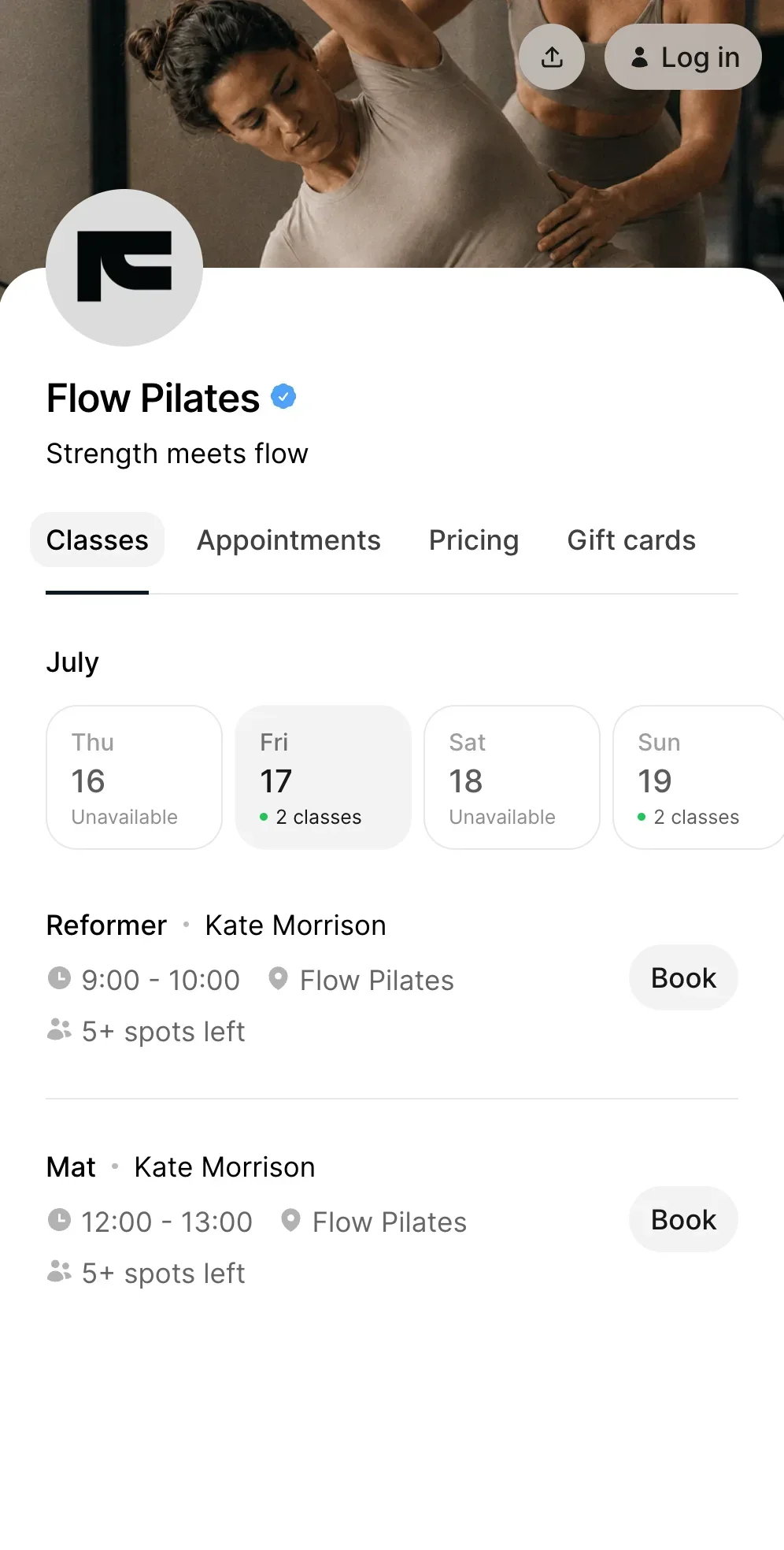
This is also useful when setting up your booking software. In Time2book, you can create services such as “Beginner Reformer Pilates,” “Mat Pilates,” “Private Pilates Session,” or “Contemporary Pilates Class,” then connect them with schedules, instructors, pricing plans, and payments.
Essential Pilates Terms Every Studio Manager Should Know
What is Pilates?
Pilates is a low-impact exercise method focused on core strength, posture, control, flexibility, breath, and mindful movement.
It can be practiced on a mat or using equipment such as the Reformer, Chair, Tower, Cadillac, or smaller props. Pilates is popular because it can be adapted for many different clients, from complete beginners to athletes, dancers, older adults, and people returning to movement after injury.
For studio managers, this is the simplest way to explain Pilates to new clients: Pilates helps people move better, build strength, improve posture, and develop more control over their body.
Classical Pilates
Classical Pilates refers to the traditional form of Pilates based on Joseph Pilates’ original method, exercise system, sequencing, and apparatus.
It usually follows a more structured order of exercises and keeps closer to the original approach. Classical studios often emphasize precision, control, flow, and progression through a set system.
For studio managers, this term matters because some clients specifically search for classical Pilates. If your instructors teach in this style, it should be clearly mentioned on your website and class pages.
Contemporary Pilates
Contemporary Pilates is a modern approach that builds on Joseph Pilates’ original method while incorporating current biomechanics, movement science, rehabilitation principles, and exercise variations.
It is often more flexible in structure than classical Pilates. Contemporary instructors may adapt exercises based on the client’s body, goals, injuries, or experience level.
For studio managers, contemporary Pilates is useful to mention if your studio focuses on modern movement, rehabilitation-style sessions, or beginner-friendly modifications.
Pilates Contrology
Contrology was the original name Joseph Pilates gave to his method. It describes controlled movement that connects the body, mind, and breath through precision, concentration, and full-body coordination.
Although most clients today use the word Pilates, Contrology is still important for understanding the roots of the method.
For studio managers, this term may appear in instructor bios, educational content, or classical Pilates pages. It is also a strong SEO topic because many people search for the origin of Pilates.
Pilates Principles
Pilates principles are the core ideas that guide how Pilates is practiced. The six most commonly taught principles are:
- Breath
- Concentration
- Centering
- Control
- Precision
- Flow
These principles help explain why Pilates is different from general strength training or stretching. Pilates is not only about doing exercises. It is about how those exercises are performed.
For studio managers, Pilates principles can be useful in beginner class descriptions, onboarding emails, instructor training notes, and educational blog content.
Pilates Class Types and Methods
Mat Pilates
Mat Pilates is practiced on the floor using bodyweight and sometimes small props. It focuses on core strength, control, posture, flexibility, and mindful movement without using large Pilates equipment. Mat Pilates is often easier for new studios to offer because it requires less equipment investment than Reformer Pilates. It can work well for group classes, online classes, workshops, and beginner programs.
For managers, mat Pilates is also simple to schedule because it usually has fewer equipment capacity limits than Reformer classes.
Reformer Pilates
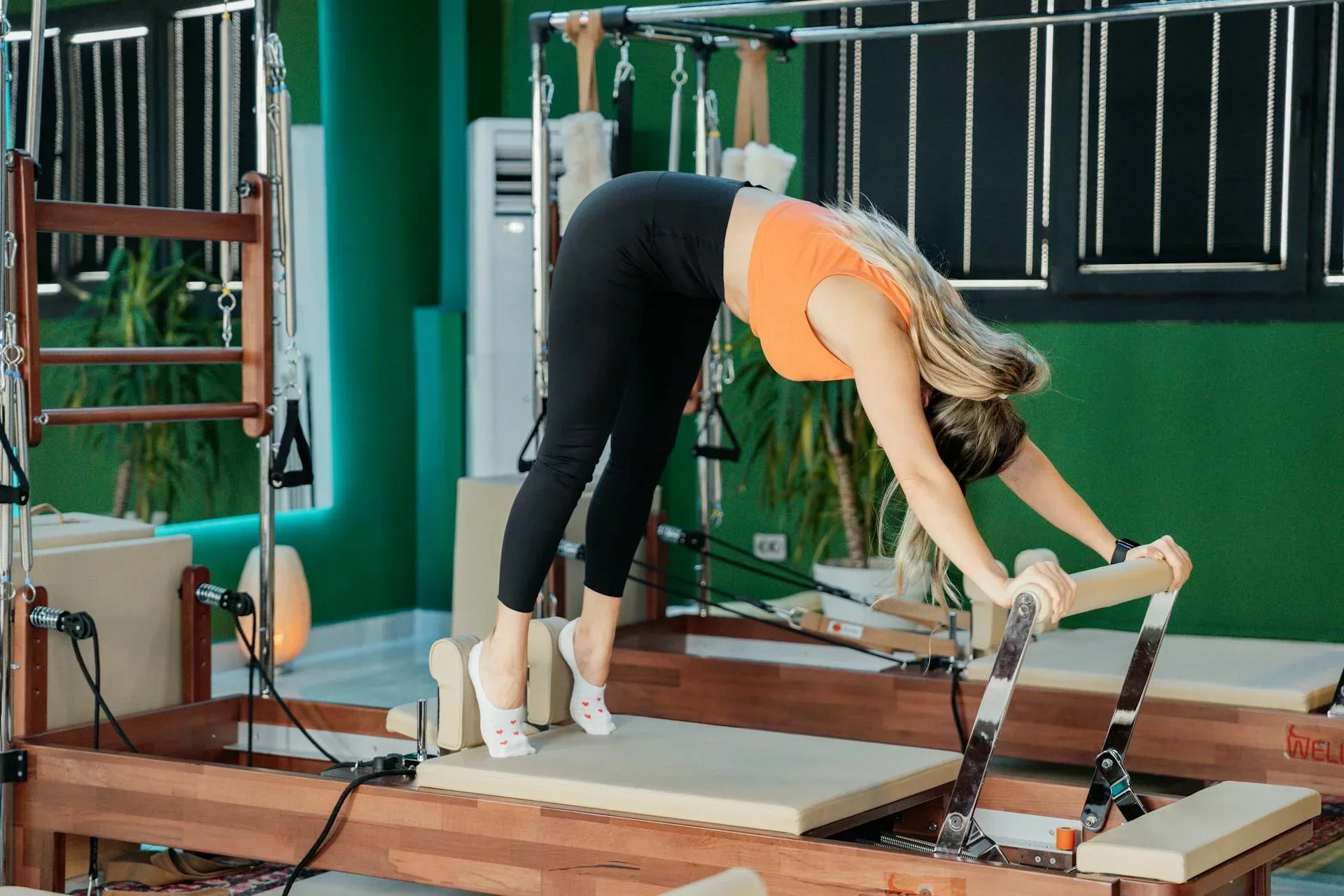
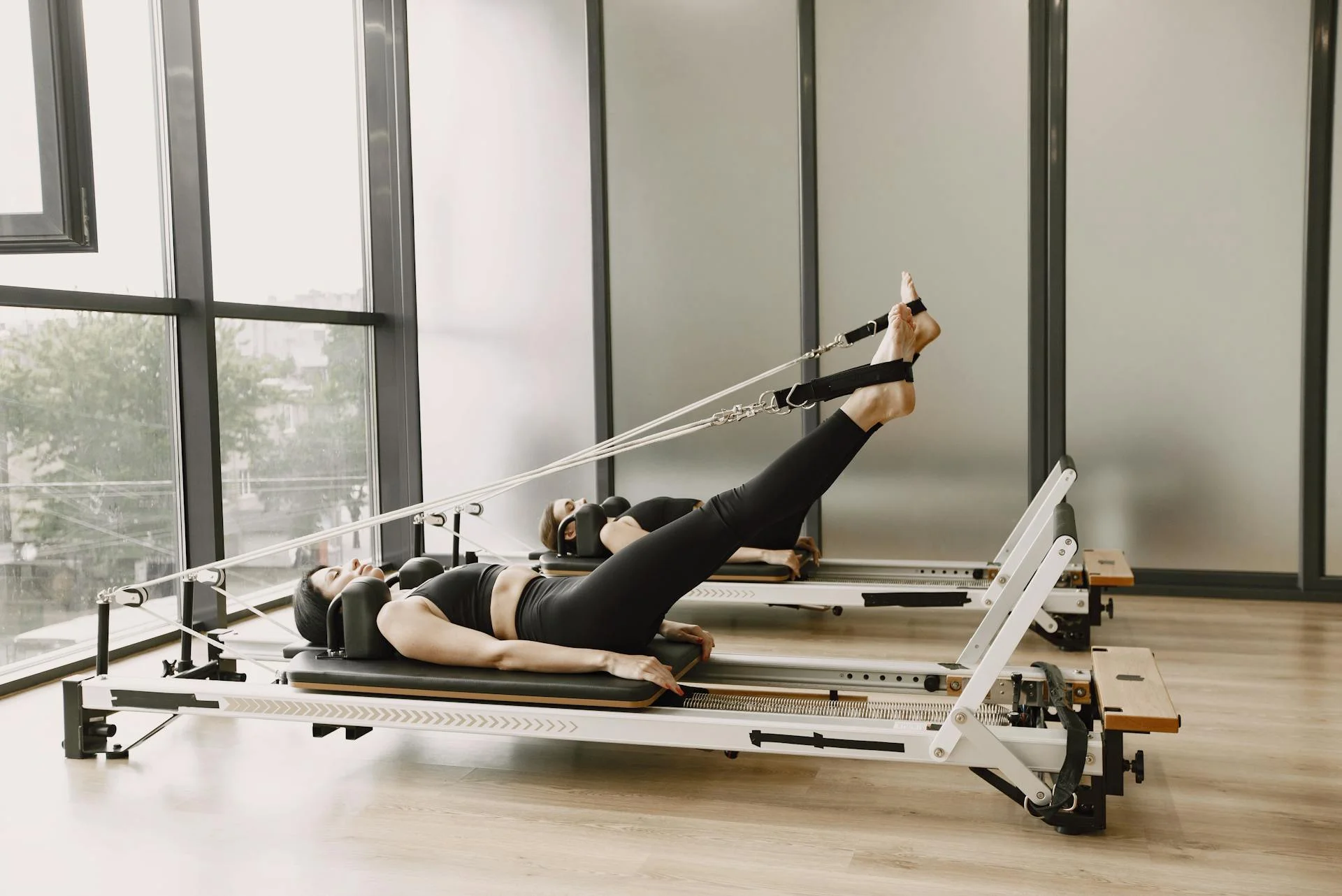
Reformer Pilates is performed on a Reformer machine that uses springs, a moving carriage, straps, and a footbar to create resistance and support. It is one of the most popular Pilates class types for boutique studios because it feels premium, structured, and results-focused. Reformer Pilates can support strength, posture, balance, flexibility, and control.
For studio managers, Reformer Pilates requires more planning than mat Pilates because every class is limited by the number of machines available. If you have 8 Reformers, your class capacity is usually 8 clients. That makes scheduling, waitlists, memberships, and cancellation rules especially important.
Private Pilates Session
A private Pilates session is a one-to-one session between a client and instructor. Private sessions are often used for beginners, clients with specific goals, injury-conscious clients, or people who want more personal attention. They are usually priced higher than group classes.
For studio managers, private Pilates sessions should be set up separately from group classes in your booking system. They may need different durations, instructor availability, pricing plans, and cancellation rules.
Semi-Private Pilates
Semi-private Pilates usually means a small session with two to four clients. It gives clients more attention than a large group class while still being more affordable than a private session. Many boutique studios use semi-private sessions as a premium offer.
For managers, semi-private sessions need careful capacity rules. You need to decide whether people book individually or whether one client can book for the full group.
Beginner Pilates
Beginner Pilates is designed for clients who are new to the method. A good beginner Pilates class usually explains breathing, alignment, neutral spine, basic core engagement, and simple exercises before moving into more advanced sequences.
For studio managers, beginner classes are important for client conversion. Many new clients feel nervous before their first Pilates class, so clear beginner-friendly wording can increase bookings.
Intermediate Pilates
Intermediate Pilates is for clients who have already learned the basics and can move with more control, coordination, and confidence. Intermediate classes may include more challenging transitions, balance work, longer sequences, and less detailed explanation of foundational cues.
For managers, class levels should be clearly explained. If beginners accidentally book into intermediate classes, they may feel lost or unsafe.
Advanced Pilates
Advanced Pilates includes more demanding exercises that require strength, mobility, balance, and body awareness. Advanced classes may include exercises like Teaser, Jackknife, High Bridge, advanced Reformer flows, or complex coordination work.
For studio managers, advanced classes should usually have prerequisites or clear descriptions so clients understand the expected level.
Pilates Body and Alignment Terms
Alignment
Alignment refers to the arrangement of the head, spine, shoulders, hips, knees, ankles, and joints so the body can move efficiently with less strain. In Pilates, alignment is a common teaching cue. Instructors may correct a client’s alignment to improve safety and movement quality.
For managers, this term is useful in class descriptions such as: “Focused on posture, alignment, and controlled movement.”
Neutral Spine
Neutral spine refers to the natural position of the spine where its normal curves are maintained without excessive arching or flattening. It is often used in Pilates to support better alignment, stability, and efficient movement.
For studio managers, neutral spine is a useful educational term for beginner content because many new clients hear it often in class.
Neutral Pelvis
Neutral pelvis refers to a balanced pelvic position often used as a starting point in Pilates. It helps support neutral spine, better alignment, and controlled movement during mat and equipment exercises.
For managers, neutral pelvis and neutral spine are good terms to include in beginner guides or “what to expect in your first Pilates class” content.
Powerhouse
In Pilates, the powerhouse refers to the body’s center, including the abdominals, lower back, hips, glutes, and pelvic floor. It is the foundation of stability, control, posture, and efficient movement in Pilates practice.
For studio managers, powerhouse is one of the most important Pilates terms to understand because it appears in many instructor cues and educational descriptions.
Abdominals
The abdominals are the muscles across the front and sides of the torso. They help stabilize the spine and support controlled movement. In Pilates, abdominal engagement is often linked to the powerhouse and core control.
Glutes
The glutes are the muscles of the buttocks. They support hip movement, pelvic stability, posture, and lower-body strength. Pilates exercises often use the glutes to stabilize the pelvis and support controlled leg movement.
Adductors
The adductors are the inner-thigh muscles that draw the legs toward the body’s midline. They are important in Pilates because they support pelvic stability, leg alignment, and controlled lower-body movement.
Axial Elongation
Axial elongation means lengthening through the spine, often described as reaching upward through the crown of the head while maintaining length through the body. In class, an instructor may use this cue to help clients avoid collapsing through the spine.
For studio managers, this is more of an instructor term, but it may appear in advanced class descriptions or teacher training content.
Articulation
Articulation means moving the spine or joints gradually, one segment at a time, instead of moving as one rigid block. A common example is the Pilates Roll Up or Pelvic Curl, where the spine moves one vertebra at a time.
Imprinting
Imprinting means gently drawing the lower spine toward the mat to reduce excessive arching and engage the abdominal muscles. Some instructors use imprinting as a modification or teaching cue, especially for beginners.
Lateral Flexion
Lateral flexion means bending the spine to the side while maintaining length through the opposite side of the body. Exercises like Mermaid use lateral flexion.
Prone
Prone means lying face down. For example, Swan is usually performed from a prone position.
Quadruped
Quadruped means a hands-and-knees position. It is often used in Pilates for balance, spinal control, shoulder stability, and core work.
Inversion
An inversion is any position where the head is lower than the heart. In Pilates, inversion-style exercises may appear in more advanced work, depending on the client’s level and the instructor’s approach.
Pilates Equipment Terms
Reformer
The Reformer is a Pilates machine with a moving carriage, springs, straps, and a footbar. It is used for many exercises that build strength, control, flexibility, and balance. Reformer classes are one of the most common offerings in modern Pilates studios.
For managers, the Reformer is directly tied to capacity and pricing. If your studio has 10 Reformers, your Reformer class capacity is usually 10 clients.
Mat
A mat is a padded surface used for floor-based Pilates exercises. Mat Pilates requires less equipment than Reformer Pilates, which makes it useful for larger classes, beginner workshops, online programs, and lower-cost memberships.
Chair
The Chair is a compact spring-based Pilates apparatus used for seated, standing, and balance-focused exercises. It is often used in private sessions, small group classes, or advanced strength-focused work.
Wunda Chair
The Wunda Chair is a spring-loaded platform apparatus used for standing, seated, and full-body conditioning movements. It can challenge strength, balance, coordination, and control.
Tower
The Tower is a vertical-frame Pilates apparatus that uses spring resistance for strength, mobility, and control work. Some studios use Towers as standalone equipment, while others use Tower attachments with Reformers.
Cadillac
The Cadillac, also called a Trapeze Table, is a larger Pilates apparatus with a raised mat platform, vertical frame, bars, springs, and straps. It is often used in private sessions, rehabilitation-focused work, and advanced Pilates exercises.
Magic Circle
The Magic Circle is a lightweight resistance ring used to add challenge to upper-body, lower-body, and core exercises. It is a useful prop for mat Pilates classes because it is affordable, portable, and easy to store.
Footwork
Footwork is a common Reformer sequence that strengthens the legs and reinforces lower-body alignment. It is often taught near the beginning of a Reformer class and may be used as a warm-up.
Springs
Springs provide resistance on Pilates equipment such as the Reformer, Chair, Tower, and Cadillac. Different spring settings can make exercises easier, harder, more supportive, or more challenging depending on the movement.
For studio managers, spring settings are mostly instructor-led, but it is useful to understand that equipment setup is part of class quality and safety.
Straps
Straps are used on the Reformer and other equipment to connect the client’s hands or feet to resistance.They are commonly used for arm work, leg work, coordination exercises, and mobility-focused movements.
Common Pilates Exercise Terms
Pilates Hundred
The Pilates Hundred is a classic exercise that warms up the body, challenges the core, and coordinates movement with breath. It is often performed near the start of a mat Pilates class and is one of the most recognizable Pilates exercises.
Pilates Roll Up
The Pilates Roll Up is a classic mat Pilates exercise that builds core control and spinal articulation. It involves rolling up from the mat to a seated position and returning down with control, one vertebra at a time.
Pilates Stance
Pilates stance, also called Pilates V, is a small turned-out position with the heels together and toes slightly apart. It is used to support alignment, inner-leg engagement, and controlled movement from the hips.
Crisscross
Crisscross is a rotational abdominal exercise similar to a slow, controlled bicycle movement. It challenges the obliques, core control, and coordination.
Double Leg Stretch
Double Leg Stretch is a core exercise where both arms and legs extend away from the body before returning to the center with control. It is often used in mat Pilates sequences.
Leg Circles
Leg Circles are circular motions of a raised leg while lying on the back. The goal is to improve hip mobility while keeping the pelvis and torso stable.
One Leg Circle
One Leg Circle is a classic Pilates stability exercise where one leg traces controlled circles while the rest of the body remains still. It teaches hip mobility, pelvic control, and abdominal stability.
Open Leg Rocker
Open Leg Rocker is a seated rolling balance exercise performed on the sit bones. It challenges balance, spinal control, and coordination.
Pelvic Curl
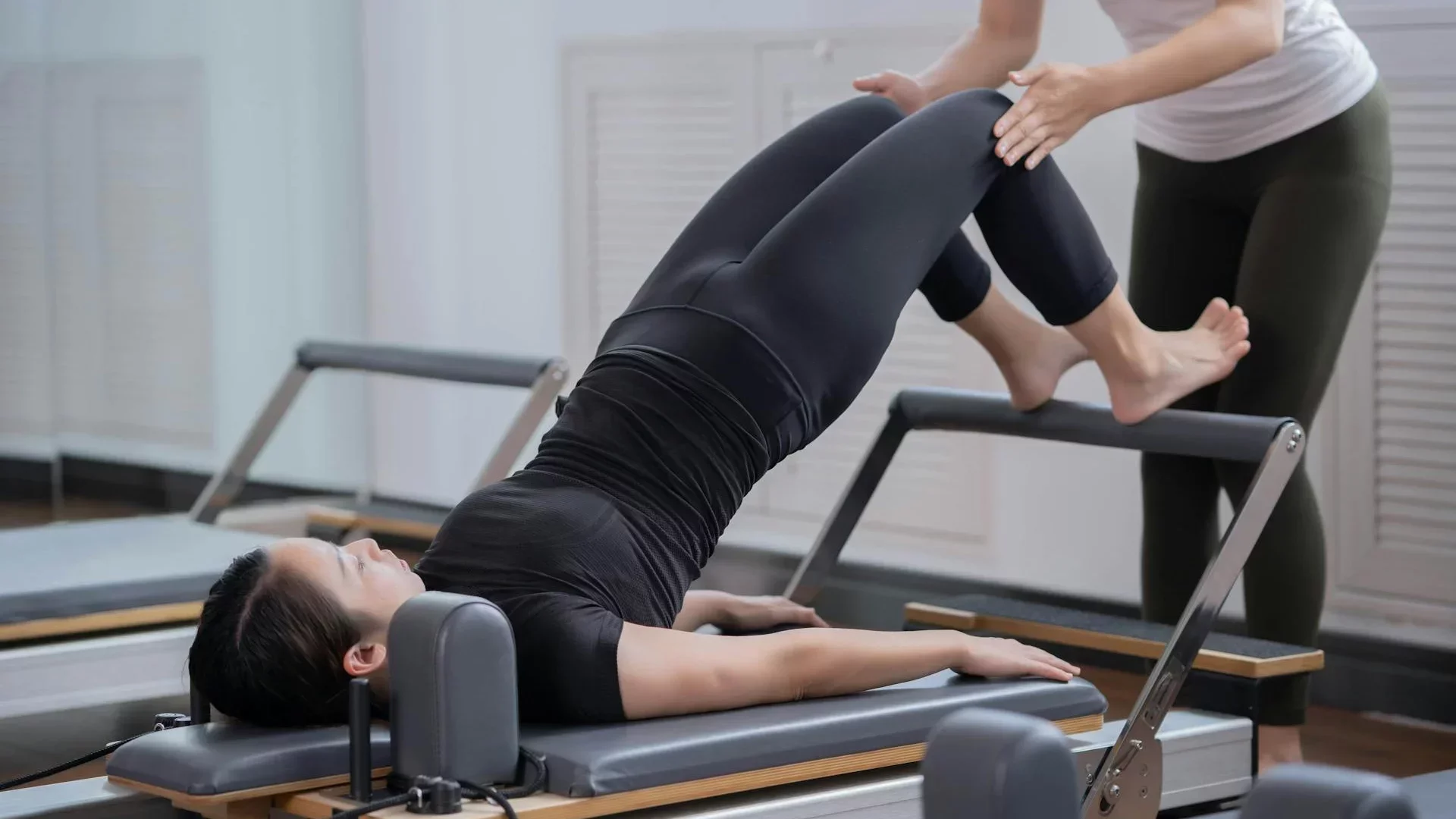
Pelvic Curl is an exercise where the hips slowly lift and lower while the spine articulates segment by segment. It can strengthen the back body, glutes, hamstrings, and core.
Plank
A plank is a straight-body support position that builds strength in the shoulders, abdominals, legs, and full body. Pilates planks often emphasize alignment, breath, and control rather than simply holding for time.
Side Plank
Side Plank is a lateral support position balanced on one arm and the side of one foot or leg. It strengthens the obliques, shoulders, hips, and side body.
Roll Over
Roll Over is an exercise where the legs travel overhead while the upper body remains grounded. It requires spinal flexibility, abdominal control, and careful instruction.
Scissors
Scissors is an abdominal exercise where the legs alternate in a controlled movement pattern. It challenges stability, coordination, and core strength.
Spine Stretch
Spine Stretch is a seated forward-folding exercise designed to lengthen the back muscles and improve spinal articulation.
Spine Twist
Spine Twist is a seated rotational exercise where the torso turns while the spine stays lifted. It helps train rotation, posture, and control.
Swan
Swan is a prone exercise that strengthens the back muscles and encourages spinal extension. It is commonly used to balance forward-flexion exercises.
Teaser
Teaser is a demanding Pilates exercise where the body forms a V-shape. It requires strong abdominal control, balance, coordination, and hip flexor strength. For studio managers, Teaser is often associated with intermediate or advanced classes.
Mermaid
Mermaid is a seated side-bending stretch that opens the rib cage and lengthens the torso. It is commonly used in both mat and equipment Pilates.
Jackknife
Jackknife is a challenging rolling movement that lifts the hips upward while maintaining control through the trunk. It is usually taught in more advanced Pilates work.
High Bridge
High Bridge is a deep back-arching position performed on the mat or apparatus. It requires strength, mobility, and careful progression.
Long Stretch
Long Stretch is a plank-based Reformer exercise that challenges strength in the shoulders, arms, and core.
Up Stretch
Up Stretch is a flowing Reformer exercise that combines strength, flexibility, and controlled movement.
Corkscrew
Corkscrew is a controlled exercise where the legs move in circular patterns while the torso remains stable against the mat.
Hip Circles
Hip Circles are circular leg movements used to strengthen the muscles around the hip joint and improve control.
Kneeling Side Kick
Kneeling Side Kick is a balance-focused exercise performed from a kneeling position. It strengthens the hips, torso, and stabilizing muscles.
V-Sit
V-Sit is a seated balance position shaped like the letter V. It is similar in appearance to Teaser but may be used more generally in fitness and Pilates-style classes.
Studio Management Terms Related to Pilates Classes
Class Capacity
Class capacity is the maximum number of clients who can book a class.
For Pilates studios, capacity often depends on equipment. A mat class may fit 15 clients, while a Reformer class may only fit 6, 8, 10, or 12 clients depending on how many machines you have.
This is one of the most important settings in your booking system.
Waitlist
A waitlist allows clients to join a list when a class is full. If someone cancels, the next client on the waitlist can be offered the spot. Waitlists are especially useful for Reformer Pilates because class capacity is limited by equipment.
Drop-In Class
A drop-in class is a single class booking without a membership or package. Drop-ins are useful for new clients, visitors, or people who want flexibility. They are usually priced higher per class than memberships or class packs.
Class Pack
A class pack lets clients buy multiple classes upfront, such as 5, 10, or 20 sessions. Class packs are popular in Pilates studios because they give clients flexibility while helping the studio collect revenue in advance.
Membership
A membership is a recurring plan that gives clients access to a set number of classes or unlimited classes each billing period. For Pilates studios, memberships help create more predictable monthly revenue.
Cancellation Window
A cancellation window is the amount of time before class when a client can cancel without losing their credit or being charged. For example, a studio may have a 12-hour cancellation window.
Clear cancellation rules are especially important for Reformer Pilates because every no-show leaves an empty machine that another client could have booked.
No-Show
A no-show happens when a client books a class but does not attend and does not cancel in time. Studio managers should define no-show rules clearly in their booking policy.
Intro Offer
An intro offer is a special first-time offer for new clients.
Examples include:
- First class for €10
- 3 classes for €39
- 2-week unlimited trial
- Private intro session
Intro offers are useful for converting new leads into regular clients.
How to Set Up Pilates Classes in Time2book
Once you understand your Pilates terminology, setting up your studio schedule becomes much easier.
In Time2book, you can organize your Pilates studio around clear class types, pricing plans, and booking rules.
For example, you could create:
- Beginner Reformer Pilates
- Intermediate Reformer Pilates
- Mat Pilates
- Private Pilates Session
- Semi-Private Pilates
- Contemporary Pilates
- Classical Pilates
- Intro Reformer Class
- Pilates Foundations Workshop
Then you can connect each service with:
- Class capacity
- Instructor
- Schedule
- Pricing plans
- Drop-in price
- Memberships
- Class packs
- Cancellation rules
- Client bookings
- Payments
This keeps your studio organized and makes booking easier for clients.
Frequently Asked Questions About Pilates Terms
The most important Pilates terms for beginners are Pilates, mat Pilates, Reformer Pilates, powerhouse, neutral spine, neutral pelvis, breath, control, alignment, and the Pilates principles.
These terms help clients understand what they will hear in their first few classes. For studio managers, they are also useful when writing beginner class descriptions and onboarding content.
Mat Pilates is practiced on the floor using bodyweight and sometimes small props. Reformer Pilates is practiced on a Reformer machine that uses springs, straps, a moving carriage, and a footbar for resistance and support.
For studio managers, the biggest operational difference is capacity. Mat Pilates usually allows larger classes, while Reformer Pilates is limited by the number of machines in the studio.
Powerhouse refers to the center of the body, including the abdominals, lower back, hips, glutes, and pelvic floor. In Pilates, the powerhouse supports stability, posture, and controlled movement. It is one of the most common terms clients will hear from instructors.
Neutral spine means keeping the natural curves of the spine instead of flattening or over-arching the back. It is often used as a starting point for safe and controlled movement. Studio managers do not need to teach it in detail, but understanding the term helps when explaining beginner Pilates classes.
Classical Pilates is the traditional form of Pilates based on Joseph Pilates’ original method, sequencing, and equipment. It usually follows a more structured progression than contemporary Pilates. If your studio teaches classical Pilates, you should mention it clearly on your website because some clients search specifically for that style.
Contemporary Pilates is a modern approach that builds on the original Pilates method while including newer movement science, biomechanics, rehabilitation principles, and exercise variations. It can be especially useful for studios that want a flexible, modern, and client-adapted teaching style.
The Pilates Hundred is a classic Pilates exercise often used near the beginning of a mat class. It combines rhythmic arm pumping, core engagement, and controlled breathing. It is one of the most recognizable Pilates exercises and often appears in beginner Pilates education.
Final Thoughts: Pilates Terms Help You Run a Clearer Studio
Learning Pilates terminology is not only for instructors. It is also useful for studio owners, managers, front-desk teams, marketers, and anyone responsible for the client experience.
When you understand terms like Reformer Pilates, mat Pilates, powerhouse, neutral spine, Contrology, classical Pilates, contemporary Pilates, and Pilates principles, you can describe your services more clearly and help clients choose the right class.
The result is a studio that feels easier to understand, easier to book, and easier to manage.
And when you’re ready to organize your classes, bookings, memberships, payments, and clients in one place, Time2book gives Pilates studios a simple modern system built for daily studio operations.
Try Time2book free today and simplify your studio bookings, payments, and client management.