
A Pilates studio business model explains how your studio attracts clients, delivers classes, earns revenue, and covers its costs. It connects your choice of mat or reformer Pilates with your pricing, memberships, instructor team, and available capacity.
For an independent reformer studio, one practical starting point is group classes supported by recurring memberships, flexible class packs, and selected private sessions. However, a private teaching practice or mat studio can be a better fit when your budget, expertise, or local demand points in another direction.
Time2book helps put these options into practice by connecting bookings, payments, memberships, and client management. Explore Pilates studio software to see how it supports your setup. In this guide, we’ll break down the main Pilates studio business model options for 2026 and what to consider before choosing yours.
What is a Pilates studio business model?
A Pilates studio business model describes who you serve, what they buy, how you deliver it, and how the business earns enough to keep operating. It should answer five questions:
- Who are your clients? Beginners, experienced practitioners, busy professionals, or another clearly defined audience.
- What do you offer? Mat classes, reformer classes, private sessions, small groups, or online instruction.
- How do clients pay? Drop-ins, class packs, recurring memberships, or a combination.
- What limits your capacity? Equipment, floor space, instructor availability, and desirable booking times.
- What remains after costs? Revenue must cover teaching, premises, administration, and the owner’s work.
A business model is one part of a business plan. Your model explains how the studio works commercially; your plan also covers market research, startup funding, operations, and launch milestones. Once you have chosen a model, use our Pilates studio business plan guide to build the wider plan.
Five Pilates studio business models compared
Choose your delivery format before designing your price list. A membership is a payment structure: it can support mat classes, reformer classes, private instruction, or a mix.
| Business model | Main offer | Revenue options | Main constraint |
|---|---|---|---|
| Group reformer studio | Scheduled classes with one reformer per client | Memberships, packs, drop-ins | Machine capacity and class occupancy |
| Private and semi-private practice | Individual or shared appointments | Single sessions, packages, recurring plans | Instructor hours and expertise |
| Mat Pilates studio | Group classes using mats and small equipment | Memberships, packs, courses | Room capacity and achievable pricing |
| Hybrid studio | Group classes plus private instruction | Mixed class and appointment products | Scheduling and service complexity |
| Online Pilates business | Live remote classes or recorded content | Subscriptions, courses, live sessions | Audience acquisition and continued engagement |
1. Group reformer studio
The group reformer model spreads the cost of one instructor across several paying clients. Eight occupied reformers generate more revenue than three occupied reformers at the same price, while the instructor’s session fee may stay unchanged.
This makes attendance central to the model. You need enough clients who want to attend at the times you can offer, at prices that support your premises and equipment costs. A larger room adds revenue potential only if those additional places sell.
Best fit: Owners building a repeatable class schedule for clients who want regular attendance.
2. Private and semi-private practice
Private instruction sells dedicated instructor attention. Semi-private appointments share that attention between two or more clients, creating another price point without requiring a full group class.
This model can suit an instructor with an established client base or a specific teaching focus. Its ceiling is available teaching time: a full diary does not automatically create a business that can grow without you. Compare earnings per teaching hour, including preparation and turnover time, before choosing your session prices.
Best fit: Experienced instructors prioritizing individual service and a smaller appointment-based operation.
3. Mat Pilates studio
A mat-focused business avoids purchasing a reformer for every group participant. Starting in a hired room can also let you test demand before committing to dedicated premises.
Lower equipment spending does not remove the need for viable class economics. Room hire, instruction, marketing, and administration still need funding. If your local market supports lower mat prices than reformer prices, calculate the attendance needed to cover each class and your monthly overhead.
Best fit: Owners testing demand or serving clients who prefer an accessible group-class format.
4. Hybrid Pilates studio
A hybrid studio combines group classes with private sessions, semi-private appointments, or workshops. Group classes can serve regular members, while private instruction provides an option for clients seeking more individual attention.
The services must fit together operationally. A private appointment cannot use a reformer already promised to a group participant. Schedule services in separate rooms or time blocks, and measure each offer’s contribution before expanding the menu.
Best fit: Studios with enough space, instructors, and demand to support complementary services.
5. Online Pilates business
Online Pilates can generate revenue through live classes, recorded libraries, structured courses, or subscriptions. Recorded content does not consume another physical studio place each time someone watches it, but production, marketing, and support still require resources.
For an existing studio, online content may be an additional service for traveling clients or home practice. For an online-only business, audience acquisition becomes a core part of the model. Treat digital revenue as a separate forecast rather than assuming your studio clients will automatically subscribe.
Best fit: Instructors with an engaged audience or a clear reason clients would choose their remote teaching.
How Pilates studios make money
Build a simple path from first visit to repeat attendance. Each product should serve a distinct client need rather than adding another choice that is difficult to explain.
Introductory offers
An introductory package gives new clients a defined way to experience your studio. For example, three beginner classes over a limited period can provide several opportunities to try the teaching and schedule.
Evaluate the offer by what happens afterward. Track how many clients attend, buy another product, and remain active. A cheap offer that fills classes without producing repeat purchases may consume capacity you could sell more effectively.
Recurring memberships
Memberships create repeat billing and a defined attendance allowance. Four- and eight-class monthly options are established structures: Club Pilates publicly offers four-class, eight-class, and unlimited memberships. That illustrates the format, rather than proving any particular tier is right for your studio.
Decide how renewals, credits, expiration, cancellation, and any rollover work before selling. Unlimited access also needs capacity testing: a member paying €180 and attending 18 times generates €10 per visit before costs.
Class packs and drop-ins
Class packs suit clients who want several visits without a recurring commitment. Drop-ins serve occasional visitors and provide a straightforward single-session option. A simple illustrative menu could look like this:
| Product | Example price | Price per included class | Purpose |
|---|---|---|---|
| Single class | €28 | €28 | Occasional attendance |
| Five-class pack | €125 | €25 | Flexible repeat visits |
| Four classes per month | €96 | €24 | Lower-frequency routine |
| Eight classes per month | €176 | €22 | More frequent routine |
These are planning examples, not market averages or recommended prices. Keep the tax basis consistent when comparing prices and calculating revenue.
Private sessions and additional services
Private appointments can complement group classes when clients want more individual attention. Workshops, corporate sessions, and retail may add revenue too, but assess the work and direct costs involved.
Gift cards bring payment forward while creating a future service obligation. They do not increase your teaching capacity. Similarly, selling more packages today does not eliminate the cost of delivering their classes later.
Pilates studio revenue model: an eight-reformer example
The following example shows how capacity, occupancy, and pricing connect. Every figure is illustrative, not a typical studio result or earnings forecast. Monetary amounts use a consistent basis excluding any applicable sales tax or VAT.
Step 1: Calculate available class places
Assume the studio has eight reformers and runs 35 group classes each week. Using 4.33 weeks per month:
Monthly capacity = 8 × 35 × 4.33 = approximately 1,212 class places.
That is delivery capacity, not 1,212 different clients. At roughly eight visits per client per month, 849 visits would represent about 106 active clients. Actual client requirements depend on attendance frequency.
Step 2: Estimate revenue at realistic occupancy
At 70% occupancy, the studio delivers approximately 849 paid visits. Assume the average revenue allocated to each visit is €22 across memberships, packs, and drop-ins:
Estimated monthly class revenue = 849 × €22 = €18,678.
This is a simplified allocation model. Do not add membership payments on top of this figure if those memberships already fund the visits. In a detailed forecast, model product sales, credit redemption, and cash receipts separately.
Step 3: Include teaching and overhead
Assume teaching costs €45 per scheduled class, totaling approximately €6,820 monthly. For comparison purposes, the full schedule runs at every occupancy level.
| Monthly expense | Illustrative amount |
|---|---|
| Group-class instructor pay | €6,820 |
| Rent and premises charges | €2,400 |
| Owner’s management compensation | €2,500 |
| Utilities and cleaning | €800 |
| Marketing | €800 |
| Software, administration, and insurance | €600 |
| Equipment maintenance | €300 |
| Payment-related costs, assumed at 3% of revenue | €560 |
| Total modeled costs | €14,780 |
Monthly operating surplus = €18,678 − €14,780 = €3,898. This is approximately 20.9% of revenue before tax, financing costs, and depreciation. It is not a net profit benchmark. The 3% payment assumption is a modeling input, not a quoted payment-provider rate.
The owner’s management compensation is separate from teaching pay. If the owner teaches some classes, allocate those sessions within the instructor budget rather than treating their teaching as free.
How much occupancy does a Pilates studio need to break even?
There is no universal break-even occupancy. It depends on your revenue per visit, teaching schedule, and overhead. The SBA’s break-even framework divides fixed costs by the selling price minus variable cost per unit.
For the example above, teaching costs are fixed for the chosen monthly timetable. Combined with €7,400 in overhead, the studio needs to cover €14,220. After the assumed 3% payment cost, each €22 visit contributes €21.34:
Break-even visits = €14,220 ÷ €21.34 = approximately 667 visits.
Break-even occupancy = 667 ÷ 1,212 = approximately 55%.
| Approximate occupancy | Paid visits | Class revenue | Operating surplus or loss* |
|---|---|---|---|
| 40% | 485 | €10,670 | −€3,870 |
| 55% | 667 | €14,674 | €14 |
| 70% | 849 | €18,678 | €3,898 |
| 85% | 1,030 | €22,660 | €7,760 |
Rounded figures; same teaching schedule and overhead throughout, before tax, financing, and depreciation.
This sensitivity test shows why filling existing classes can matter more than adding new ones. Review peak and off-peak demand separately: an evening waitlist does not guarantee demand for another midday class. Changing the schedule also changes teaching costs, so recalculate rather than reusing this break-even point.
Pilates studio business model canvas: a practical example
Strategyzer’s Business Model Canvas organizes a business into nine connected building blocks. Use the following example as a starting point for your own decisions, then test its assumptions locally.
| Building block | Example for a boutique reformer studio |
|---|---|
| Customer segments | Local beginners and regular practitioners seeking guided small-group exercise |
| Value proposition | Clear progression, attentive teaching, and convenient booking |
| Channels | Local search, referrals, social content, and nearby business partnerships |
| Customer relationships | Beginner onboarding, progress conversations, and relevant studio updates |
| Revenue streams | Recurring memberships, class packs, drop-ins, and private sessions |
| Key resources | Premises, reformers, qualified instructors, booking systems, and working capital |
| Key activities | Teaching, scheduling, client acquisition, retention, and equipment care |
| Key partners | Equipment suppliers, instructors, payment providers, and local referral partners |
| Cost structure | Premises, teaching, management, software, marketing, and maintenance |
Make your positioning specific enough to guide decisions. “Beginner-friendly reformer Pilates with evening classes for nearby professionals” tells you more about scheduling and onboarding than “Pilates for everyone.”
How to choose and validate your Pilates studio business model
1. Start with a specific audience
Identify clients you can realistically reach, their preferred times, and the instruction they value. Review nearby studios’ public schedules and offers, then speak with prospective clients about their current habits and purchasing decisions.
2. Test willingness to pay
Run paid trial classes, a short course, or private appointments before building a large timetable. Measure purchases and repeat bookings. Social engagement can indicate interest, but it does not tell you whether enough people will pay your proposed price.
3. Model a cautious launch
Estimate startup spending separately from monthly operations. Include equipment, fit-out, deposits, and launch costs, then calculate how much cash you need while attendance develops. Forecast several occupancy levels rather than assuming the studio opens at its mature capacity.
4. Limit the initial offer
Start with products you can explain clearly: an intro offer, a flexible pack, a small number of memberships, and private sessions if demand supports them. Add new services when they solve a demonstrated need and produce enough contribution to justify delivery.
5. Check capacity before selling more memberships
One hundred members with eight monthly credits represent up to 800 visits of demand. Compare that allowance with available places, especially at popular times. Selling plans that clients cannot use conveniently can undermine renewals even when the monthly revenue initially looks attractive.
Metrics that show whether your model works
Review a small set of numbers consistently. Together, they explain whether growth comes from better attendance, higher spending, or simply more work.
| Metric | Calculation or review | What it helps you decide |
|---|---|---|
| Class occupancy | Attended places ÷ available places | Which time slots need attention |
| Revenue per visit | Revenue allocated to visits ÷ visits | Whether pricing supports delivery |
| Contribution per class | Allocated revenue minus direct class costs | Which services support overhead |
| Intro conversion | Intro clients making a next purchase ÷ intro clients | Whether onboarding leads to repeat business |
| Membership churn | Members leaving during the month ÷ members at its start | How much replacement demand you need |
| Acquisition cost | Attributable acquisition spending ÷ new paying clients | Whether a marketing channel is affordable |
| Cash runway | Available operating cash ÷ monthly cash burn | How long you can fund a loss-making launch |
Track attendance and revenue alongside cash. An upfront pack sale produces cash before all its sessions are delivered, so your bank balance alone cannot show whether the service is profitable.
Use software to support the model you choose
Your studio needs to turn its commercial rules into a smooth client experience. Clients should understand what they are buying, which services it covers, and how to book their next visit.
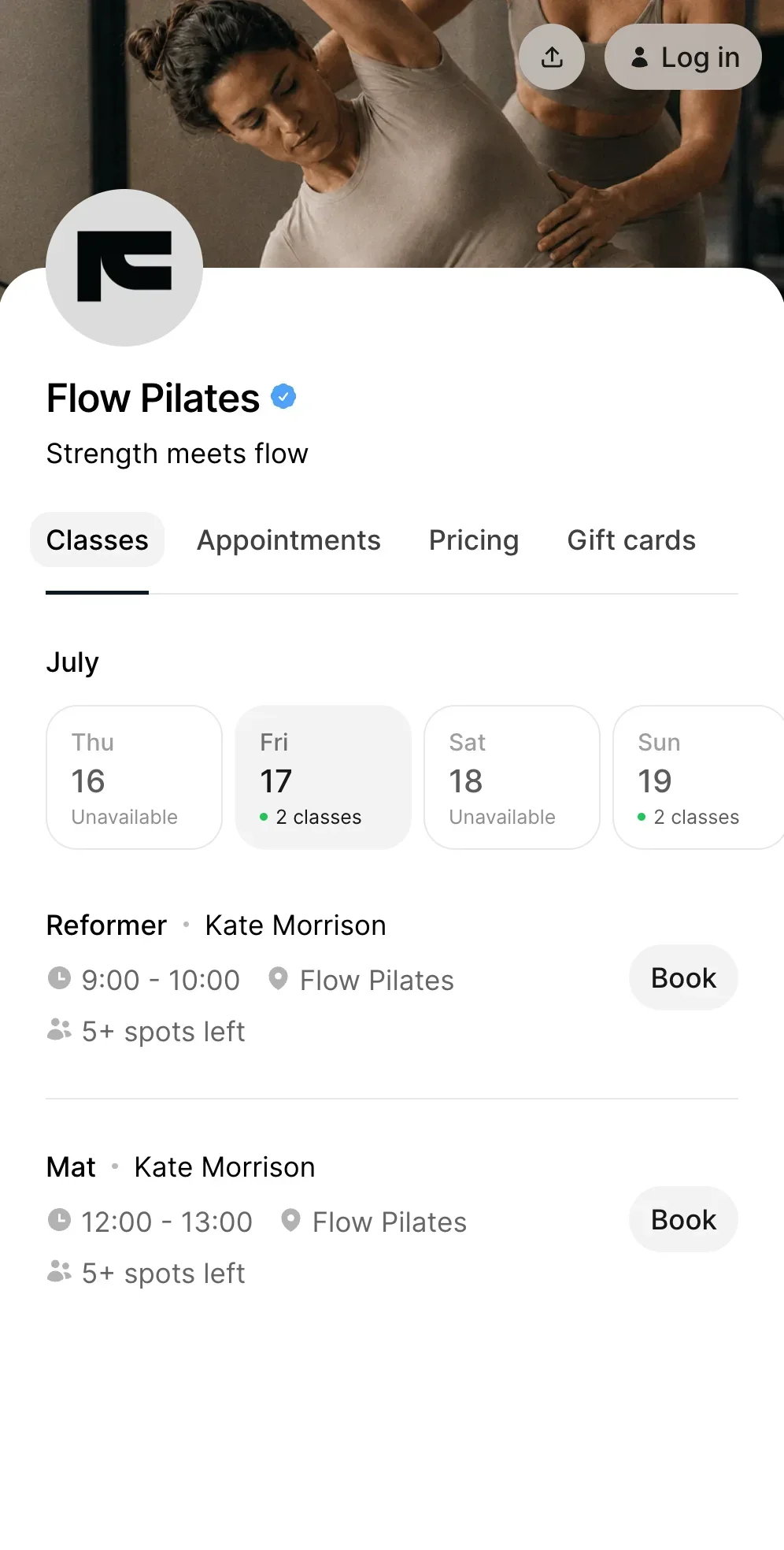
Time2book supports class scheduling, private appointments, online payments, recurring memberships, class packs, and client records in one platform. It also tracks plan usage and remaining sessions, helping studios manage repeat attendance without maintaining separate credit spreadsheets.
Set service capacity, pricing, and booking policies to match your actual operating model. Keep checking the economics as attendance grows: software helps administer the offer, while your pricing and delivery decisions determine whether it works financially.
Frequently asked questions
The best Pilates studio business model depends on local demand, your expertise, available capital, and preferred way of teaching. A group reformer studio can combine recurring memberships with class packs and private sessions. A private practice or mat studio may fit better when you want fewer equipment commitments or more individual instruction.
Pilates studios earn revenue from group classes, recurring memberships, class packs, drop-ins, and private sessions. Some add workshops, corporate classes, retail, or online content. Profit depends on what remains after teaching costs, overhead, and owner compensation.
Memberships suit clients seeking regular attendance and create repeat billing. Class packs offer flexibility without a recurring commitment. Offering both can serve different clients, provided the prices, credit rules, and available capacity work together.
A reformer studio is not automatically more profitable. Its revenue potential must be weighed against equipment spending, premises costs, instructor pay, and limited class places. Compare both formats using achievable local prices and realistic attendance assumptions.
Calculate the visits needed to cover your costs, then divide by average monthly visits per client. If your studio needs 667 visits to break even and clients average eight visits monthly, that represents approximately 84 active clients. Actual requirements vary with spending, attendance, and service mix.
Offer unlimited memberships only after testing likely attendance and peak-time capacity. Frequent use lowers revenue per visit and may restrict availability for other clients. Defined monthly credit allowances can be easier to forecast, particularly in a small reformer studio.
Yes. Time2book supports group classes and private appointments, alongside memberships, class packs, payments, and client records. Studios can give clients one booking page while managing their services from one platform.
Build a Pilates studio business model around repeat attendance
A workable Pilates studio business model connects client demand, service capacity, and pricing with the full cost of delivery. Start with a clear audience and a manageable offer, test paid demand, and calculate how much attendance you need before expanding.
For a boutique reformer studio, memberships can support routine attendance while packs and private sessions serve different needs. Keep measuring whether that mix covers teaching, overhead, and your own work. Try Time2book free today and simplify your studio bookings, payments, and client management.